

fumarate or malate. In most natural environments, sulfatereducers preferably use dihydrogen and acetate.
The electron acceptor most commonly used by sulfatereducers is the sulfate. Other sulfur compounds such as sulfite
and thiosulfate can serve as electron acceptors, as well
as elemental sulfur for a few particular strains belonging
to the genera Desulfovibrio and Desulfomicrobium.
Box 14.11: Measurements of Sulfate-Reducing Activity
The measurement of the sulfate-reducing activity in
sediment is performed by determining the reduced
forms of sulfur (elemental sulfur, iron monosulfide,
pyrite, etc.) produced after the addition of radioactive
sulfate (
35 SO 4
2 - ). Most often, this technique is applied
to sediment cores by the method of injection into
strata. The method involves, after incubation, a
sediment distillation to recover the reduced forms of
sulfur and trap the insoluble form of zinc sulfide (ZnS).
After these steps of injection/incubation and distillation, the method is based in part on the analysis by
spectrophotometry of sulfate concentration (Tabatabai
1974) and sulfide concentration (Cline 1969) in the
different fractions obtained after distillation, and second, on the measurement of the radioactivity emitted
by the fraction containing the sulfide. This method was
originally described by Jørgensen and Fenchel (1974).
The authors used a sediment distillation under acid
conditions which permitted the recovery as a fraction
of all the reduced forms of sulfur, essentially free
sulfide and acid-volatile sulfide (FeS). The method
has subsequently been modified to retrieve all
elements of radioactive sulfur from sulfate (Fossing
and Jørgensen 1989). This new technique of distillation, commonly called single step method involves a
distillation under acidic and reducing conditions with
the presence of chromium (CrIII). It allows to take into
account a greater number of reduced forms of sulfur,
including some products of sulfide reoxidation such as
elemental sulfur and sulfide trapped in the form of
pyrite (FeS 2 ), which were not taken into account in
the original method. The latter method has subsequently been the subject of many optimizations
according to study sites (marine or freshwater, temperate, hot or cold) by considering the injected dose of
radioactive sulfate, the distillation process or the time
incubation. The method presented here is an example
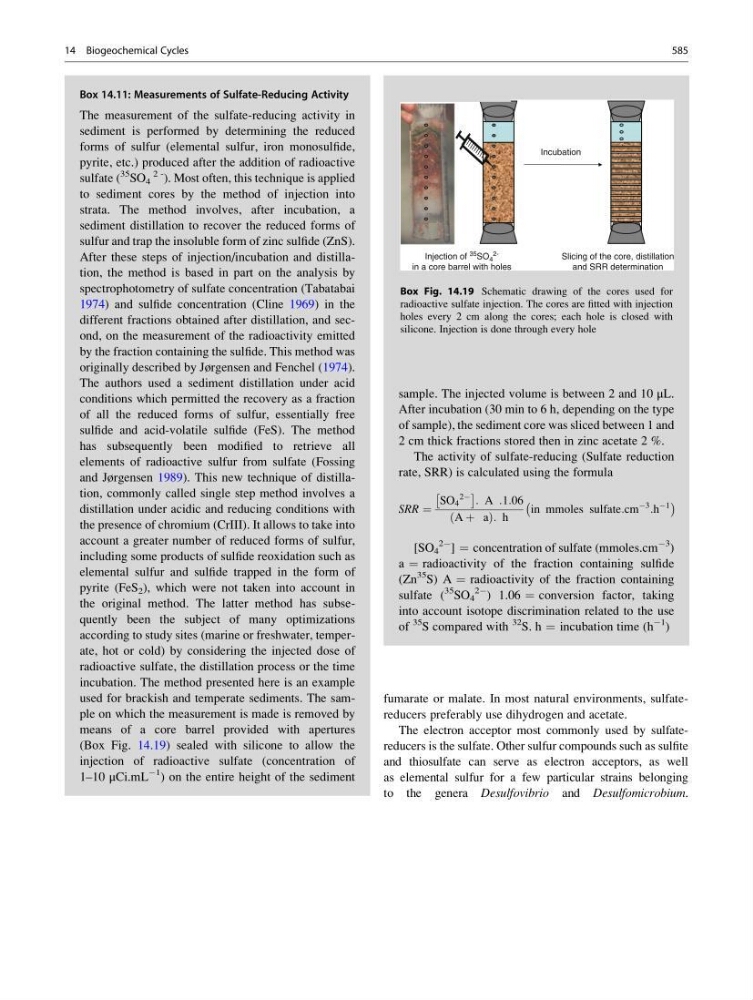
used for brackish and temperate sediments. The sample on which the measurement is made is removed by
means of a core barrel provided with apertures
(Box Fig. 14.19) sealed with silicone to allow the
injection of radioactive sulfate (concentration of
1–10 μCi.mL
À1 ) on the entire height of the sediment
(continued)
Box 14.11 (continued)
sample. The injected volume is between 2 and 10 μL.
After incubation (30 min to 6 h, depending on the type
of sample), the sediment core was sliced between 1 and
2 cm thick fractions stored then in zinc acetate 2 %.
The activity of sulfate-reducing (Sulfate reduction
rate, SRR) is calculated using the formula
SRR ¼
SO 4
2À
Â
Ã
: A :1:06
ðA þ aÞ: h
in mmoles sulfate:cm
À3
:h
À1
À
Á
[SO 4
2À ] ¼ concentration of sulfate (mmoles.cm
À3 )
a ¼ radioactivity of the fraction containing sulfide
(Zn
35 S) A ¼ radioactivity of the fraction containing
sulfate (
35 SO 4
2À
) 1.06 ¼ conversion factor, taking
into account isotope discrimination related to the use
of
35 S compared with
32 S. h ¼ incubation time (h
À1 )
Injection of
35
SO 4
2in a core barrel with holes
Incubation
Slicing of the core, distillation
and SRR determination
Box Fig. 14.19 Schematic drawing of the cores used for
radioactive sulfate injection. The cores are fitted with injection
holes every 2 cm along the cores; each hole is closed with
silicone. Injection is done through every hole
14 Biogeochemical Cycles
585