

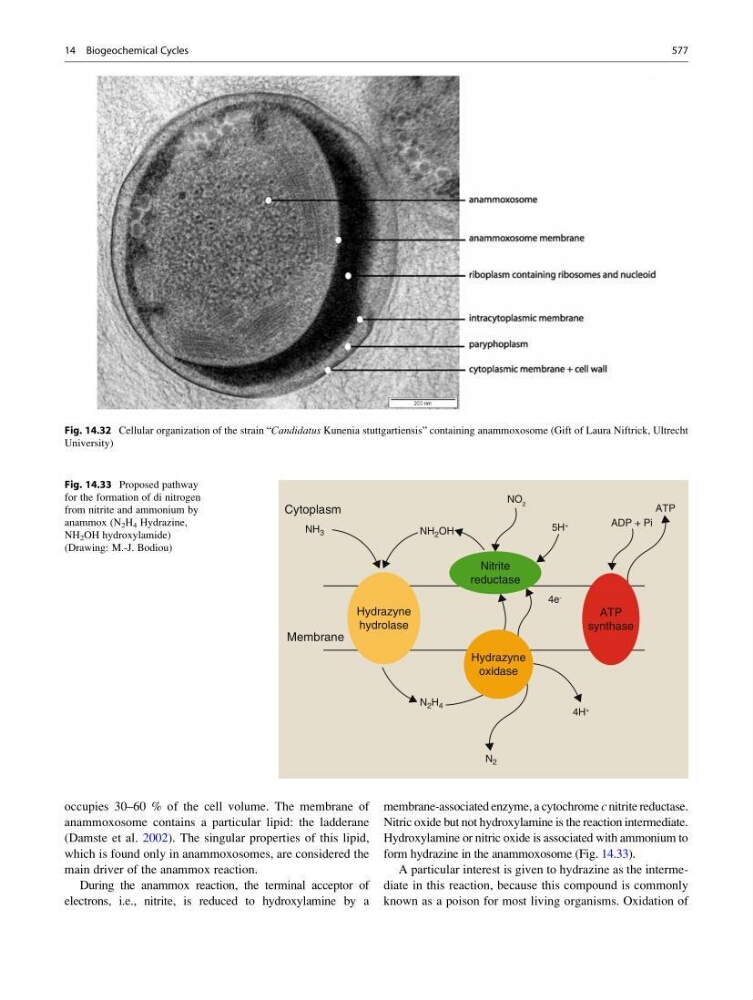
occupies 30–60 % of the cell volume. The membrane of
anammoxosome contains a particular lipid: the ladderane
(Damste et al. 2002). The singular properties of this lipid,
which is found only in anammoxosomes, are considered the
main driver of the anammox reaction.
During the anammox reaction, the terminal acceptor of
electrons, i.e., nitrite, is reduced to hydroxylamine by a
membrane-associated enzyme, a cytochrome c nitrite reductase.
Nitric oxide but not hydroxylamine is the reaction intermediate.
Hydroxylamine or nitric oxide is associated with ammonium to
form hydrazine in the anammoxosome (Fig. 14.33).
A particular interest is given to hydrazine as the intermediate in this reaction, because this compound is commonly
known as a poison for most living organisms. Oxidation of
NH 2 OH
NO 2
5H
+
ADP + Pi
ATP
N 2 H 4
oxydase
N 2
Cytoplasm
NH 3
Membrane
4H
+
4e
-
Hydrazyne
hydrolase
ATP
synthase
Hydrazyne
oxidase
Nitrite
reductase
Fig. 14.33 Proposed pathway
for the formation of di nitrogen
from nitrite and ammonium by
anammox (N 2 H 4 Hydrazine,
NH 2 OH hydroxylamide)
(Drawing: M.-J. Bodiou)
Fig. 14.32 Cellular organization of the strain “Candidatus Kunenia stuttgartiensis” containing anammoxosome (Gift of Laura Niftrick, Ultrecht
University)
14 Biogeochemical Cycles
577