

hydrazine takes place in the anammoxosome and forms
dinitrogen. The enzyme performing this reaction can either
be the hydroxylamine oxidoreductase (HAO) or the hydrazine dehydrogenase. This latter reaction provides four
electrons used for the reduction of nitrite to hydroxylamine.
All these reactions allow the transfer of 4 protons through
the membrane of anammoxosome and, therefore, the promotion of a proton gradient for the synthesis of ATP molecules,
ATP synthases being present in the membrane of
anammoxosomes (Van Niftrik et al. 2004).
The anammox process is expressed only in anaerobic
conditions and is inhibited in the presence of oxygen, but
this inhibition is reversible. Organic matter also has an effect
on the production of dinitrogen via anammox, by increasing
the rate of mineralization and therefore the production of
ammonium. The activity of anammox has been demonstrated
in the wastewater treatment systems rich in organic matter,
which can reach up to 60 % of the total production of N 2 in
some ecosystems.
Temperature also has an effect on the anammox activity.
Indeed, in situ studies have shown that the production of
molecular nitrogen by anammox is maximum around 15
C
and becomes zero around 37
C. At a temperature of 6
C,
80 % of dinitrogen is still produced by anammox whereas at
37
C, denitrification becomes dominant.
14.3.6 Nitrous Oxide Production
Nitrous oxide is a very stable gas, with a lifetime of about
120 years in the troposphere. It is a greenhouse gas which,
similar to methane (CH 4 ) or carbon dioxide (CO 2 ),
contributes to the increase in temperature at the surface of
the Earth via absorption of infrared radiations. In the troposphere, this gas has a concentration of 310 ppb. Because of
its long lifetime, its concentration, and its high radioactive
absorption coefficient, the contribution of one molecule of
N 2 O to the increasing greenhouse effect would be 180–300
times greater than that of one molecule of CO 2 . Since 1980,
the concentration of N 2 O in the troposphere is continuously
increasing by 0.2–0.3 % per year, which yield an overall
increase of 15 % between the pre-industrial era and the
present time. A stabilization of the current rate requires a
reduction in anthropogenic emissions of more than 50 %.
Beyond 0.3 ppm, N 2 O can flow into the stratosphere where
it undergoes the following photochemical reaction: N 2 O + O
! 2NO. N 2 O is thus a natural source of nitric oxide, which
then catalyzes the destruction of the ozone layer as follows:
NO þ O 3 ! NO 2
À
þ O 2 and NO 2
À
þ O ! NO þ O 2
Modeling studies predict that a severe increase in the
denitrification rates in the Arctic could increase by more
than 30 % of the ozone hole over the boreal pole.
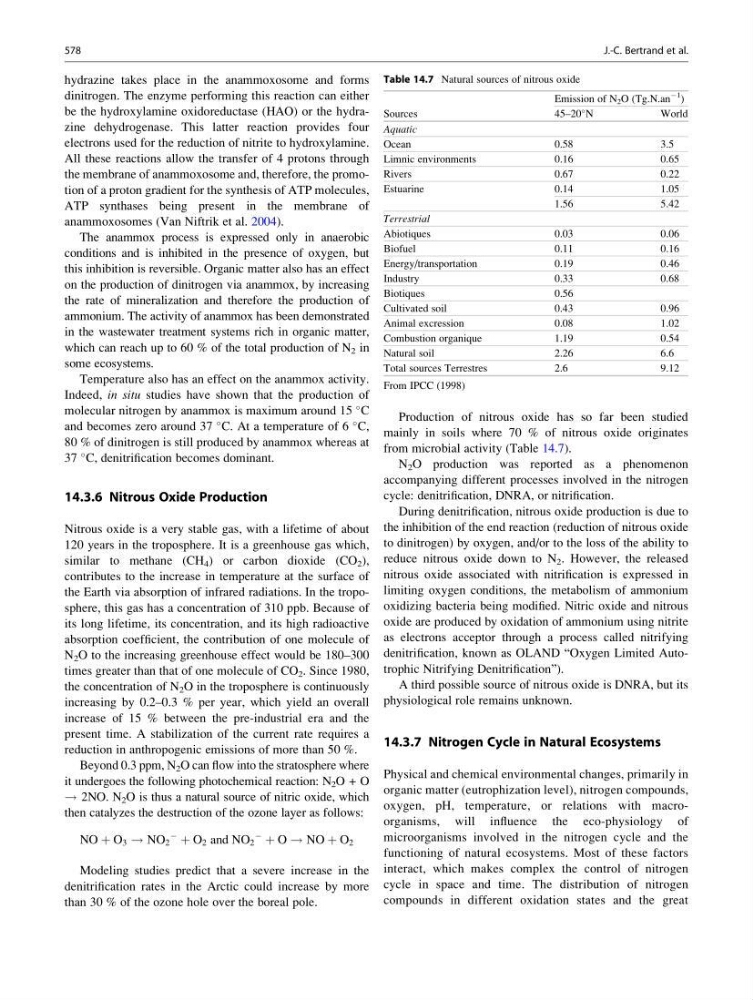
Production of nitrous oxide has so far been studied
mainly in soils where 70 % of nitrous oxide originates
from microbial activity (Table 14.7).
N 2 O production was reported as a phenomenon
accompanying different processes involved in the nitrogen
cycle: denitrification, DNRA, or nitrification.
During denitrification, nitrous oxide production is due to
the inhibition of the end reaction (reduction of nitrous oxide
to dinitrogen) by oxygen, and/or to the loss of the ability to
reduce nitrous oxide down to N 2 . However, the released
nitrous oxide associated with nitrification is expressed in
limiting oxygen conditions, the metabolism of ammonium
oxidizing bacteria being modified. Nitric oxide and nitrous
oxide are produced by oxidation of ammonium using nitrite
as electrons acceptor through a process called nitrifying
denitrification, known as OLAND “Oxygen Limited Autotrophic Nitrifying Denitrification”).
A third possible source of nitrous oxide is DNRA, but its
physiological role remains unknown.
14.3.7 Nitrogen Cycle in Natural Ecosystems
Physical and chemical environmental changes, primarily in
organic matter (eutrophization level), nitrogen compounds,
oxygen, pH, temperature, or relations with macroorganisms, will influence the eco-physiology of
microorganisms involved in the nitrogen cycle and the
functioning of natural ecosystems. Most of these factors
interact, which makes complex the control of nitrogen
cycle in space and time. The distribution of nitrogen
compounds in different oxidation states and the great
Table 14.7 Natural sources of nitrous oxide
Sources
Emission of N 2 O (Tg.N.an
À1
)
45–20
N
World
Aquatic
Ocean
0.58
3.5
Limnic environments
0.16
0.65
Rivers
0.67
0.22
Estuarine
0.14
1.05
1.56
5.42
Terrestrial
Abiotiques
0.03
0.06
Biofuel
0.11
0.16
Energy/transportation
0.19
0.46
Industry
0.33
0.68
Biotiques
0.56
Cultivated soil
0.43
0.96
Animal excression
0.08
1.02
Combustion organique
1.19
0.54
Natural soil
2.26
6.6
Total sources Terrestres
2.6
9.12
From IPCC (1998)
578
J.-C. Bertrand et al.