

types of nitrite reductases which are very different in their
structure, but although have a similar function: One is made of
cytochrome cd 1 (Nir-cd 1 ) and the other of copper (Nir-Cu).
They are encoded by the genes nirS and nirK, respectively.
Until now, these two types of nitrite reductases were never
found simultaneously in the same organism.
Among the enzymes of denitrification, nitric oxide reductase was the one discovered more recently. Nitric oxide
reductase forms a complex membraneous cytochrome bc
with two monomers.
The conversion of nitrous oxide (N 2 O) to dinitrogen (N 2 )
is the final step of denitrification (cf. Sect. 3.3.2, Fig. 3.21).
The enzyme that catalyses this reduction, the nitrous oxide
reductase, is a generally soluble homodimer, located in the
periplasm. Mechanisms and factors that inactivate nitrous
oxide reductase are still unknown, but oxygen seems to play
an active role in this phenomenon. Moreover, this enzyme is
inhibited by acetylene (C 2 H 2 ), thus leading to an accumulation of nitrous oxide. This acetylene inhibition technique is
used to measure denitrifying activity in pure cultures and
natural samples (Box 14.10).
In Gram-positive bacteria which have no periplasm, denitrification enzymes are associated with the membrane. However, the structure of these enzymes is very close to that of
periplasmic enzymes in Gram-negative bacteria.
Denitrification rates are influenced by many factors such as
oxygen, nitrate and organic matter concentrations, pH, temperature, and the presence of macrofauna. These factors interact with each other and make the control of denitrification
complex in spatial and temporal scales. In 1982, Tiedje and
colleagues (Tiedje et al. 1982) presented a conceptual model
of control based on three factors with the following hierarchy:
oxygen > nitrate > organic matter. The availability of nitrate
and of labile carbon control denitrification rates and the importance of the ratio denitrification: DNRA. In the presence of
high nitrate concentrations, denitrifying community is
favored. Dissolved oxygen concentration controls denitrification either directly (enzyme inhibition) or indirectly via nitrification (nitrate production). In oxic area, denitrifying activity
can exist in “hot spots” of denitrification defined as anoxic
micro-niches and characterized by a strong coupling between
nitrification and denitrification. Such anoxic micro-niches in
globally oxygenated ecosystems (Fig. 14.3), colonized by
denitrifying microorganisms were also reported in Mediterranean waters rich in suspended particles. Denitrification rates
measured by the acetylene inhibition technique (AIT) remain
low compared with those observed in sediments. Apart from
some special cases, denitrification enzymes are induced under
anaerobic conditions and inhibited in the presence of oxygen.
However, depending on bacterial species, these enzymes do
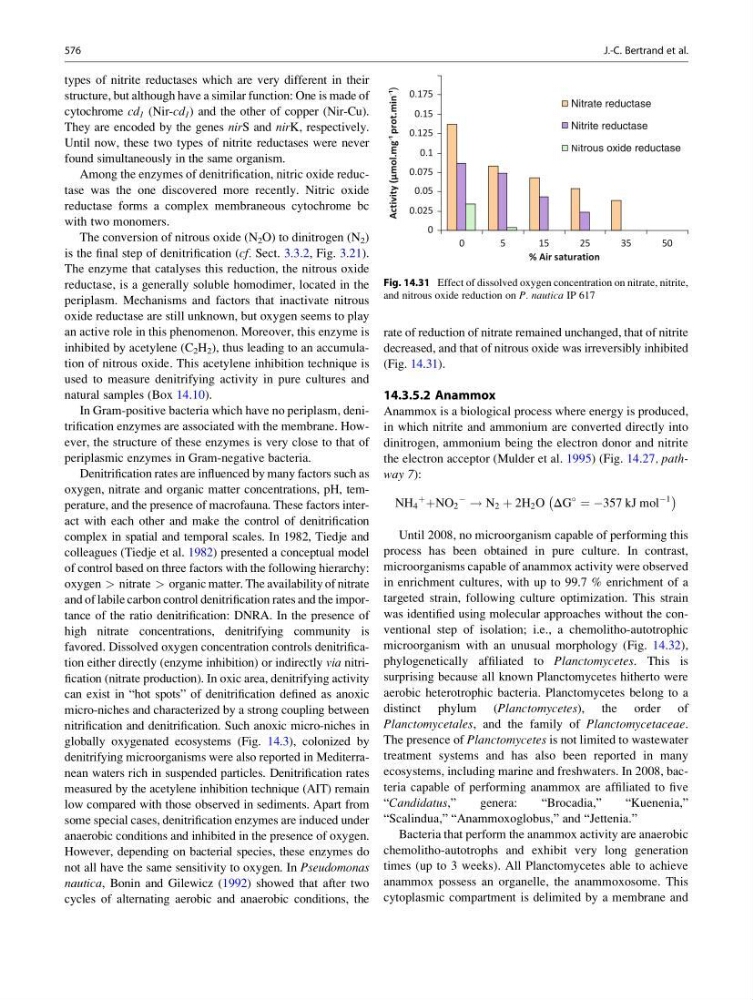
not all have the same sensitivity to oxygen. In Pseudomonas
nautica, Bonin and Gilewicz (1992) showed that after two
cycles of alternating aerobic and anaerobic conditions, the
rate of reduction of nitrate remained unchanged, that of nitrite
decreased, and that of nitrous oxide was irreversibly inhibited
(Fig. 14.31).
14.3.5.2 Anammox
Anammox is a biological process where energy is produced,
in which nitrite and ammonium are converted directly into
dinitrogen, ammonium being the electron donor and nitrite
the electron acceptor (Mulder et al. 1995) (Fig. 14.27, pathway 7):
NH 4
þ
þNO 2
À
! N 2 þ 2H 2 O ΔG
¼ À357 kJ mol
À1
À
Á
Until 2008, no microorganism capable of performing this
process has been obtained in pure culture. In contrast,
microorganisms capable of anammox activity were observed
in enrichment cultures, with up to 99.7 % enrichment of a
targeted strain, following culture optimization. This strain
was identified using molecular approaches without the conventional step of isolation; i.e., a chemolitho-autotrophic
microorganism with an unusual morphology (Fig. 14.32),
phylogenetically affiliated to Planctomycetes. This is
surprising because all known Planctomycetes hitherto were
aerobic heterotrophic bacteria. Planctomycetes belong to a
distinct phylum (Planctomycetes), the order of
Planctomycetales, and the family of Planctomycetaceae.
The presence of Planctomycetes is not limited to wastewater
treatment systems and has also been reported in many
ecosystems, including marine and freshwaters. In 2008, bacteria capable of performing anammox are affiliated to five
“Candidatus,”
genera:
“Brocadia,”
“Kuenenia,”
“Scalindua,” “Anammoxoglobus,” and “Jettenia.”
Bacteria that perform the anammox activity are anaerobic
chemolitho-autotrophs and exhibit very long generation
times (up to 3 weeks). All Planctomycetes able to achieve
anammox possess an organelle, the anammoxosome. This
cytoplasmic compartment is delimited by a membrane and
0
0.025
0.05
0.075
0.1
0.125
0.15
0.175
0
5
15
25
35
50
% Air saturation
Activity (μmol.mg
‐1
prot.min
‐1
)
Nitrate reductase
Nitrite reductase
Nitrous oxide reductase
Fig. 14.31 Effect of dissolved oxygen concentration on nitrate, nitrite,
and nitrous oxide reduction on P. nautica IP 617
576
J.-C. Bertrand et al.