

In an ecological point of view, denitrification is an
important process that allows biological elimination of nitrogen. Indeed, 15–70 % of the ammonium derived from the
mineralization of organic matter could be eliminated
through the coupling nitrification/denitrification.
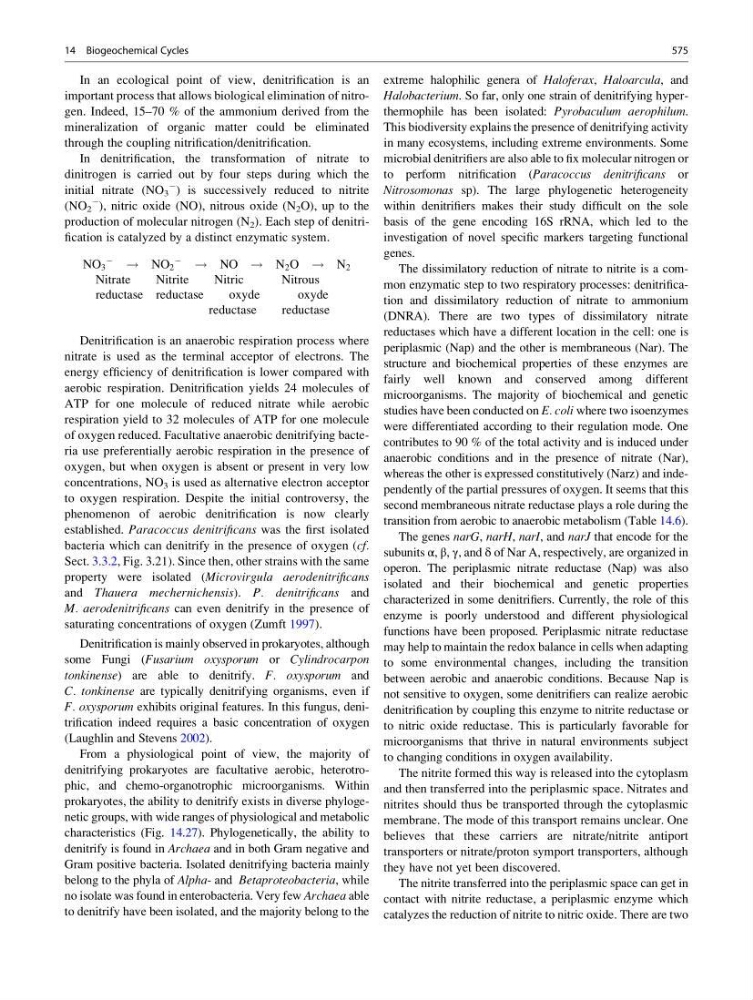
In denitrification, the transformation of nitrate to
dinitrogen is carried out by four steps during which the
initial nitrate (NO 3
À ) is successively reduced to nitrite
(NO 2
À
), nitric oxide (NO), nitrous oxide (N 2 O), up to the
production of molecular nitrogen (N 2 ). Each step of denitrification is catalyzed by a distinct enzymatic system.
NO 3
À
! NO 2
À
! NO ! N 2 O ! N 2
Nitrate
Nitrite
Nitric
Nitrous
reductase reductase
oxyde
oxyde
reductase
reductase
Denitrification is an anaerobic respiration process where
nitrate is used as the terminal acceptor of electrons. The
energy efficiency of denitrification is lower compared with
aerobic respiration. Denitrification yields 24 molecules of
ATP for one molecule of reduced nitrate while aerobic
respiration yield to 32 molecules of ATP for one molecule
of oxygen reduced. Facultative anaerobic denitrifying bacteria use preferentially aerobic respiration in the presence of
oxygen, but when oxygen is absent or present in very low
concentrations, NO 3 is used as alternative electron acceptor
to oxygen respiration. Despite the initial controversy, the
phenomenon of aerobic denitrification is now clearly
established. Paracoccus denitrificans was the first isolated
bacteria which can denitrify in the presence of oxygen (cf.
Sect. 3.3.2, Fig. 3.21). Since then, other strains with the same
property were isolated (Microvirgula aerodenitrificans
and Thauera mechernichensis). P. denitrificans and
M. aerodenitrificans can even denitrify in the presence of
saturating concentrations of oxygen (Zumft 1997).
Denitrification is mainly observed in prokaryotes, although
some Fungi (Fusarium oxysporum or Cylindrocarpon
tonkinense) are able to denitrify. F. oxysporum and
C. tonkinense are typically denitrifying organisms, even if
F. oxysporum exhibits original features. In this fungus, denitrification indeed requires a basic concentration of oxygen
(Laughlin and Stevens 2002).
From a physiological point of view, the majority of
denitrifying prokaryotes are facultative aerobic, heterotrophic, and chemo-organotrophic microorganisms. Within
prokaryotes, the ability to denitrify exists in diverse phylogenetic groups, with wide ranges of physiological and metabolic
characteristics (Fig. 14.27). Phylogenetically, the ability to
denitrify is found in Archaea and in both Gram negative and
Gram positive bacteria. Isolated denitrifying bacteria mainly
belong to the phyla of Alpha- and Betaproteobacteria, while
no isolate was found in enterobacteria. Very few Archaea able
to denitrify have been isolated, and the majority belong to the
extreme halophilic genera of Haloferax, Haloarcula, and
Halobacterium. So far, only one strain of denitrifying hyperthermophile has been isolated: Pyrobaculum aerophilum.
This biodiversity explains the presence of denitrifying activity
in many ecosystems, including extreme environments. Some
microbial denitrifiers are also able to fix molecular nitrogen or
to perform nitrification (Paracoccus denitrificans or
Nitrosomonas sp). The large phylogenetic heterogeneity
within denitrifiers makes their study difficult on the sole
basis of the gene encoding 16S rRNA, which led to the
investigation of novel specific markers targeting functional
genes.
The dissimilatory reduction of nitrate to nitrite is a common enzymatic step to two respiratory processes: denitrification and dissimilatory reduction of nitrate to ammonium
(DNRA). There are two types of dissimilatory nitrate
reductases which have a different location in the cell: one is
periplasmic (Nap) and the other is membraneous (Nar). The
structure and biochemical properties of these enzymes are
fairly well known and conserved among different
microorganisms. The majority of biochemical and genetic
studies have been conducted on E. coli where two isoenzymes
were differentiated according to their regulation mode. One
contributes to 90 % of the total activity and is induced under
anaerobic conditions and in the presence of nitrate (Nar),
whereas the other is expressed constitutively (Narz) and independently of the partial pressures of oxygen. It seems that this
second membraneous nitrate reductase plays a role during the
transition from aerobic to anaerobic metabolism (Table 14.6).
The genes narG, narH, narI, and narJ that encode for the
subunits α, β, γ, and δ of Nar A, respectively, are organized in
operon. The periplasmic nitrate reductase (Nap) was also
isolated and their biochemical and genetic properties
characterized in some denitrifiers. Currently, the role of this
enzyme is poorly understood and different physiological
functions have been proposed. Periplasmic nitrate reductase
may help to maintain the redox balance in cells when adapting
to some environmental changes, including the transition
between aerobic and anaerobic conditions. Because Nap is
not sensitive to oxygen, some denitrifiers can realize aerobic
denitrification by coupling this enzyme to nitrite reductase or
to nitric oxide reductase. This is particularly favorable for
microorganisms that thrive in natural environments subject
to changing conditions in oxygen availability.
The nitrite formed this way is released into the cytoplasm
and then transferred into the periplasmic space. Nitrates and
nitrites should thus be transported through the cytoplasmic
membrane. The mode of this transport remains unclear. One
believes that these carriers are nitrate/nitrite antiport
transporters or nitrate/proton symport transporters, although
they have not yet been discovered.
The nitrite transferred into the periplasmic space can get in
contact with nitrite reductase, a periplasmic enzyme which
catalyzes the reduction of nitrite to nitric oxide. There are two
14 Biogeochemical Cycles
575