

The functioning of these enzymes consumes high
quantities of energy: 8 electrons and 16 ATP are necessary
for the fixation of one molecule of dinitrogen:
N 2 þ 8H
þ
þ 8e
‐
þ 16ATP ! 2NH 3 þ H 2 þ 16ADP þ 16Pi
Under natural conditions, between 20 and 30 ATP would
be used. This system, energetically costly, works only in the
absence of other nitrogen sources in the medium. Therefore,
dinitrogenase complex is highly dependent on environmental conditions such as the presence of other sources of available nitrogen and oxygen. The presence of other nitrogen
sources which can be more easily assimilated (nitrate,
ammonium) generally inhibits the N 2 fixation. Similarly,
oxygen (or more likely an oxidized product which is more
reactive such as superoxide ions or hydroxyl radicals) would
oxidize dinitrogenase reductase, causing a conformational
change in this protein and its inactivation. However, many
diazotrophs are aerobic and have had to develop various
strategies to prevent the irreversible inactivation of enzymes
(Fay 1992):
1. The first strategy consists of increasing the respiratory
activity depending on the partial pressure of oxygen present in the cell, thereby maintaining an active dinitrogenase
complex.
2. Another type of protection has been discovered in
Klebsiella pneumoniae and Rhodopseudomonas, known
as conformation protection or “switch-off-switch-on”
phenomenon, consisting of a reversible inactivation of
the enzyme when the partial pressure of oxygen becomes
too high. This conformation change involves a protein
(FeS) which binds to dinitrogenase in the presence of
oxygen. This mechanism does not allow fixation but
avoids the irreversible inactivation of dinitrogenase.
3. This weakly specific enzyme, capable of forming hydrogen,
is at the origin of another protection mechanism involving a
unidirectional hydrogenase, that allows O 2 elimination
(Knallgas reaction: O 2 + 2H 2 ! H 2 O).
Table 14.6 Different processes leading to the reduction of nitrate and the involved enzymes
Denitrification
DNRA
Nitrate assimilation
NO 3 ! NO 2
NAR or/and NAP
NAR or/and NAP
NAS
NO 2 ! NH 4
NAD(P)H NiR orFormate NIR
NO 2 ! NO
Cu-NIR or cd1-NIR
NO ! N 2 O
NOR (Nitric oxide reductase)
N 2 O ! N 2
N2OR (nitrous oxide reductase)
Aquificae Thermotogae
Acidobacteria/Fibrobacteres
Deinococcus/Thermus
Chloroflexi
Cyanobacteria
Firmicutes
PVC group
Chlorobi / Bacteroidetes
Epsilonproteobacteria
Deltaproteobacteria
Alphaproteobacteria
Betaproteobacteria
Gammaproteobacteria
0.1
a
Actinobacteria
Spirochaetes
Proteobacteria
N
N
F
F
F
F
F
F
F Dn
Dn
Dn
Dn
Dn
Dn
AnX
RDNA
RDNA
RDNA
Nanoarchaeota
Korarchaeota
Thaumarchaeota
Thermoproteales
Desulfurococcales
Sulfolobales
Crenarchaeota
Halobacteriales
Methanomicrobia
Thermoplasmatales
Methanobacteriales F
Methanococcales
Thermococcales
Archaeoglobales
Methanopyrales
b
Euryarchaeota
N
F
F
F
Dn
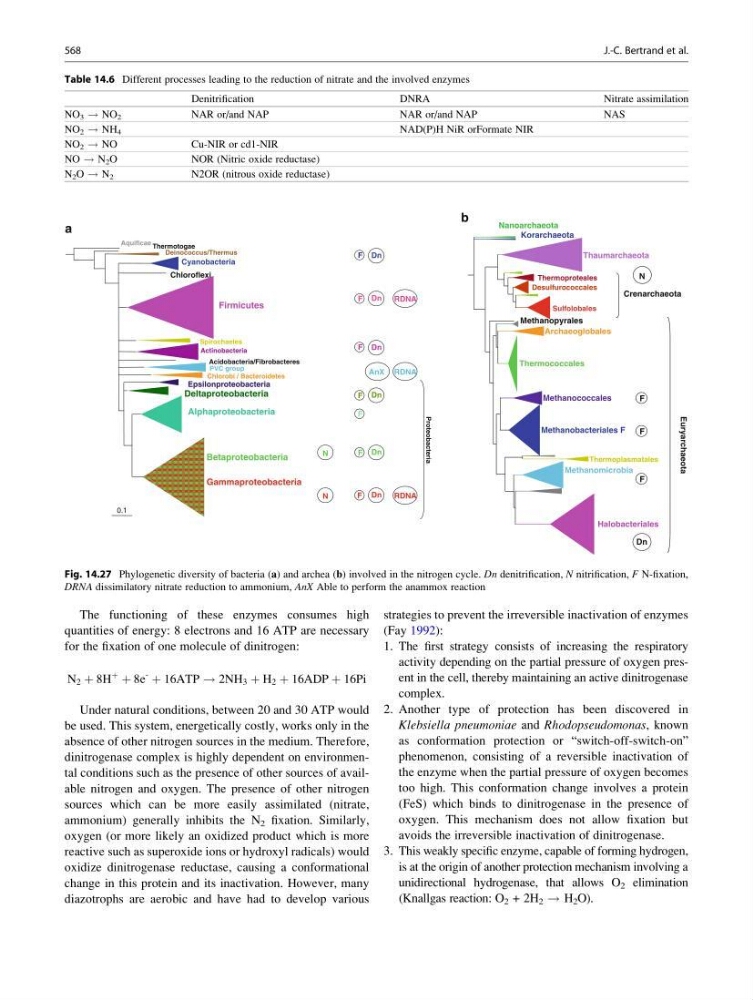
Fig. 14.27 Phylogenetic diversity of bacteria (a) and archea (b) involved in the nitrogen cycle. Dn denitrification, N nitrification, F N-fixation,
DRNA dissimilatory nitrate reduction to ammonium, AnX Able to perform the anammox reaction
568
J.-C. Bertrand et al.