

All these mechanisms protect the dinitrogenase complex
from the oxygen present in the medium.
In addition, some phototrophic organisms produce
oxygen through photosynthesis. This is the case of many
cyanobacteria which use different protection mechanisms:
1. Photosynthesis and N 2 fixation can be uncoupled during the
daily cycle, with fixation occurring at night. In this case,
ATP required for fixation is provided by respiration and not
through photosynthesis. This process has been demonstrated
in Gloeothece sp, Synecchococcus, Microcoleus
chthonoplastes, and Oscillatoria under natural conditions.
2. Another mechanism exists in some filamentous
cyanobacteria that have specialized cell structures for
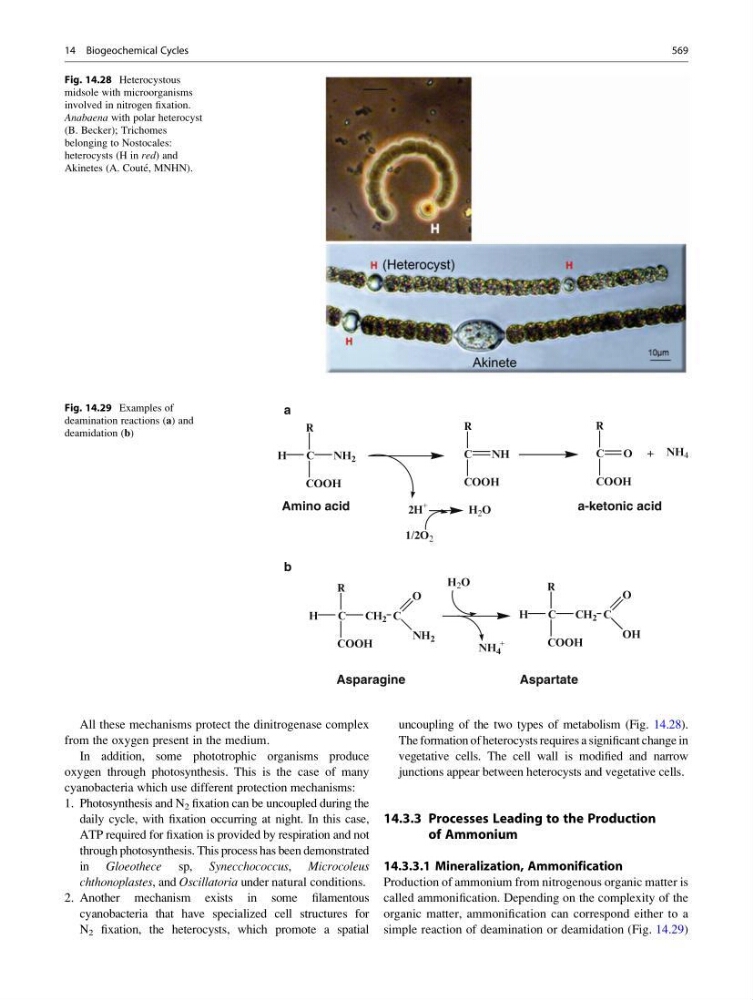
N 2 fixation, the heterocysts, which promote a spatial
uncoupling of the two types of metabolism (Fig. 14.28).
The formation of heterocysts requires a significant change in
vegetative cells. The cell wall is modified and narrow
junctions appear between heterocysts and vegetative cells.
14.3.3 Processes Leading to the Production
of Ammonium
14.3.3.1 Mineralization, Ammonification
Production of ammonium from nitrogenous organic matter is
called ammonification. Depending on the complexity of the
organic matter, ammonification can correspond either to a
simple reaction of deamination or deamidation (Fig. 14.29)
Fig. 14.28 Heterocystous
midsole with microorganisms
involved in nitrogen fixation.
Anabaena with polar heterocyst
(B. Becker); Trichomes
belonging to Nostocales:
heterocysts (H in red) and
Akinetes (A. Coute ´, MNHN).
H
C
R
COOH
NH 2
R
C
NH
COOH
R
C
O
COOH
NH 4
2H
+
H 2 O
1/2O 2
+
H
C
R
COOH
CH 2
NH 4
+
H 2 O
C
O
NH 2
H
C
R
COOH
CH 2 C
O
OH
a
b
Asparagine
Aspartate
Amino acid
a-ketonic acid
Fig. 14.29 Examples of
deamination reactions (a) and
deamidation (b)
14 Biogeochemical Cycles
569