

reductase (cf. Chapter 3.4.4, Figure 3.42). The specificity of
these two enzymes is weak. Indeed, the dinitrogenase is
capable of catalyzing many reactions other than the fixation
of dinitrogen, such as the reduction of various compounds:
cyanide, cyclopropene, acetylene, azide, methyl isocyanide,
diazirine, and nitrous oxide. The ability to reduce acetylene
down to ethylene is commonly used to quantify the activity
of nitrogen-fixing microorganisms in natural samples. This
inexpensive method, easy to implement, is an alternative to
the isotopic method.
A m m o n if ic a t i o n
N i t r a t io n
N itrit ation
A m m o n if ic a t i o
n
N IT R O G EN FIXA T IO N
N
I T R I F I C A T I O N
OXIC
ANOXIC
A N A M M O X
NADR
DN
DN
DN
N I T R O G E N
F I X A T I O N
3
4
2
1a
1b
2
3
7
6
5
NH 4
+
NH 4
+
N 2
N 2 O
N 2 O
N 2 O
N 2 O
NO 2
-
NO 2
-
N 2
NO 3
-
Organic
N
Degradation
Oxidation
Assimilation
Reduction
Abiotic pathways
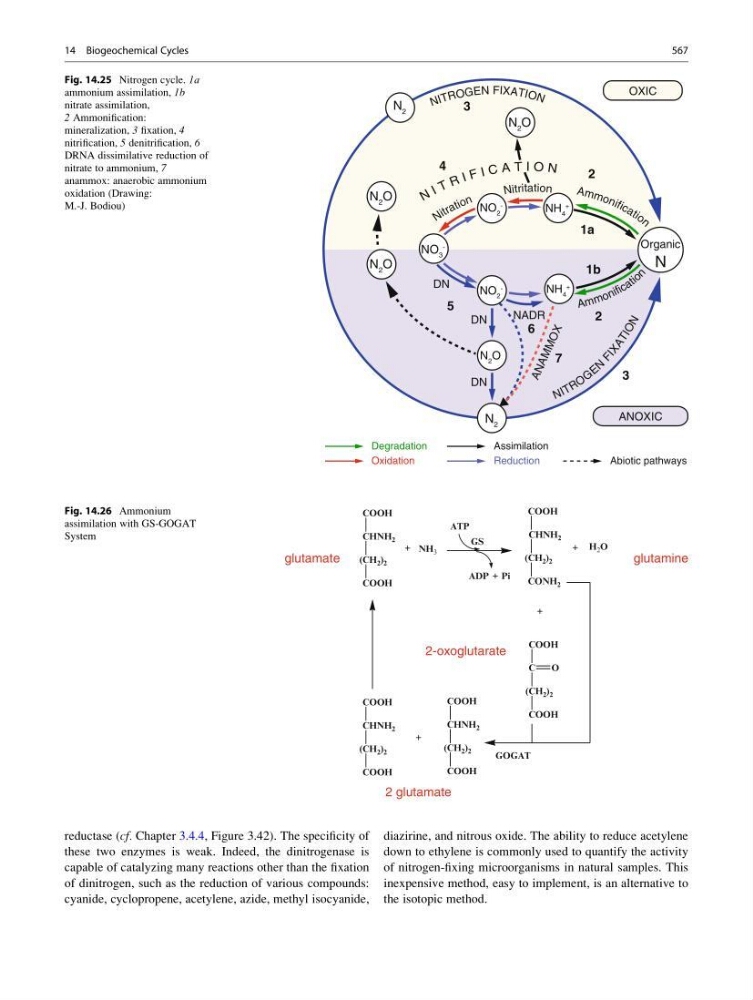
Fig. 14.25 Nitrogen cycle. 1a
ammonium assimilation, 1b
nitrate assimilation,
2 Ammonification:
mineralization, 3 fixation, 4
nitrification, 5 denitrification, 6
DRNA dissimilative reduction of
nitrate to ammonium, 7
anammox: anaerobic ammonium
oxidation (Drawing:
M.-J. Bodiou)
COOH
CHNH 2
CHNH 2
(CH 2 ) 2
(CH 2 ) 2
COOH
COOH
CONH 2
H 2 O
COOH
CHNH 2
CHNH 2
(CH 2 ) 2
(CH 2 ) 2
(CH 2 ) 2
COOH
COOH
COOH
COOH
C
COOH
O
+
NH 3
+
ATP
ADP + Pi
+
+
GOGAT
GS
glutamine
glutamate
2-oxoglutarate
2 glutamate
Fig. 14.26 Ammonium
assimilation with GS-GOGAT
System
14 Biogeochemical Cycles
567