

14.3 Nitrogen Cycle
14.3.1 Introduction
Nitrogen is a chemical element with symbol N and atomic
number 7. Nitrogen is present in natural state in the form of
two stable isotopes (
14 N,
15 N). The standard (
15 N/
14 N) atm for
the atmosphere is at 3.613 Â 10
À3 .
Nitrogen is one of the major nutrients used by plants and
animals. Combined nitrogen refers to all forms of nitrogen
other than dinitrogen (N 2 ). Organic nitrogen (N org ) is nitrogen
which is bound to carbon to form complex molecules. In living
beings, organic nitrogen is present mainly in the form of
proteins (nitrogen constitutes 18 % of proteins), nucleic acids
(DNA, RNA), in certain polysaccharides such as chitin (shell
of arthropods) or peptidoglycan (membrane wall of bacteria).
The nitrogen content in plants can be particularly low, less than
0.5 % of the total mass, while the content can reach 15 % in
bacteria. Living organisms obtain nitrogen from their
surrounding environment as dissolved chemicals or by predation. Organic nitrogen returns back to the environment in the
form of organic matter (excretion – urine, feces, mucus – or
dead organisms). The atmosphere consists of 78 % of
dinitrogen. Nitrogen means “lifeless,” its name comes from
its low chemical reactivity. Indeed, very few organisms are
able to directly use dinitrogen as a nitrogen source, despite its
wide availability.
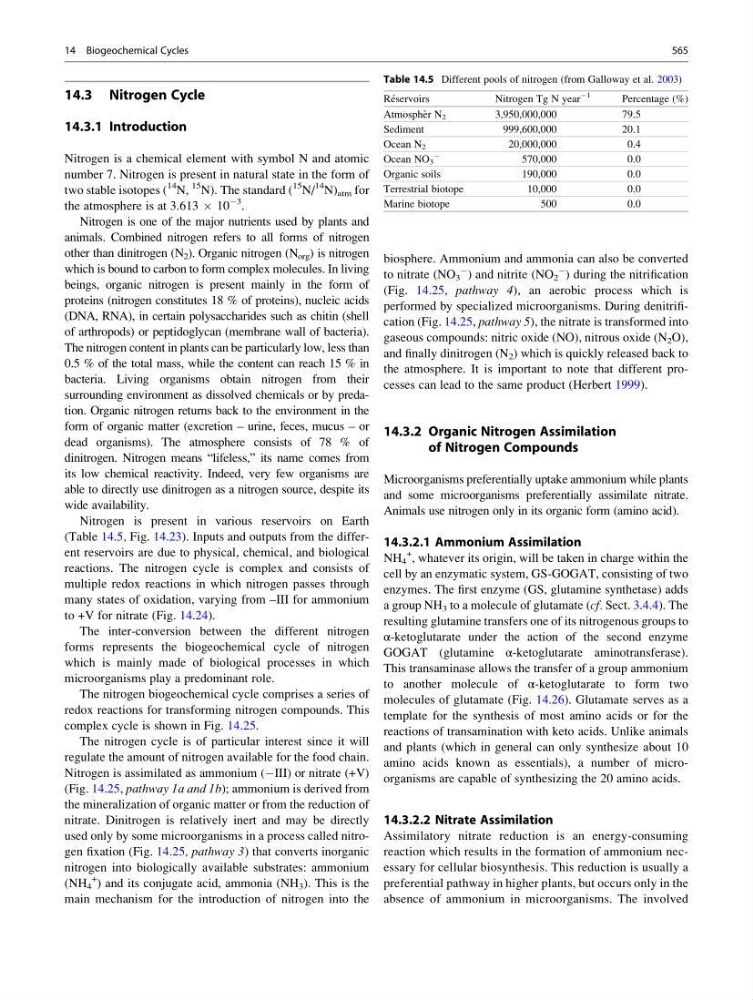
Nitrogen is present in various reservoirs on Earth
(Table 14.5, Fig. 14.23). Inputs and outputs from the different reservoirs are due to physical, chemical, and biological
reactions. The nitrogen cycle is complex and consists of
multiple redox reactions in which nitrogen passes through
many states of oxidation, varying from –III for ammonium
to +V for nitrate (Fig. 14.24).
The inter-conversion between the different nitrogen
forms represents the biogeochemical cycle of nitrogen
which is mainly made of biological processes in which
microorganisms play a predominant role.
The nitrogen biogeochemical cycle comprises a series of
redox reactions for transforming nitrogen compounds. This
complex cycle is shown in Fig. 14.25.
The nitrogen cycle is of particular interest since it will
regulate the amount of nitrogen available for the food chain.
Nitrogen is assimilated as ammonium (ÀIII) or nitrate (+V)
(Fig. 14.25, pathway 1a and 1b); ammonium is derived from
the mineralization of organic matter or from the reduction of
nitrate. Dinitrogen is relatively inert and may be directly
used only by some microorganisms in a process called nitrogen fixation (Fig. 14.25, pathway 3) that converts inorganic
nitrogen into biologically available substrates: ammonium
(NH 4
+
) and its conjugate acid, ammonia (NH 3 ). This is the
main mechanism for the introduction of nitrogen into the
biosphere. Ammonium and ammonia can also be converted
to nitrate (NO 3
À ) and nitrite (NO 2
À
) during the nitrification
(Fig. 14.25, pathway 4), an aerobic process which is
performed by specialized microorganisms. During denitrification (Fig. 14.25, pathway 5), the nitrate is transformed into
gaseous compounds: nitric oxide (NO), nitrous oxide (N 2 O),
and finally dinitrogen (N 2 ) which is quickly released back to
the atmosphere. It is important to note that different processes can lead to the same product (Herbert 1999).
14.3.2 Organic Nitrogen Assimilation
of Nitrogen Compounds
Microorganisms preferentially uptake ammonium while plants
and some microorganisms preferentially assimilate nitrate.
Animals use nitrogen only in its organic form (amino acid).
14.3.2.1 Ammonium Assimilation
NH 4
+
, whatever its origin, will be taken in charge within the
cell by an enzymatic system, GS-GOGAT, consisting of two
enzymes. The first enzyme (GS, glutamine synthetase) adds
a group NH 3 to a molecule of glutamate (cf. Sect. 3.4.4). The
resulting glutamine transfers one of its nitrogenous groups to
α-ketoglutarate under the action of the second enzyme
GOGAT (glutamine α-ketoglutarate aminotransferase).
This transaminase allows the transfer of a group ammonium
to another molecule of α-ketoglutarate to form two
molecules of glutamate (Fig. 14.26). Glutamate serves as a
template for the synthesis of most amino acids or for the
reactions of transamination with keto acids. Unlike animals
and plants (which in general can only synthesize about 10
amino acids known as essentials), a number of microorganisms are capable of synthesizing the 20 amino acids.
14.3.2.2 Nitrate Assimilation
Assimilatory nitrate reduction is an energy-consuming
reaction which results in the formation of ammonium necessary for cellular biosynthesis. This reduction is usually a
preferential pathway in higher plants, but occurs only in the
absence of ammonium in microorganisms. The involved
Table 14.5 Different pools of nitrogen (from Galloway et al. 2003)
Re ´servoirs
Nitrogen Tg N year
À1
Percentage (%)
Atmosphe `r N 2
3,950,000,000
79.5
Sediment
999,600,000
20.1
Ocean N 2
20,000,000
0.4
Ocean NO 3
À
570,000
0.0
Organic soils
190,000
0.0
Terrestrial biotope
10,000
0.0
Marine biotope
500
0.0
14 Biogeochemical Cycles
565