

Box 14.9 (continued)
AOM (cf. Box Schemes 14.1 and 14.2), has been
reported (Beal et al. 2009), but the organisms responsible
for this process and the metabolic intermediates involved
have yet to be determined.
The long-term enrichment of cultures mediating
AOM and the combination of a large array of geochemical, molecular biological, and microbiological
techniques led, however, to the recent discovery of
three alternative mechanisms of AOM in which a
single microorganism, either a bacteria or an archaea,
can mediate both the oxidative and reductive processes
of AOM using previously undescribed metabolic
pathways. After eight years of culturing
microorganisms enriched from sea-floor sediments, it
was demonstrated that AOM coupled to sulfatereduction might not be an obligate syntrophic process
(as shown in Box Schemes 14.1 and 14.2) but may be
carried out by archaea of the ANME-2 clade alone
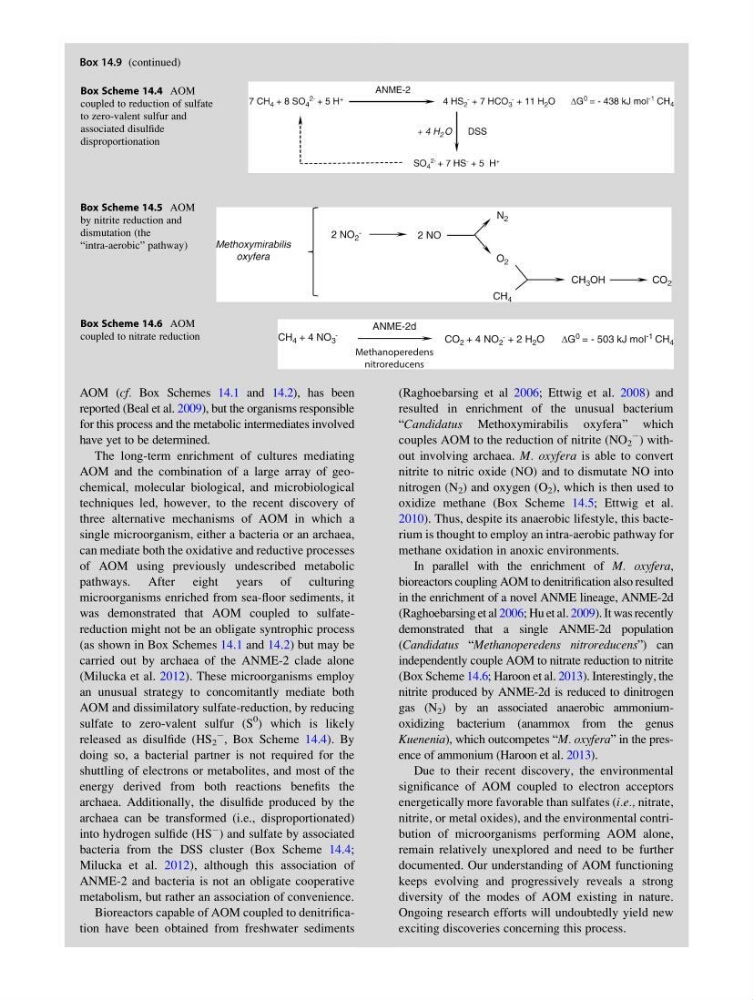
(Milucka et al. 2012). These microorganisms employ
an unusual strategy to concomitantly mediate both
AOM and dissimilatory sulfate-reduction, by reducing
sulfate to zero-valent sulfur (S
0 ) which is likely
released as disulfide (HS 2
À , Box Scheme 14.4). By
doing so, a bacterial partner is not required for the
shuttling of electrons or metabolites, and most of the
energy derived from both reactions benefits the
archaea. Additionally, the disulfide produced by the
archaea can be transformed (i.e., disproportionated)
into hydrogen sulfide (HS
À ) and sulfate by associated
bacteria from the DSS cluster (Box Scheme 14.4;
Milucka et al. 2012), although this association of
ANME-2 and bacteria is not an obligate cooperative
metabolism, but rather an association of convenience.
Bioreactors capable of AOM coupled to denitrification have been obtained from freshwater sediments
(continued)
(Raghoebarsing et al 2006; Ettwig et al. 2008) and
resulted in enrichment of the unusual bacterium
“Candidatus Methoxymirabilis oxyfera” which
couples AOM to the reduction of nitrite (NO 2
À ) without involving archaea. M. oxyfera is able to convert
nitrite to nitric oxide (NO) and to dismutate NO into
nitrogen (N 2 ) and oxygen (O 2 ), which is then used to
oxidize methane (Box Scheme 14.5; Ettwig et al.
2010). Thus, despite its anaerobic lifestyle, this bacterium is thought to employ an intra-aerobic pathway for
methane oxidation in anoxic environments.
In parallel with the enrichment of M. oxyfera,
bioreactors coupling AOM to denitrification also resulted
in the enrichment of a novel ANME lineage, ANME-2d
(Raghoebarsing et al 2006; Hu et al. 2009). It was recently
demonstrated that a single ANME-2d population
(Candidatus “Methanoperedens nitroreducens”) can
independently couple AOM to nitrate reduction to nitrite
(Box Scheme 14.6; Haroon et al. 2013). Interestingly, the
nitrite produced by ANME-2d is reduced to dinitrogen
gas (N 2 ) by an associated anaerobic ammoniumoxidizing bacterium (anammox from the genus
Kuenenia), which outcompetes “M. oxyfera” in the presence of ammonium (Haroon et al. 2013).
Due to their recent discovery, the environmental
significance of AOM coupled to electron acceptors
energetically more favorable than sulfates (i.e., nitrate,
nitrite, or metal oxides), and the environmental contribution of microorganisms performing AOM alone,
remain relatively unexplored and need to be further
documented. Our understanding of AOM functioning
keeps evolving and progressively reveals a strong
diversity of the modes of AOM existing in nature.
Ongoing research efforts will undoubtedly yield new
exciting discoveries concerning this process.
Box Scheme 14.4 AOM
coupled to reduction of sulfate
to zero-valent sulfur and
associated disulfide
disproportionation
Box Scheme 14.5 AOM
by nitrite reduction and
dismutation (the
“intra-aerobic” pathway)
CH 4 + 4 NO 3
-
DG 0 = - 503 kJ mol -1 CH 4
ANME-2d
CO 2 + 4 NO 2
- + 2 H 2 O
Methanoperedens
nitroreducens
Box Scheme 14.6 AOM
coupled to nitrate reduction
ANME-2
7 CH4 + 8 804 2 - + 5 H+ - - - - - - - - - 4 HS 2 - + 7 HC0 3 - + 11 H 2 0
•4H,O j DSS
+ I
I
I
I
I
I
L--------------------- SOl-+ 7 HS- + 5 H+
Methoxymirabilis
oxyfera
2N0 2 - ~