

Assimilation of Organic Carbon into the Microbial
Biomass
While some carbon of organic substrates used for redox
reactions is ultimately lost as CO 2 , another part is
assimilated and used for the growth of micro-organisms
(Fig. 14.17, pathway 5). The efficiency of substrate utilization, calculated as the ratio between the quantity of carbon
assimilated to the total amount of carbon used, is higher
for simple sugars compared with polymers or to more
recalcitrant compounds such as lignin. This efficiency
is generally substantial for fungi (35–55 %), low for
aerobic bacteria (<10 %), and even lower for anaerobic
bacteria (<5 %).
Nitrogen and carbon are essential components of biomass
and their assimilation is essential for microbial growth
(Fig. 14.1), with a mean stoichiometric ratio of 1 nitrogen
for 10 carbon atoms. Thus, for an utilization efficiency of
50 %, the consumption of a substrate containing 20 atoms
of carbon (of which 10 will be oxidized as CO 2 and 10
assimilated) requires one atom of nitrogen. Therefore, if
the C:N ratio of the substrate is less than 20, extra nitrogen
from the external medium is needed (nitrogen immobilization by micro-organisms). In contrast, if the C:N ratio of the
substrate is comprised between 12 and 15, the microbial
community will release nitrogen in the surrounding medium
(net mineralization). The quality of organic matter based on
C:N ratio thus ultimately determines both the rate of its
degradation and the intensity of the competition between
heterotrophic microorganisms and plants for nutrients: The
two communities are typically in competition for C:N ratios
between 15 and 20, while heterotrophic microorganisms
supply plants with nutrients for substrate C:N ratios less
than 15.
Humus Formation
Humus results from the transformation of organic matter
under the influence of biotic and abiotic processes. It is a
complex material, more heterogeneous than lignin, and
chemically poorly defined. The fraction of organic material
that is not mineralized or assimilated (consisting mainly
of tannins, waxes, suberin, polyphenolic residues of lignin,
etc.) constitutes the phenolic precursors of humus. These
precursors include reactive centers from which binding
products from microbial metabolism or bodies (protein
residues, nucleic acids) condense spontaneously or under
the action of enzymes to gradually become humus
(Figs. 14.17, 14.20). This process involves several steps,
including the formation of highly reactive compounds called
quinones under the action of polyphenoloxidase and
peroxidases (enzymes synthesized by fungi to degrade
lignin).
Box 14.5 (continued)
and 140 mg C.kg
À1 of fresh organic C input remained
in low and high nutrient soils, respectively.
In particular, the input of exogenous C stimulated
heterotrophic microorganisms in both soils leading to
the decomposition of endogenous stable OM: It is the
so-called priming effect. This effect was higher in the
LNS than in the HNS, resulting in a negative balance of
total C in nutrient-poor soil. In LNS, after the fresh C
input, the total soil C content decreased, whereas in HNS
the balance was positive and the soil further stored C.
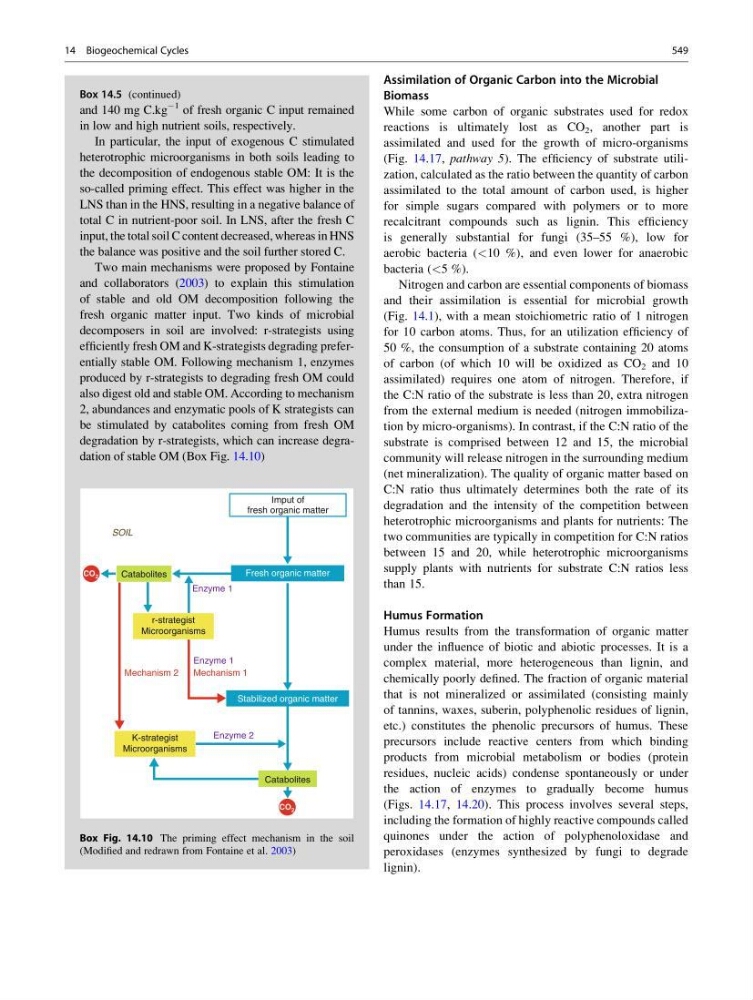
Two main mechanisms were proposed by Fontaine
and collaborators (2003) to explain this stimulation
of stable and old OM decomposition following the
fresh organic matter input. Two kinds of microbial
decomposers in soil are involved: r-strategists using
efficiently fresh OM and K-strategists degrading preferentially stable OM. Following mechanism 1, enzymes
produced by r-strategists to degrading fresh OM could
also digest old and stable OM. According to mechanism
2, abundances and enzymatic pools of K strategists can
be stimulated by catabolites coming from fresh OM
degradation by r-strategists, which can increase degradation of stable OM (Box Fig. 14.10)
K-strategist
Microorganisms
r-strategist
Microorganisms
Enzyme 1
Enzyme 1
Enzyme 2
Catabolites
Catabolites
Mechanism 1
Mechanism 2
Imput of
fresh organic matter
Stabilized organic matter
Fresh organic matter
SOIL
CO 2
CO 2
Box Fig. 14.10 The priming effect mechanism in the soil
(Modified and redrawn from Fontaine et al. 2003)
14 Biogeochemical Cycles
549
Biomass
While some carbon of organic substrates used for redox
reactions is ultimately lost as CO 2 , another part is
assimilated and used for the growth of micro-organisms
(Fig. 14.17, pathway 5). The efficiency of substrate utilization, calculated as the ratio between the quantity of carbon
assimilated to the total amount of carbon used, is higher
for simple sugars compared with polymers or to more
recalcitrant compounds such as lignin. This efficiency
is generally substantial for fungi (35–55 %), low for
aerobic bacteria (<10 %), and even lower for anaerobic
bacteria (<5 %).
Nitrogen and carbon are essential components of biomass
and their assimilation is essential for microbial growth
(Fig. 14.1), with a mean stoichiometric ratio of 1 nitrogen
for 10 carbon atoms. Thus, for an utilization efficiency of
50 %, the consumption of a substrate containing 20 atoms
of carbon (of which 10 will be oxidized as CO 2 and 10
assimilated) requires one atom of nitrogen. Therefore, if
the C:N ratio of the substrate is less than 20, extra nitrogen
from the external medium is needed (nitrogen immobilization by micro-organisms). In contrast, if the C:N ratio of the
substrate is comprised between 12 and 15, the microbial
community will release nitrogen in the surrounding medium
(net mineralization). The quality of organic matter based on
C:N ratio thus ultimately determines both the rate of its
degradation and the intensity of the competition between
heterotrophic microorganisms and plants for nutrients: The
two communities are typically in competition for C:N ratios
between 15 and 20, while heterotrophic microorganisms
supply plants with nutrients for substrate C:N ratios less
than 15.
Humus Formation
Humus results from the transformation of organic matter
under the influence of biotic and abiotic processes. It is a
complex material, more heterogeneous than lignin, and
chemically poorly defined. The fraction of organic material
that is not mineralized or assimilated (consisting mainly
of tannins, waxes, suberin, polyphenolic residues of lignin,
etc.) constitutes the phenolic precursors of humus. These
precursors include reactive centers from which binding
products from microbial metabolism or bodies (protein
residues, nucleic acids) condense spontaneously or under
the action of enzymes to gradually become humus
(Figs. 14.17, 14.20). This process involves several steps,
including the formation of highly reactive compounds called
quinones under the action of polyphenoloxidase and
peroxidases (enzymes synthesized by fungi to degrade
lignin).
Box 14.5 (continued)
and 140 mg C.kg
À1 of fresh organic C input remained
in low and high nutrient soils, respectively.
In particular, the input of exogenous C stimulated
heterotrophic microorganisms in both soils leading to
the decomposition of endogenous stable OM: It is the
so-called priming effect. This effect was higher in the
LNS than in the HNS, resulting in a negative balance of
total C in nutrient-poor soil. In LNS, after the fresh C
input, the total soil C content decreased, whereas in HNS
the balance was positive and the soil further stored C.
Two main mechanisms were proposed by Fontaine
and collaborators (2003) to explain this stimulation
of stable and old OM decomposition following the
fresh organic matter input. Two kinds of microbial
decomposers in soil are involved: r-strategists using
efficiently fresh OM and K-strategists degrading preferentially stable OM. Following mechanism 1, enzymes
produced by r-strategists to degrading fresh OM could
also digest old and stable OM. According to mechanism
2, abundances and enzymatic pools of K strategists can
be stimulated by catabolites coming from fresh OM
degradation by r-strategists, which can increase degradation of stable OM (Box Fig. 14.10)
K-strategist
Microorganisms
r-strategist
Microorganisms
Enzyme 1
Enzyme 1
Enzyme 2
Catabolites
Catabolites
Mechanism 1
Mechanism 2
Imput of
fresh organic matter
Stabilized organic matter
Fresh organic matter
SOIL
CO 2
CO 2
Box Fig. 14.10 The priming effect mechanism in the soil
(Modified and redrawn from Fontaine et al. 2003)
14 Biogeochemical Cycles
549