

and fungi that usually have several endo- or exo-cellulases,
cellobiohydrolases and β-glucosidases acting in synergy
as extracellular enzymes. These enzymes ensure the breakdown of cellulose chains, the release of cellobiose and,
ultimately, of molecules of glucose. Some organisms such
as fungi have a broad spectrum of enzymes while others are
only able to produce few enzymes but take advantage of
microbial consortia to gain their energy from the decomposition of cellulose. Similarly, the decomposition of
hemicelluloses involves the action of extracellular enzymes,
but these are more diverse. Indeed, hemicelluloses are more
complex molecules compared with cellulose, including
different hexoses, pentoses, and uronic acids. The release
of simple and soluble sugars from the degradation of
hemicelluloses and cellulose allows the development of a
microbial community that differs from that typical of Phase I
and is subjected to enhanced competition among microorganisms. The end-products of the degradation of cellulose
act as inhibitors of the activity of cellulases. By consuming
these products, non-cellulolytic microorganisms ensure the
completion of cellulose mineralization by cellulolytic
organisms. Other important polymers degraded during the
decomposition of soil organic matter are starch (linear or
branched polymers of glucose molecules degraded by extracellular amylases produced by bacteria and fungi), chitin
(linear polymer of N-acetylglucosamine from fungal cell
walls and exoskeletons of arthropods) and peptidoglycans
(polymers of N-acetylglucosamine and N-acetylmuramic
acid from bacterial cell walls).
Some compounds such as lignin (which represents
5–30 % of the plant tissues), waxes, resins etc. are heterogeneous and recalcitrant to decomposition. Their decomposition occurs during a third phase and is typically slow and
often incomplete even under oxic conditions. The decomposition of these recalcitrant compounds requires the
stimulating presence of simple sugars acting as “starters”
for the decomposition process, i.e., the so-called priming
effect (Fontaine et al. 2003). This is a key mechanism for
understanding and predicting phenomena of carbon storage/
release from soil (Box 14.5). Decomposition of the most
recalcitrant compounds is essentially done by fungi (white
rot) in the groups of basidiomycetes and ascomycetes. From
an evolutionary point of view, the biochemical heterogeneity
of recalcitrant compounds probably has limited the synthesis
of specific enzymes involved in their biodegradation, which
involves the action of enzymes with broad-spectrum activity, primarily peroxidases and laccases.
The activity of these extracellular enzymes can be heavily
modified by their attachment/adsorption to the surface of
roots or micro-organisms which often favor their activity,
or to the surface of mineral particles such as clays which
often restrict their activity. The quality of the fresh organic
matter entering the soil ecosystem is often a major factor
controlling the rate of the decomposition of recalcitrant
compounds, other factors being especially climatic ones
(temperature and humidity).
In conclusion, fungi play an essential role in the above
various steps of the decomposition of litter. Fungal
successions are generally observed during the 3 phases of
decomposition (Fig. 14.19), thereby emphasizing the more
or less specialization of fungal species involved in the
decomposition process (Koide et al. 2005). It is currently
possible to identify fungal and prokaryotic taxa involved in
the different degradation phases in soil or compost samples,
by molecular biology approaches using DNA extracted from
environmental samples (Danon et al. 2008).
Box 14.5: Stimulation of Decomposition of Native Soil
Organic Matter by the Supply of Fresh Organic Matter:
The Priming Effect
Franck Poly and Xavier Le Roux
A positive relationship may be expected between the
inputs of fresh organic matter (OM) to the soil and the
carbon (C) storage by the soil. However, this relationship is rarely observed in field conditions; fresh OM
and soil C content are generally not correlated or
negatively correlated. A lab experiment demonstrated
that in a nutrient-poor soil, a fresh OM input (
13
C
labeled cellulose) can lead to a reduction of soil C
stock (Fontaine et al. 2004).
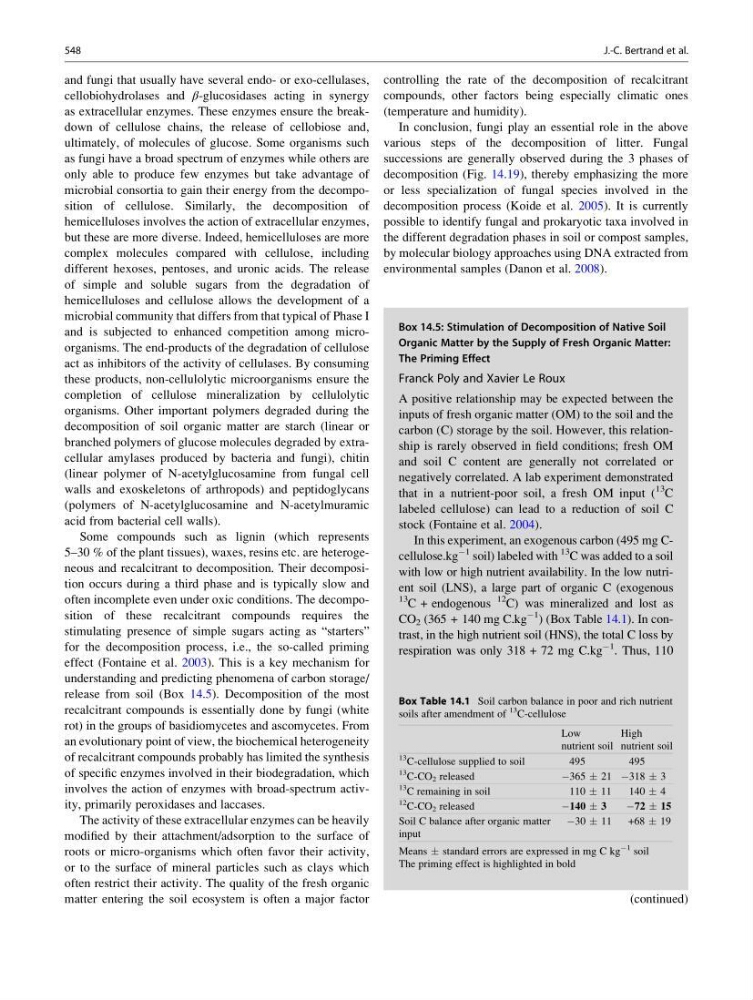
In this experiment, an exogenous carbon (495 mg Ccellulose.kg
À1 soil) labeled with
13
C was added to a soil
with low or high nutrient availability. In the low nutrient soil (LNS), a large part of organic C (exogenous
13
C + endogenous
12
C) was mineralized and lost as
CO 2 (365 + 140 mg C.kg
À1
) (Box Table 14.1). In contrast, in the high nutrient soil (HNS), the total C loss by
respiration was only 318 + 72 mg C.kg
À1
. Thus, 110
(continued)
Box Table 14.1 Soil carbon balance in poor and rich nutrient
soils after amendment of
13
C-cellulose
Low
nutrient soil
High
nutrient soil
13
C-cellulose supplied to soil
495
495
13
C-CO 2 released
À365 Æ 21 À318 Æ 3
13
C remaining in soil
110 Æ 11
140 Æ 4
12
C-CO 2 released
À140 Æ 3
À72 Æ 15
Soil C balance after organic matter
input
À30 Æ 11
+68 Æ 19
Means Æ standard errors are expressed in mg C kg
À1 soil
The priming effect is highlighted in bold
548
J.-C. Bertrand et al.
cellobiohydrolases and β-glucosidases acting in synergy
as extracellular enzymes. These enzymes ensure the breakdown of cellulose chains, the release of cellobiose and,
ultimately, of molecules of glucose. Some organisms such
as fungi have a broad spectrum of enzymes while others are
only able to produce few enzymes but take advantage of
microbial consortia to gain their energy from the decomposition of cellulose. Similarly, the decomposition of
hemicelluloses involves the action of extracellular enzymes,
but these are more diverse. Indeed, hemicelluloses are more
complex molecules compared with cellulose, including
different hexoses, pentoses, and uronic acids. The release
of simple and soluble sugars from the degradation of
hemicelluloses and cellulose allows the development of a
microbial community that differs from that typical of Phase I
and is subjected to enhanced competition among microorganisms. The end-products of the degradation of cellulose
act as inhibitors of the activity of cellulases. By consuming
these products, non-cellulolytic microorganisms ensure the
completion of cellulose mineralization by cellulolytic
organisms. Other important polymers degraded during the
decomposition of soil organic matter are starch (linear or
branched polymers of glucose molecules degraded by extracellular amylases produced by bacteria and fungi), chitin
(linear polymer of N-acetylglucosamine from fungal cell
walls and exoskeletons of arthropods) and peptidoglycans
(polymers of N-acetylglucosamine and N-acetylmuramic
acid from bacterial cell walls).
Some compounds such as lignin (which represents
5–30 % of the plant tissues), waxes, resins etc. are heterogeneous and recalcitrant to decomposition. Their decomposition occurs during a third phase and is typically slow and
often incomplete even under oxic conditions. The decomposition of these recalcitrant compounds requires the
stimulating presence of simple sugars acting as “starters”
for the decomposition process, i.e., the so-called priming
effect (Fontaine et al. 2003). This is a key mechanism for
understanding and predicting phenomena of carbon storage/
release from soil (Box 14.5). Decomposition of the most
recalcitrant compounds is essentially done by fungi (white
rot) in the groups of basidiomycetes and ascomycetes. From
an evolutionary point of view, the biochemical heterogeneity
of recalcitrant compounds probably has limited the synthesis
of specific enzymes involved in their biodegradation, which
involves the action of enzymes with broad-spectrum activity, primarily peroxidases and laccases.
The activity of these extracellular enzymes can be heavily
modified by their attachment/adsorption to the surface of
roots or micro-organisms which often favor their activity,
or to the surface of mineral particles such as clays which
often restrict their activity. The quality of the fresh organic
matter entering the soil ecosystem is often a major factor
controlling the rate of the decomposition of recalcitrant
compounds, other factors being especially climatic ones
(temperature and humidity).
In conclusion, fungi play an essential role in the above
various steps of the decomposition of litter. Fungal
successions are generally observed during the 3 phases of
decomposition (Fig. 14.19), thereby emphasizing the more
or less specialization of fungal species involved in the
decomposition process (Koide et al. 2005). It is currently
possible to identify fungal and prokaryotic taxa involved in
the different degradation phases in soil or compost samples,
by molecular biology approaches using DNA extracted from
environmental samples (Danon et al. 2008).
Box 14.5: Stimulation of Decomposition of Native Soil
Organic Matter by the Supply of Fresh Organic Matter:
The Priming Effect
Franck Poly and Xavier Le Roux
A positive relationship may be expected between the
inputs of fresh organic matter (OM) to the soil and the
carbon (C) storage by the soil. However, this relationship is rarely observed in field conditions; fresh OM
and soil C content are generally not correlated or
negatively correlated. A lab experiment demonstrated
that in a nutrient-poor soil, a fresh OM input (
13
C
labeled cellulose) can lead to a reduction of soil C
stock (Fontaine et al. 2004).
In this experiment, an exogenous carbon (495 mg Ccellulose.kg
À1 soil) labeled with
13
C was added to a soil
with low or high nutrient availability. In the low nutrient soil (LNS), a large part of organic C (exogenous
13
C + endogenous
12
C) was mineralized and lost as
CO 2 (365 + 140 mg C.kg
À1
) (Box Table 14.1). In contrast, in the high nutrient soil (HNS), the total C loss by
respiration was only 318 + 72 mg C.kg
À1
. Thus, 110
(continued)
Box Table 14.1 Soil carbon balance in poor and rich nutrient
soils after amendment of
13
C-cellulose
Low
nutrient soil
High
nutrient soil
13
C-cellulose supplied to soil
495
495
13
C-CO 2 released
À365 Æ 21 À318 Æ 3
13
C remaining in soil
110 Æ 11
140 Æ 4
12
C-CO 2 released
À140 Æ 3
À72 Æ 15
Soil C balance after organic matter
input
À30 Æ 11
+68 Æ 19
Means Æ standard errors are expressed in mg C kg
À1 soil
The priming effect is highlighted in bold
548
J.-C. Bertrand et al.