

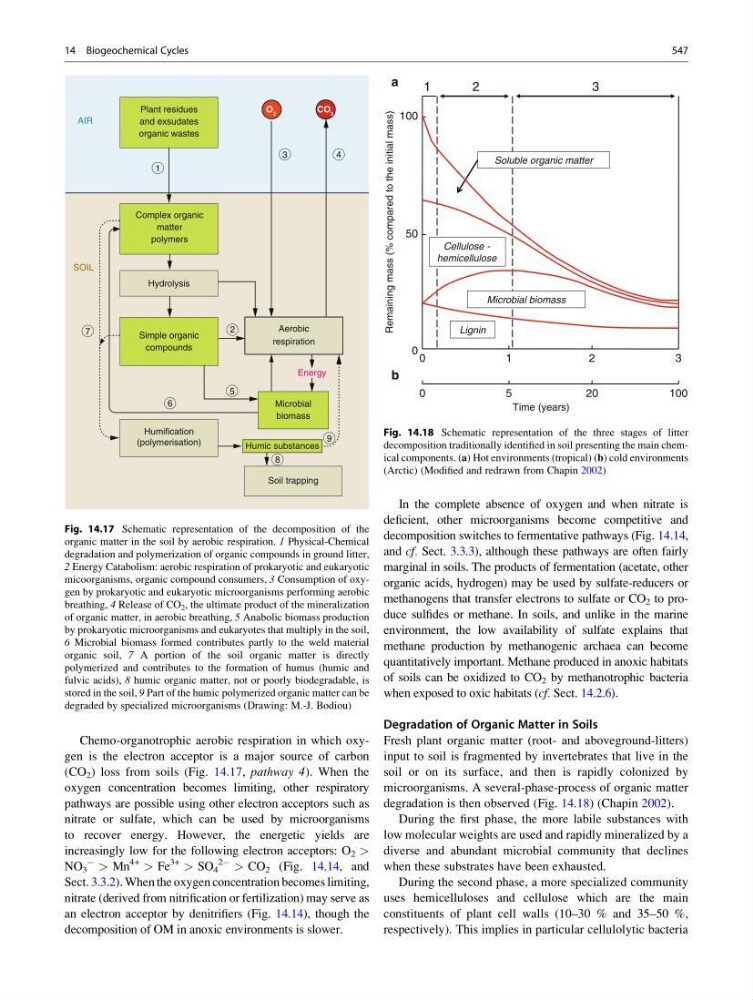
Chemo-organotrophic aerobic respiration in which oxygen is the electron acceptor is a major source of carbon
(CO 2 ) loss from soils (Fig. 14.17, pathway 4). When the
oxygen concentration becomes limiting, other respiratory
pathways are possible using other electron acceptors such as
nitrate or sulfate, which can be used by microorganisms
to recover energy. However, the energetic yields are
increasingly low for the following electron acceptors: O 2 >
NO 3
À
> Mn
4+
> Fe
3+
> SO 4
2À
> CO 2 (Fig. 14.14, and
Sect. 3.3.2). When the oxygen concentration becomes limiting,
nitrate (derived from nitrification or fertilization) may serve as
an electron acceptor by denitrifiers (Fig. 14.14), though the
decomposition of OM in anoxic environments is slower.
In the complete absence of oxygen and when nitrate is
deficient, other microorganisms become competitive and
decomposition switches to fermentative pathways (Fig. 14.14,
and cf. Sect. 3.3.3), although these pathways are often fairly
marginal in soils. The products of fermentation (acetate, other
organic acids, hydrogen) may be used by sulfate-reducers or
methanogens that transfer electrons to sulfate or CO 2 to produce sulfides or methane. In soils, and unlike in the marine
environment, the low availability of sulfate explains that
methane production by methanogenic archaea can become
quantitatively important. Methane produced in anoxic habitats
of soils can be oxidized to CO 2 by methanotrophic bacteria
when exposed to oxic habitats (cf. Sect. 14.2.6).
Degradation of Organic Matter in Soils
Fresh plant organic matter (root- and aboveground-litters)
input to soil is fragmented by invertebrates that live in the
soil or on its surface, and then is rapidly colonized by
microorganisms. A several-phase-process of organic matter
degradation is then observed (Fig. 14.18) (Chapin 2002).
During the first phase, the more labile substances with
low molecular weights are used and rapidly mineralized by a
diverse and abundant microbial community that declines
when these substrates have been exhausted.
During the second phase, a more specialized community
uses hemicelluloses and cellulose which are the main
constituents of plant cell walls (10–30 % and 35–50 %,
respectively). This implies in particular cellulolytic bacteria
O 2
CO 2
AIR
SOIL
1
2
3
4
5
6
7
8
9
Energy
Complex organic
matter
polymers
Plant residues
and exsudates
organic wastes
Hydrolysis
Simple organic
compounds
Humification
(polymerisation)
Humic substances
Soil trapping
Microbial
biomass
Aerobic
respiration
Fig. 14.17 Schematic representation of the decomposition of the
organic matter in the soil by aerobic respiration. 1 Physical-Chemical
degradation and polymerization of organic compounds in ground litter,
2 Energy Catabolism: aerobic respiration of prokaryotic and eukaryotic
micoorganisms, organic compound consumers, 3 Consumption of oxygen by prokaryotic and eukaryotic microorganisms performing aerobic
breathing, 4 Release of CO 2 , the ultimate product of the mineralization
of organic matter, in aerobic breathing, 5 Anabolic biomass production
by prokaryotic microorganisms and eukaryotes that multiply in the soil,
6 Microbial biomass formed contributes partly to the weld material
organic soil, 7 A portion of the soil organic matter is directly
polymerized and contributes to the formation of humus (humic and
fulvic acids), 8 humic organic matter, not or poorly biodegradable, is
stored in the soil, 9 Part of the humic polymerized organic matter can be
degraded by specialized microorganisms (Drawing: M.-J. Bodiou)
100
0
50
0
5
0
3
2
1
100
20
b
a
3
2
1
Remaining mass (% compared to the initial mass)
Time (years)
Soluble organic matter
Cellulose -
hemicellulose
Microbial biomass
Lignin
Fig. 14.18 Schematic representation of the three stages of litter
decomposition traditionally identified in soil presenting the main chemical components. (a) Hot environments (tropical) (b) cold environments
(Arctic) (Modified and redrawn from Chapin 2002)
14 Biogeochemical Cycles
547
(CO 2 ) loss from soils (Fig. 14.17, pathway 4). When the
oxygen concentration becomes limiting, other respiratory
pathways are possible using other electron acceptors such as
nitrate or sulfate, which can be used by microorganisms
to recover energy. However, the energetic yields are
increasingly low for the following electron acceptors: O 2 >
NO 3
À
> Mn
4+
> Fe
3+
> SO 4
2À
> CO 2 (Fig. 14.14, and
Sect. 3.3.2). When the oxygen concentration becomes limiting,
nitrate (derived from nitrification or fertilization) may serve as
an electron acceptor by denitrifiers (Fig. 14.14), though the
decomposition of OM in anoxic environments is slower.
In the complete absence of oxygen and when nitrate is
deficient, other microorganisms become competitive and
decomposition switches to fermentative pathways (Fig. 14.14,
and cf. Sect. 3.3.3), although these pathways are often fairly
marginal in soils. The products of fermentation (acetate, other
organic acids, hydrogen) may be used by sulfate-reducers or
methanogens that transfer electrons to sulfate or CO 2 to produce sulfides or methane. In soils, and unlike in the marine
environment, the low availability of sulfate explains that
methane production by methanogenic archaea can become
quantitatively important. Methane produced in anoxic habitats
of soils can be oxidized to CO 2 by methanotrophic bacteria
when exposed to oxic habitats (cf. Sect. 14.2.6).
Degradation of Organic Matter in Soils
Fresh plant organic matter (root- and aboveground-litters)
input to soil is fragmented by invertebrates that live in the
soil or on its surface, and then is rapidly colonized by
microorganisms. A several-phase-process of organic matter
degradation is then observed (Fig. 14.18) (Chapin 2002).
During the first phase, the more labile substances with
low molecular weights are used and rapidly mineralized by a
diverse and abundant microbial community that declines
when these substrates have been exhausted.
During the second phase, a more specialized community
uses hemicelluloses and cellulose which are the main
constituents of plant cell walls (10–30 % and 35–50 %,
respectively). This implies in particular cellulolytic bacteria
O 2
CO 2
AIR
SOIL
1
2
3
4
5
6
7
8
9
Energy
Complex organic
matter
polymers
Plant residues
and exsudates
organic wastes
Hydrolysis
Simple organic
compounds
Humification
(polymerisation)
Humic substances
Soil trapping
Microbial
biomass
Aerobic
respiration
Fig. 14.17 Schematic representation of the decomposition of the
organic matter in the soil by aerobic respiration. 1 Physical-Chemical
degradation and polymerization of organic compounds in ground litter,
2 Energy Catabolism: aerobic respiration of prokaryotic and eukaryotic
micoorganisms, organic compound consumers, 3 Consumption of oxygen by prokaryotic and eukaryotic microorganisms performing aerobic
breathing, 4 Release of CO 2 , the ultimate product of the mineralization
of organic matter, in aerobic breathing, 5 Anabolic biomass production
by prokaryotic microorganisms and eukaryotes that multiply in the soil,
6 Microbial biomass formed contributes partly to the weld material
organic soil, 7 A portion of the soil organic matter is directly
polymerized and contributes to the formation of humus (humic and
fulvic acids), 8 humic organic matter, not or poorly biodegradable, is
stored in the soil, 9 Part of the humic polymerized organic matter can be
degraded by specialized microorganisms (Drawing: M.-J. Bodiou)
100
0
50
0
5
0
3
2
1
100
20
b
a
3
2
1
Remaining mass (% compared to the initial mass)
Time (years)
Soluble organic matter
Cellulose -
hemicellulose
Microbial biomass
Lignin
Fig. 14.18 Schematic representation of the three stages of litter
decomposition traditionally identified in soil presenting the main chemical components. (a) Hot environments (tropical) (b) cold environments
(Arctic) (Modified and redrawn from Chapin 2002)
14 Biogeochemical Cycles
547