

14.2.5.3 Degradation of Organic Matter in Soils
(the Plant – Microorganisms – Soil
System)
Main Metabolic Pathways of the Carbon Cycle in Soils
Carbon cycling in soils occurs across a mosaic of oxic and
more or less anoxic habitats whose distribution varies in
space (e.g., oxygen gradients observed between the surface
and the interior of soil aggregates). In addition, some
habitats are subject to important temporal fluctuations.
The soil macroporosity may experience an oscillation of
oxic/anoxic conditions in relation to major flood events,
rises of groundwater, or more generally precipitation
regime. Soil is more heterogeneous than sediment, and
several types of metabolisms may thus complement each
other over time or across microhabitats with different levels
of oxygenation.
Box 14.4 (continued)
Termites and Methane (Brauman et al. 2008)
If the earthworms constitute the principal biomass in
temperate soils, they are in competition, in the tropical
soils, with termites whose density can reach 10,000
ind.m
2 . Lavelle (2002) indicated that termite nest
recover almost 10 % of African soils and constitute
important microbial oasis. The relationship termitesmicroorganisms is complex and highly dependent of
the trophic affiliation (wood feeders, fungus growing
termites, soil feeders). However, among these different
feeding habits, only the soil feeding termites (50 % of
the 2,600 species described) live and feed on the soil;
thus, they are considered, through their foraging
activities, as true soil engineers comparable to
earthworms. If the environmental conditions of the
digestive tube are particularly favorable to microbial
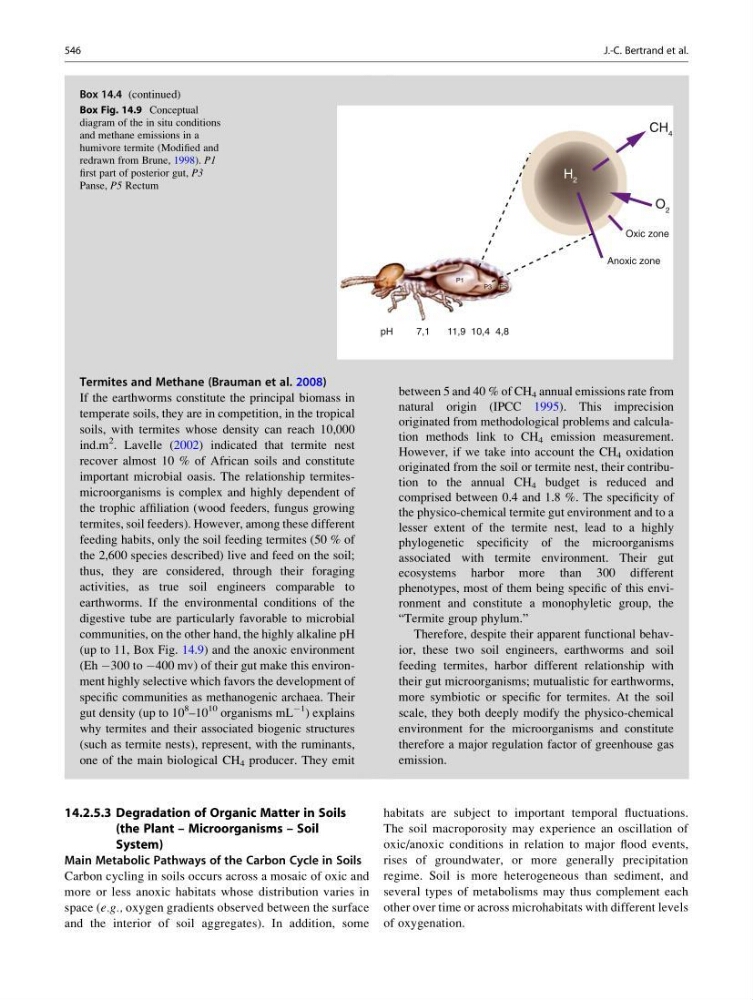
communities, on the other hand, the highly alkaline pH
(up to 11, Box Fig. 14.9) and the anoxic environment
(Eh À300 to À400 mv) of their gut make this environment highly selective which favors the development of
specific communities as methanogenic archaea. Their
gut density (up to 10
8 –10
10 organisms mL
À1 ) explains
why termites and their associated biogenic structures
(such as termite nests), represent, with the ruminants,
one of the main biological CH 4 producer. They emit
(continued)
Box 14.4 (continued)
between 5 and 40 % of CH 4 annual emissions rate from
natural origin (IPCC 1995). This imprecision
originated from methodological problems and calculation methods link to CH 4 emission measurement.
However, if we take into account the CH 4 oxidation
originated from the soil or termite nest, their contribution to the annual CH 4 budget is reduced and
comprised between 0.4 and 1.8 %. The specificity of
the physico-chemical termite gut environment and to a
lesser extent of the termite nest, lead to a highly
phylogenetic specificity of the microorganisms
associated with termite environment. Their gut
ecosystems harbor more than 300 different
phenotypes, most of them being specific of this environment and constitute a monophyletic group, the
“Termite group phylum.”
Therefore, despite their apparent functional behavior, these two soil engineers, earthworms and soil
feeding termites, harbor different relationship with
their gut microorganisms; mutualistic for earthworms,
more symbiotic or specific for termites. At the soil
scale, they both deeply modify the physico-chemical
environment for the microorganisms and constitute
therefore a major regulation factor of greenhouse gas
emission.
P1
P3 P5
H 2
CH 4
Oxic zone
Anoxic zone
O 2
pH
7,1
11,9 10,4 4,8
Box Fig. 14.9 Conceptual
diagram of the in situ conditions
and methane emissions in a
humivore termite (Modified and
redrawn from Brune, 1998). P1
first part of posterior gut, P3
Panse, P5 Rectum
546
J.-C. Bertrand et al.
(the Plant – Microorganisms – Soil
System)
Main Metabolic Pathways of the Carbon Cycle in Soils
Carbon cycling in soils occurs across a mosaic of oxic and
more or less anoxic habitats whose distribution varies in
space (e.g., oxygen gradients observed between the surface
and the interior of soil aggregates). In addition, some
habitats are subject to important temporal fluctuations.
The soil macroporosity may experience an oscillation of
oxic/anoxic conditions in relation to major flood events,
rises of groundwater, or more generally precipitation
regime. Soil is more heterogeneous than sediment, and
several types of metabolisms may thus complement each
other over time or across microhabitats with different levels
of oxygenation.
Box 14.4 (continued)
Termites and Methane (Brauman et al. 2008)
If the earthworms constitute the principal biomass in
temperate soils, they are in competition, in the tropical
soils, with termites whose density can reach 10,000
ind.m
2 . Lavelle (2002) indicated that termite nest
recover almost 10 % of African soils and constitute
important microbial oasis. The relationship termitesmicroorganisms is complex and highly dependent of
the trophic affiliation (wood feeders, fungus growing
termites, soil feeders). However, among these different
feeding habits, only the soil feeding termites (50 % of
the 2,600 species described) live and feed on the soil;
thus, they are considered, through their foraging
activities, as true soil engineers comparable to
earthworms. If the environmental conditions of the
digestive tube are particularly favorable to microbial
communities, on the other hand, the highly alkaline pH
(up to 11, Box Fig. 14.9) and the anoxic environment
(Eh À300 to À400 mv) of their gut make this environment highly selective which favors the development of
specific communities as methanogenic archaea. Their
gut density (up to 10
8 –10
10 organisms mL
À1 ) explains
why termites and their associated biogenic structures
(such as termite nests), represent, with the ruminants,
one of the main biological CH 4 producer. They emit
(continued)
Box 14.4 (continued)
between 5 and 40 % of CH 4 annual emissions rate from
natural origin (IPCC 1995). This imprecision
originated from methodological problems and calculation methods link to CH 4 emission measurement.
However, if we take into account the CH 4 oxidation
originated from the soil or termite nest, their contribution to the annual CH 4 budget is reduced and
comprised between 0.4 and 1.8 %. The specificity of
the physico-chemical termite gut environment and to a
lesser extent of the termite nest, lead to a highly
phylogenetic specificity of the microorganisms
associated with termite environment. Their gut
ecosystems harbor more than 300 different
phenotypes, most of them being specific of this environment and constitute a monophyletic group, the
“Termite group phylum.”
Therefore, despite their apparent functional behavior, these two soil engineers, earthworms and soil
feeding termites, harbor different relationship with
their gut microorganisms; mutualistic for earthworms,
more symbiotic or specific for termites. At the soil
scale, they both deeply modify the physico-chemical
environment for the microorganisms and constitute
therefore a major regulation factor of greenhouse gas
emission.
P1
P3 P5
H 2
CH 4
Oxic zone
Anoxic zone
O 2
pH
7,1
11,9 10,4 4,8
Box Fig. 14.9 Conceptual
diagram of the in situ conditions
and methane emissions in a
humivore termite (Modified and
redrawn from Brune, 1998). P1
first part of posterior gut, P3
Panse, P5 Rectum
546
J.-C. Bertrand et al.