

100
0
50
0
1 2
1 8
6
Remaining mass
(% of initial mass)
Holocellulose
Polyphenols
Soluble carbon
hydrates
Lignin
Time (months)
b
Rhytismataceae
Pestalotiopsis guepini
Coelomyceta sp.1
Khuskia oryzae
(phase Nigrospora)
Xylaria sp.
Geniculisporium
sp. 1
Eupenicillium sp.
Geniculosporium
sp. 2
0
1 2
1 8
6
Time (months)
Phases of decomposition
II
I
III
a
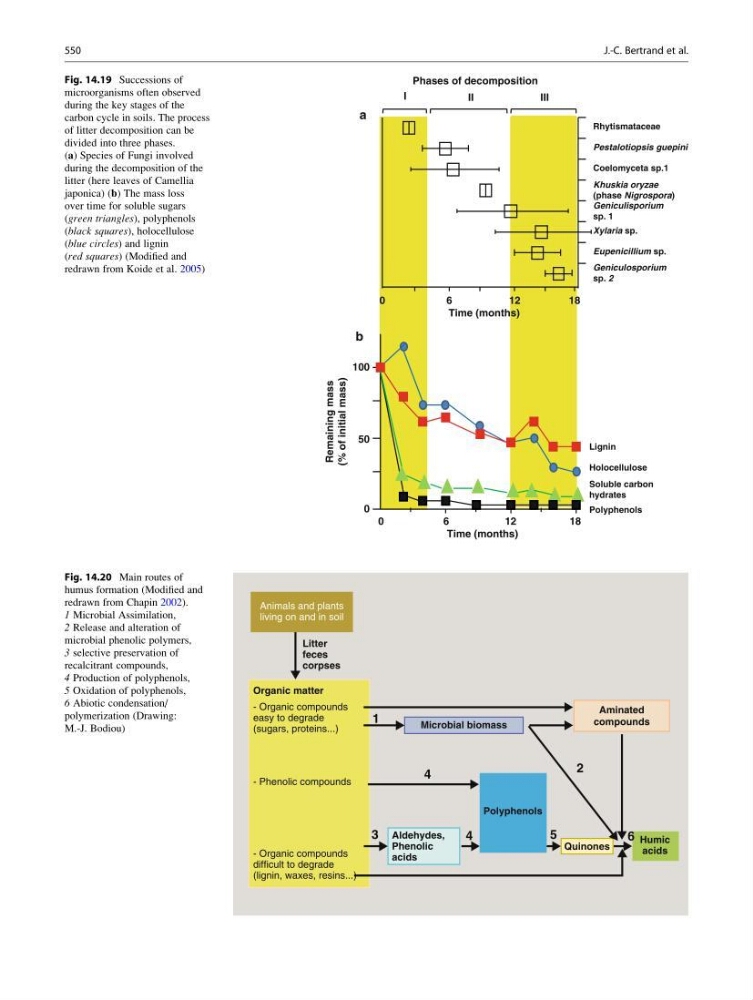
Fig. 14.19 Successions of
microorganisms often observed
during the key stages of the
carbon cycle in soils. The process
of litter decomposition can be
divided into three phases.
(a) Species of Fungi involved
during the decomposition of the
litter (here leaves of Camellia
japonica) (b) The mass loss
over time for soluble sugars
(green triangles), polyphenols
(black squares), holocellulose
(blue circles) and lignin
(red squares) (Modified and
redrawn from Koide et al. 2005)
Animals and plants
living on and in soil
- Organic compounds
easy to degrade
(sugars, proteins...)
- Phenolic compounds
- Organic compounds
difficult to degrade
(lignin, waxes, resins...)
Organic matter
Microbial biomass
Aminated
compounds
Aldehydes,
Phenolic
acids
Polyphenols
Quinones
Humic
acids
Litter
feces
corpses
1
2
3
4
4
5
6
Fig. 14.20 Main routes of
humus formation (Modified and
redrawn from Chapin 2002).
1 Microbial Assimilation,
2 Release and alteration of
microbial phenolic polymers,
3 selective preservation of
recalcitrant compounds,
4 Production of polyphenols,
5 Oxidation of polyphenols,
6 Abiotic condensation/
polymerization (Drawing:
M.-J. Bodiou)
550
J.-C. Bertrand et al.
0
50
0
1 2
1 8
6
Remaining mass
(% of initial mass)
Holocellulose
Polyphenols
Soluble carbon
hydrates
Lignin
Time (months)
b
Rhytismataceae
Pestalotiopsis guepini
Coelomyceta sp.1
Khuskia oryzae
(phase Nigrospora)
Xylaria sp.
Geniculisporium
sp. 1
Eupenicillium sp.
Geniculosporium
sp. 2
0
1 2
1 8
6
Time (months)
Phases of decomposition
II
I
III
a
Fig. 14.19 Successions of
microorganisms often observed
during the key stages of the
carbon cycle in soils. The process
of litter decomposition can be
divided into three phases.
(a) Species of Fungi involved
during the decomposition of the
litter (here leaves of Camellia
japonica) (b) The mass loss
over time for soluble sugars
(green triangles), polyphenols
(black squares), holocellulose
(blue circles) and lignin
(red squares) (Modified and
redrawn from Koide et al. 2005)
Animals and plants
living on and in soil
- Organic compounds
easy to degrade
(sugars, proteins...)
- Phenolic compounds
- Organic compounds
difficult to degrade
(lignin, waxes, resins...)
Organic matter
Microbial biomass
Aminated
compounds
Aldehydes,
Phenolic
acids
Polyphenols
Quinones
Humic
acids
Litter
feces
corpses
1
2
3
4
4
5
6
Fig. 14.20 Main routes of
humus formation (Modified and
redrawn from Chapin 2002).
1 Microbial Assimilation,
2 Release and alteration of
microbial phenolic polymers,
3 selective preservation of
recalcitrant compounds,
4 Production of polyphenols,
5 Oxidation of polyphenols,
6 Abiotic condensation/
polymerization (Drawing:
M.-J. Bodiou)
550
J.-C. Bertrand et al.