

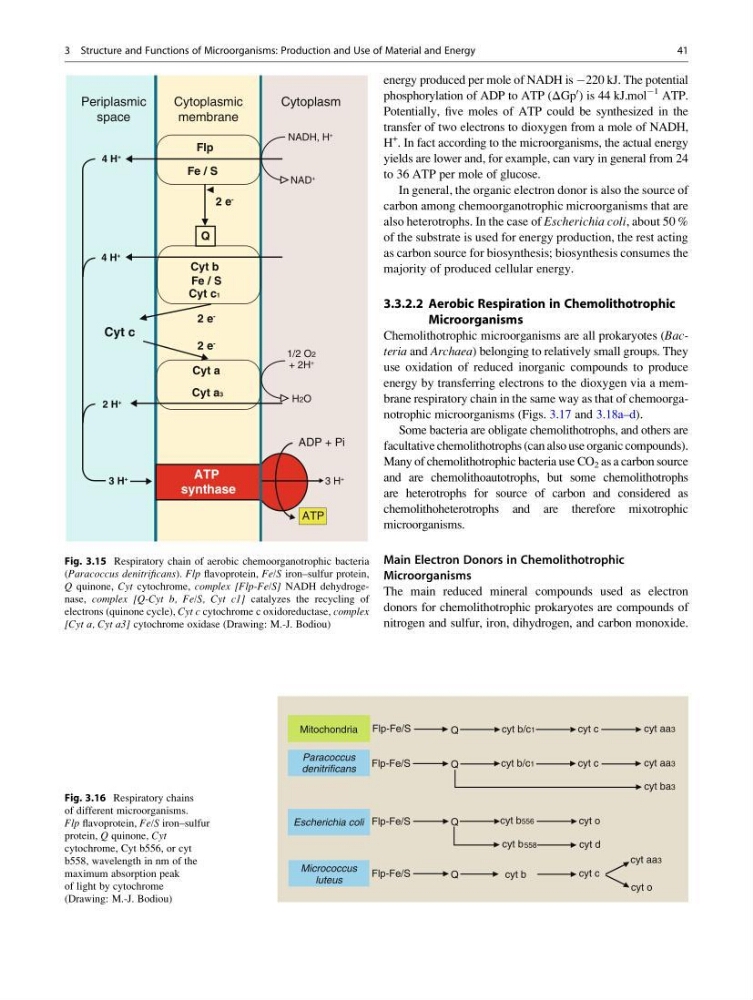
energy produced per mole of NADH is À220 kJ. The potential
phosphorylation of ADP to ATP (ΔGp
0 ) is 44 kJ.mol
À1 ATP.
Potentially, five moles of ATP could be synthesized in the
transfer of two electrons to dioxygen from a mole of NADH,
H
+
. In fact according to the microorganisms, the actual energy
yields are lower and, for example, can vary in general from 24
to 36 ATP per mole of glucose.
In general, the organic electron donor is also the source of
carbon among chemoorganotrophic microorganisms that are
also heterotrophs. In the case of Escherichia coli, about 50 %
of the substrate is used for energy production, the rest acting
as carbon source for biosynthesis; biosynthesis consumes the
majority of produced cellular energy.
3.3.2.2 Aerobic Respiration in Chemolithotrophic
Microorganisms
Chemolithotrophic microorganisms are all prokaryotes (Bacteria and Archaea) belonging to relatively small groups. They
use oxidation of reduced inorganic compounds to produce
energy by transferring electrons to the dioxygen via a membrane respiratory chain in the same way as that of chemoorganotrophic microorganisms (Figs. 3.17 and 3.18a–d).
Some bacteria are obligate chemolithotrophs, and others are
facultative chemolithotrophs (can also use organic compounds).
Many of chemolithotrophic bacteria use CO 2 as a carbon source
and are chemolithoautotrophs, but some chemolithotrophs
are heterotrophs for source of carbon and considered as
chemolithoheterotrophs and are therefore mixotrophic
microorganisms.
Main Electron Donors in Chemolithotrophic
Microorganisms
The main reduced mineral compounds used as electron
donors for chemolithotrophic prokaryotes are compounds of
nitrogen and sulfur, iron, dihydrogen, and carbon monoxide.
Flp
Fe / S
Q
Cyt c
2 H
+
1/2 O2
+ 2H
+
Cyt a3
Cyt a
4 H
+
4 H
+
NADH, H
+
NAD
+
2 e
-
2 e
-
2 e
-
Cyt b
Fe / S
Cyt c1
Periplasmic
space
Cytoplasmic
membrane
Cytoplasm
ATP
synthase
H2O
ADP + Pi
3 H
+
3 H
+
ATP
Fig. 3.15 Respiratory chain of aerobic chemoorganotrophic bacteria
(Paracoccus denitrificans). Flp flavoprotein, Fe/S iron–sulfur protein,
Q quinone, Cyt cytochrome, complex [Flp-Fe/S] NADH dehydrogenase, complex [Q-Cyt b, Fe/S, Cyt c1] catalyzes the recycling of
electrons (quinone cycle), Cyt c cytochrome c oxidoreductase, complex
[Cyt a, Cyt a3] cytochrome oxidase (Drawing: M.-J. Bodiou)
cyt b/c1
cyt b/c1
cyt c
cyt c
cyt aa3
cyt aa3
cyt aa3
cyt ba3
cyt b
cyt c
Mitochondria
Paracoccus
denitrificans
Escherichia coli
Micrococcus
luteus
Flp-Fe/S
Flp-Fe/S
Flp-Fe/S
Flp-Fe/S
Q
Q
Q
Q
cyt b556
cyt b558
cyt o
cyt o
cyt d
Fig. 3.16 Respiratory chains
of different microorganisms.
Flp flavoprotein, Fe/S iron–sulfur
protein, Q quinone, Cyt
cytochrome, Cyt b556, or cyt
b558, wavelength in nm of the
maximum absorption peak
of light by cytochrome
(Drawing: M.-J. Bodiou)
3 Structure and Functions of Microorganisms: Production and Use of Material and Energy
41
phosphorylation of ADP to ATP (ΔGp
0 ) is 44 kJ.mol
À1 ATP.
Potentially, five moles of ATP could be synthesized in the
transfer of two electrons to dioxygen from a mole of NADH,
H
+
. In fact according to the microorganisms, the actual energy
yields are lower and, for example, can vary in general from 24
to 36 ATP per mole of glucose.
In general, the organic electron donor is also the source of
carbon among chemoorganotrophic microorganisms that are
also heterotrophs. In the case of Escherichia coli, about 50 %
of the substrate is used for energy production, the rest acting
as carbon source for biosynthesis; biosynthesis consumes the
majority of produced cellular energy.
3.3.2.2 Aerobic Respiration in Chemolithotrophic
Microorganisms
Chemolithotrophic microorganisms are all prokaryotes (Bacteria and Archaea) belonging to relatively small groups. They
use oxidation of reduced inorganic compounds to produce
energy by transferring electrons to the dioxygen via a membrane respiratory chain in the same way as that of chemoorganotrophic microorganisms (Figs. 3.17 and 3.18a–d).
Some bacteria are obligate chemolithotrophs, and others are
facultative chemolithotrophs (can also use organic compounds).
Many of chemolithotrophic bacteria use CO 2 as a carbon source
and are chemolithoautotrophs, but some chemolithotrophs
are heterotrophs for source of carbon and considered as
chemolithoheterotrophs and are therefore mixotrophic
microorganisms.
Main Electron Donors in Chemolithotrophic
Microorganisms
The main reduced mineral compounds used as electron
donors for chemolithotrophic prokaryotes are compounds of
nitrogen and sulfur, iron, dihydrogen, and carbon monoxide.
Flp
Fe / S
Q
Cyt c
2 H
+
1/2 O2
+ 2H
+
Cyt a3
Cyt a
4 H
+
4 H
+
NADH, H
+
NAD
+
2 e
-
2 e
-
2 e
-
Cyt b
Fe / S
Cyt c1
Periplasmic
space
Cytoplasmic
membrane
Cytoplasm
ATP
synthase
H2O
ADP + Pi
3 H
+
3 H
+
ATP
Fig. 3.15 Respiratory chain of aerobic chemoorganotrophic bacteria
(Paracoccus denitrificans). Flp flavoprotein, Fe/S iron–sulfur protein,
Q quinone, Cyt cytochrome, complex [Flp-Fe/S] NADH dehydrogenase, complex [Q-Cyt b, Fe/S, Cyt c1] catalyzes the recycling of
electrons (quinone cycle), Cyt c cytochrome c oxidoreductase, complex
[Cyt a, Cyt a3] cytochrome oxidase (Drawing: M.-J. Bodiou)
cyt b/c1
cyt b/c1
cyt c
cyt c
cyt aa3
cyt aa3
cyt aa3
cyt ba3
cyt b
cyt c
Mitochondria
Paracoccus
denitrificans
Escherichia coli
Micrococcus
luteus
Flp-Fe/S
Flp-Fe/S
Flp-Fe/S
Flp-Fe/S
Q
Q
Q
Q
cyt b556
cyt b558
cyt o
cyt o
cyt d
Fig. 3.16 Respiratory chains
of different microorganisms.
Flp flavoprotein, Fe/S iron–sulfur
protein, Q quinone, Cyt
cytochrome, Cyt b556, or cyt
b558, wavelength in nm of the
maximum absorption peak
of light by cytochrome
(Drawing: M.-J. Bodiou)
3 Structure and Functions of Microorganisms: Production and Use of Material and Energy
41