

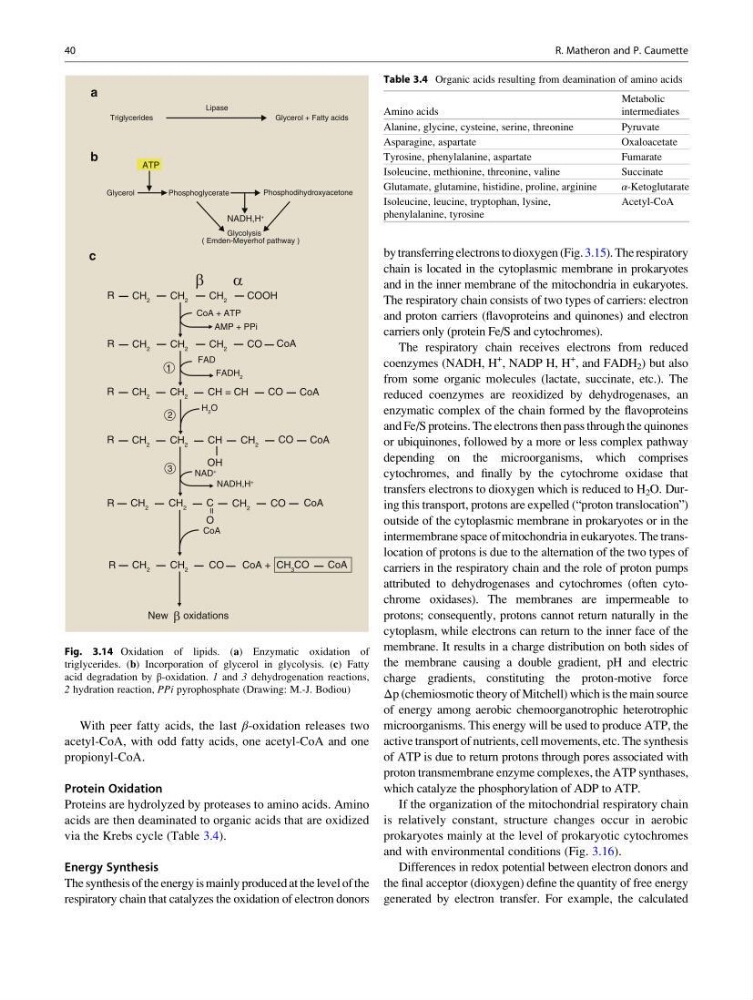
With peer fatty acids, the last β-oxidation releases two
acetyl-CoA, with odd fatty acids, one acetyl-CoA and one
propionyl-CoA.
Protein Oxidation
Proteins are hydrolyzed by proteases to amino acids. Amino
acids are then deaminated to organic acids that are oxidized
via the Krebs cycle (Table 3.4).
Energy Synthesis
The synthesis of the energy is mainly produced at the level of the
respiratory chain that catalyzes the oxidation of electron donors
by transferring electrons to dioxygen (Fig. 3.15). The respiratory
chain is located in the cytoplasmic membrane in prokaryotes
and in the inner membrane of the mitochondria in eukaryotes.
The respiratory chain consists of two types of carriers: electron
and proton carriers (flavoproteins and quinones) and electron
carriers only (protein Fe/S and cytochromes).
The respiratory chain receives electrons from reduced
coenzymes (NADH, H
+
, NADP H, H
+
, and FADH 2 ) but also
from some organic molecules (lactate, succinate, etc.). The
reduced coenzymes are reoxidized by dehydrogenases, an
enzymatic complex of the chain formed by the flavoproteins
and Fe/S proteins. The electrons then pass through the quinones
or ubiquinones, followed by a more or less complex pathway
depending on the microorganisms, which comprises
cytochromes, and finally by the cytochrome oxidase that
transfers electrons to dioxygen which is reduced to H 2 O. During this transport, protons are expelled (“proton translocation”)
outside of the cytoplasmic membrane in prokaryotes or in the
intermembrane space of mitochondria in eukaryotes. The translocation of protons is due to the alternation of the two types of
carriers in the respiratory chain and the role of proton pumps
attributed to dehydrogenases and cytochromes (often cytochrome oxidases). The membranes are impermeable to
protons; consequently, protons cannot return naturally in the
cytoplasm, while electrons can return to the inner face of the
membrane. It results in a charge distribution on both sides of
the membrane causing a double gradient, pH and electric
charge gradients, constituting the proton-motive force
Δp (chemiosmotic theory of Mitchell) which is the main source
of energy among aerobic chemoorganotrophic heterotrophic
microorganisms. This energy will be used to produce ATP, the
active transport of nutrients, cell movements, etc. The synthesis
of ATP is due to return protons through pores associated with
proton transmembrane enzyme complexes, the ATP synthases,
which catalyze the phosphorylation of ADP to ATP.
If the organization of the mitochondrial respiratory chain
is relatively constant, structure changes occur in aerobic
prokaryotes mainly at the level of prokaryotic cytochromes
and with environmental conditions (Fig. 3.16).
Differences in redox potential between electron donors and
the final acceptor (dioxygen) define the quantity of free energy
generated by electron transfer. For example, the calculated
Triglycerides
Glycerol + Fatty acids
Lipase
a
Glycerol
ATP
Phosphoglycerate
Phosphodihydroxyacetone
NADH,H
+
Glycolysis
( Emden-Meyerhof pathway )
b
1
3
2
CoA + ATP
AMP + PPi
FAD
FADH 2
H 2 O
NAD
+
NADH,H
+
=
New
CH 2
R
CH 2
CH 2
COOH
CH 2
R
CH 2
CH 2
R
CH 2
CH = CH
CH 2
R
CH 2
CH
OH
CH 2
R
CH 2
CH 2
R
CH 2
CH 2
CH 2
CH 2
CO CoA
CO
CoA
CO
CoA
C
CO
CoA
CoA
CO
CoA + CH 3 CO
CoA
oxidations
O
c
Fig. 3.14 Oxidation of lipids. (a) Enzymatic oxidation of
triglycerides. (b) Incorporation of glycerol in glycolysis. (c) Fatty
acid degradation by β-oxidation. 1 and 3 dehydrogenation reactions,
2 hydration reaction, PPi pyrophosphate (Drawing: M.-J. Bodiou)
Table 3.4 Organic acids resulting from deamination of amino acids
Amino acids
Metabolic
intermediates
Alanine, glycine, cysteine, serine, threonine
Pyruvate
Asparagine, aspartate
Oxaloacetate
Tyrosine, phenylalanine, aspartate
Fumarate
Isoleucine, methionine, threonine, valine
Succinate
Glutamate, glutamine, histidine, proline, arginine
α-Ketoglutarate
Isoleucine, leucine, tryptophan, lysine,
phenylalanine, tyrosine
Acetyl-CoA
40
R. Matheron and P. Caumette
acetyl-CoA, with odd fatty acids, one acetyl-CoA and one
propionyl-CoA.
Protein Oxidation
Proteins are hydrolyzed by proteases to amino acids. Amino
acids are then deaminated to organic acids that are oxidized
via the Krebs cycle (Table 3.4).
Energy Synthesis
The synthesis of the energy is mainly produced at the level of the
respiratory chain that catalyzes the oxidation of electron donors
by transferring electrons to dioxygen (Fig. 3.15). The respiratory
chain is located in the cytoplasmic membrane in prokaryotes
and in the inner membrane of the mitochondria in eukaryotes.
The respiratory chain consists of two types of carriers: electron
and proton carriers (flavoproteins and quinones) and electron
carriers only (protein Fe/S and cytochromes).
The respiratory chain receives electrons from reduced
coenzymes (NADH, H
+
, NADP H, H
+
, and FADH 2 ) but also
from some organic molecules (lactate, succinate, etc.). The
reduced coenzymes are reoxidized by dehydrogenases, an
enzymatic complex of the chain formed by the flavoproteins
and Fe/S proteins. The electrons then pass through the quinones
or ubiquinones, followed by a more or less complex pathway
depending on the microorganisms, which comprises
cytochromes, and finally by the cytochrome oxidase that
transfers electrons to dioxygen which is reduced to H 2 O. During this transport, protons are expelled (“proton translocation”)
outside of the cytoplasmic membrane in prokaryotes or in the
intermembrane space of mitochondria in eukaryotes. The translocation of protons is due to the alternation of the two types of
carriers in the respiratory chain and the role of proton pumps
attributed to dehydrogenases and cytochromes (often cytochrome oxidases). The membranes are impermeable to
protons; consequently, protons cannot return naturally in the
cytoplasm, while electrons can return to the inner face of the
membrane. It results in a charge distribution on both sides of
the membrane causing a double gradient, pH and electric
charge gradients, constituting the proton-motive force
Δp (chemiosmotic theory of Mitchell) which is the main source
of energy among aerobic chemoorganotrophic heterotrophic
microorganisms. This energy will be used to produce ATP, the
active transport of nutrients, cell movements, etc. The synthesis
of ATP is due to return protons through pores associated with
proton transmembrane enzyme complexes, the ATP synthases,
which catalyze the phosphorylation of ADP to ATP.
If the organization of the mitochondrial respiratory chain
is relatively constant, structure changes occur in aerobic
prokaryotes mainly at the level of prokaryotic cytochromes
and with environmental conditions (Fig. 3.16).
Differences in redox potential between electron donors and
the final acceptor (dioxygen) define the quantity of free energy
generated by electron transfer. For example, the calculated
Triglycerides
Glycerol + Fatty acids
Lipase
a
Glycerol
ATP
Phosphoglycerate
Phosphodihydroxyacetone
NADH,H
+
Glycolysis
( Emden-Meyerhof pathway )
b
1
3
2
CoA + ATP
AMP + PPi
FAD
FADH 2
H 2 O
NAD
+
NADH,H
+
=
New
CH 2
R
CH 2
CH 2
COOH
CH 2
R
CH 2
CH 2
R
CH 2
CH = CH
CH 2
R
CH 2
CH
OH
CH 2
R
CH 2
CH 2
R
CH 2
CH 2
CH 2
CH 2
CO CoA
CO
CoA
CO
CoA
C
CO
CoA
CoA
CO
CoA + CH 3 CO
CoA
oxidations
O
c
Fig. 3.14 Oxidation of lipids. (a) Enzymatic oxidation of
triglycerides. (b) Incorporation of glycerol in glycolysis. (c) Fatty
acid degradation by β-oxidation. 1 and 3 dehydrogenation reactions,
2 hydration reaction, PPi pyrophosphate (Drawing: M.-J. Bodiou)
Table 3.4 Organic acids resulting from deamination of amino acids
Amino acids
Metabolic
intermediates
Alanine, glycine, cysteine, serine, threonine
Pyruvate
Asparagine, aspartate
Oxaloacetate
Tyrosine, phenylalanine, aspartate
Fumarate
Isoleucine, methionine, threonine, valine
Succinate
Glutamate, glutamine, histidine, proline, arginine
α-Ketoglutarate
Isoleucine, leucine, tryptophan, lysine,
phenylalanine, tyrosine
Acetyl-CoA
40
R. Matheron and P. Caumette