

intense water circulation inside sediment tunnels built by
the so-called “gallery-diffusing” organisms, such as polychaete worms that can pump up to 6.6 ml of water
per minute through its gallery. It was also demonstrated
that microbial communities present in these galleries
were different from those outside (Satoh et al. 2007);
2. Draw down organic matter (downward conveyors,
regenerators, and gallery diffusors) or bring back to the
oxygenated surface sediment, materials buried in an
anoxic zone (upward conveyor and regenerators). One
of the consequences of these organic material movements
will be the appearance of oxygenated microniches in
typically anoxic sediment, and conversely. These microenvironments correspond to areas of high microbial
activity (“hot spot”);
3. Create alternating oxic and anoxic conditions that
amplify organic matter degradation (Aller 1994);
4. Regulate the microbial biomass. It was shown that 50 %
of microbial production is consumed by benthic
invertebrates, encompassing macrofauna (2/3) and
meiofauna (the remaining);
5. Change the organic matter composition during gut transit
and provide more labile organic materials to microorganisms; any organic compound in the sediment will
pass, at least once, through the digestive tract of benthic
animals;
6. Change the composition of microbial populations fixed
on ingested particles that pass through the digestive tract
(Grossi et al. 2006);
7. Favor exchanges of dissolved organic and inorganic
materials at the water-sediment interface.
Organic Matter Sequestration in the Sediment
A small fraction of organic carbon is not degraded in sediment and will be lost for the carbon cycle; sediment then acts
as a carbon “sink.” This loss which average 0.1 % could
reach 4 % in strictly anoxic sediments. The sedimenttrapped organic matter will lead to the formation of fulvic
and humic acids*, and later, kerogen. In addition, the presence of biomacromolecules that are particularly resistant to
chemical and microbial transformation, such as those found
in some higher plants (cutans and suberans), chlorobiontes
(algaenans), dinobiontes (dinosporine) and cyanobacteria
(bacterans), suggests that the organic matter amount
sequestered in sediment is underestimated.
14.2.5 The Carbon Cycle in Soils
The soil, whose key characteristics have been described in
Sect. 13.1.3, plays a key role in the carbon cycle at all scales
on Earth (cf. Sect. 14.2.2). Organic matter in soils represents
a stock of about 1,500 Pg of carbon (PgC), and a further
amount of 500 PgC is contained in soil microbial biomass.
These stocks are particularly high when compared with that
(762 PgC) contained in the atmosphere (Fig. 14.5). This
implies that any alteration of carbon cycle or stocks in
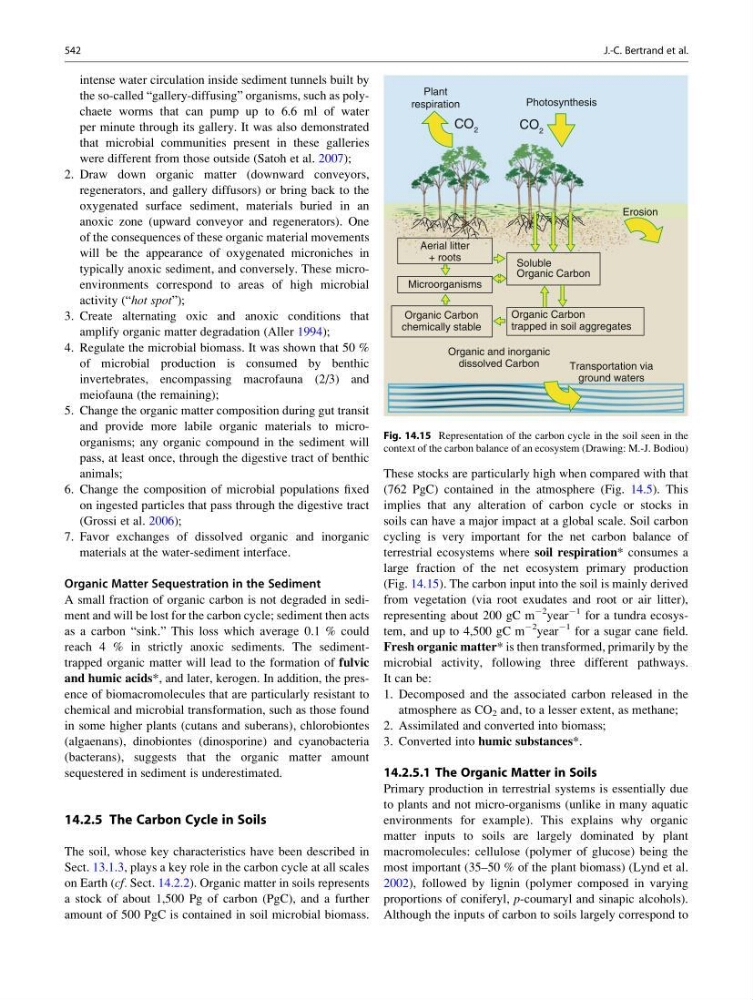
soils can have a major impact at a global scale. Soil carbon
cycling is very important for the net carbon balance of
terrestrial ecosystems where soil respiration* consumes a
large fraction of the net ecosystem primary production
(Fig. 14.15). The carbon input into the soil is mainly derived
from vegetation (via root exudates and root or air litter),
representing about 200 gC m
À2 year
À1 for a tundra ecosystem, and up to 4,500 gC m
À2 year
À1 for a sugar cane field.
Fresh organic matter* is then transformed, primarily by the
microbial activity, following three different pathways.
It can be:
1. Decomposed and the associated carbon released in the
atmosphere as CO 2 and, to a lesser extent, as methane;
2. Assimilated and converted into biomass;
3. Converted into humic substances*.
14.2.5.1 The Organic Matter in Soils
Primary production in terrestrial systems is essentially due
to plants and not micro-organisms (unlike in many aquatic
environments for example). This explains why organic
matter inputs to soils are largely dominated by plant
macromolecules: cellulose (polymer of glucose) being the
most important (35–50 % of the plant biomass) (Lynd et al.
2002), followed by lignin (polymer composed in varying
proportions of coniferyl, p-coumaryl and sinapic alcohols).
Although the inputs of carbon to soils largely correspond to
Organic Carbon
chemically stable
Microorganisms
Aerial litter
+ roots
Organic Carbon
trapped in soil aggregates
Soluble
Organic Carbon
Erosion
Organic and inorganic
dissolved Carbon
Transportation via
ground waters
CO 2
CO 2
Plant
respiration
Photosynthesis
Fig. 14.15 Representation of the carbon cycle in the soil seen in the
context of the carbon balance of an ecosystem (Drawing: M.-J. Bodiou)
542
J.-C. Bertrand et al.
the so-called “gallery-diffusing” organisms, such as polychaete worms that can pump up to 6.6 ml of water
per minute through its gallery. It was also demonstrated
that microbial communities present in these galleries
were different from those outside (Satoh et al. 2007);
2. Draw down organic matter (downward conveyors,
regenerators, and gallery diffusors) or bring back to the
oxygenated surface sediment, materials buried in an
anoxic zone (upward conveyor and regenerators). One
of the consequences of these organic material movements
will be the appearance of oxygenated microniches in
typically anoxic sediment, and conversely. These microenvironments correspond to areas of high microbial
activity (“hot spot”);
3. Create alternating oxic and anoxic conditions that
amplify organic matter degradation (Aller 1994);
4. Regulate the microbial biomass. It was shown that 50 %
of microbial production is consumed by benthic
invertebrates, encompassing macrofauna (2/3) and
meiofauna (the remaining);
5. Change the organic matter composition during gut transit
and provide more labile organic materials to microorganisms; any organic compound in the sediment will
pass, at least once, through the digestive tract of benthic
animals;
6. Change the composition of microbial populations fixed
on ingested particles that pass through the digestive tract
(Grossi et al. 2006);
7. Favor exchanges of dissolved organic and inorganic
materials at the water-sediment interface.
Organic Matter Sequestration in the Sediment
A small fraction of organic carbon is not degraded in sediment and will be lost for the carbon cycle; sediment then acts
as a carbon “sink.” This loss which average 0.1 % could
reach 4 % in strictly anoxic sediments. The sedimenttrapped organic matter will lead to the formation of fulvic
and humic acids*, and later, kerogen. In addition, the presence of biomacromolecules that are particularly resistant to
chemical and microbial transformation, such as those found
in some higher plants (cutans and suberans), chlorobiontes
(algaenans), dinobiontes (dinosporine) and cyanobacteria
(bacterans), suggests that the organic matter amount
sequestered in sediment is underestimated.
14.2.5 The Carbon Cycle in Soils
The soil, whose key characteristics have been described in
Sect. 13.1.3, plays a key role in the carbon cycle at all scales
on Earth (cf. Sect. 14.2.2). Organic matter in soils represents
a stock of about 1,500 Pg of carbon (PgC), and a further
amount of 500 PgC is contained in soil microbial biomass.
These stocks are particularly high when compared with that
(762 PgC) contained in the atmosphere (Fig. 14.5). This
implies that any alteration of carbon cycle or stocks in
soils can have a major impact at a global scale. Soil carbon
cycling is very important for the net carbon balance of
terrestrial ecosystems where soil respiration* consumes a
large fraction of the net ecosystem primary production
(Fig. 14.15). The carbon input into the soil is mainly derived
from vegetation (via root exudates and root or air litter),
representing about 200 gC m
À2 year
À1 for a tundra ecosystem, and up to 4,500 gC m
À2 year
À1 for a sugar cane field.
Fresh organic matter* is then transformed, primarily by the
microbial activity, following three different pathways.
It can be:
1. Decomposed and the associated carbon released in the
atmosphere as CO 2 and, to a lesser extent, as methane;
2. Assimilated and converted into biomass;
3. Converted into humic substances*.
14.2.5.1 The Organic Matter in Soils
Primary production in terrestrial systems is essentially due
to plants and not micro-organisms (unlike in many aquatic
environments for example). This explains why organic
matter inputs to soils are largely dominated by plant
macromolecules: cellulose (polymer of glucose) being the
most important (35–50 % of the plant biomass) (Lynd et al.
2002), followed by lignin (polymer composed in varying
proportions of coniferyl, p-coumaryl and sinapic alcohols).
Although the inputs of carbon to soils largely correspond to
Organic Carbon
chemically stable
Microorganisms
Aerial litter
+ roots
Organic Carbon
trapped in soil aggregates
Soluble
Organic Carbon
Erosion
Organic and inorganic
dissolved Carbon
Transportation via
ground waters
CO 2
CO 2
Plant
respiration
Photosynthesis
Fig. 14.15 Representation of the carbon cycle in the soil seen in the
context of the carbon balance of an ecosystem (Drawing: M.-J. Bodiou)
542
J.-C. Bertrand et al.