

concentrations 100–1,000 times higher than those found in the
overlying waters. Part of these monomers is transported by
diffusion into oxygenated zones where they are degraded by
aerobic heterotrophic prokaryotes. The monomers remaining
in the sediment are used by different prokaryotic
communities. Some are growth substrates for bacteria and
archaea, denitrifying, oxidizing iron and manganese, and/or
reducing sulfate (cf. Sects. 14.3, 14.4, 14.5). All monomers
are assimilated by fermentative microorganisms, primarily
those responsible for the complex polymer hydrolysis. These
fermentation products are: lactate, ethanol, volatile fatty acids
(such as acetate, propionate, butyrate), fumarate, hydrogen,
and carbon dioxide. These compounds are growth substrates
for the majority of anaerobic prokaryotic communities.
Role of Fermentative Microorganisms
Based on energy efficiency, fermentative prokaryotes are
disadvantaged compared with prokaryotes that perform
aerobic and anaerobic respiration (cf. Sect. 3.3.3). However,
in anoxic ecosystems (marine and lake sediments, soils,
digestive tracts of many animals and humans, anaerobic
digesters), fermentative microorganisms play an essential
role. Indeed they are the only ones able to use macromolecules (enzymatic hydrolysis) that other microorganisms cannot harness. They generate substrates that
can fuel different respiratory metabolic pathways. Fermentative prokaryotes are the first trophic link in the anaerobic
detrital food chain and, in their absence, all mineralization
processes would be impossible.
In Marine Systems, Sulfate Reduction Is the Dominant
Metabolism
In coastal sediments, 25–50 % of organic carbon is
mineralized by prokaryotic sulfate reduction, sulfate being
generally present at non-limiting concentrations, in contrast
with nitrate that seems to play a minor role as an oxidant.
The denitrification contribution to degradation processes is
limited, only 3 % of organic carbon being oxidized by
denitrifying prokaryotes (Jørgensen 1983). Similarly, the
methanogen activity is also low. Because of their lower
energetic metabolism, methanogens are outcompeted by
sulfate-reducers for the use of acetate, formate, and hydrogen (Fig. 14.14). However, the methanogen activity in the
anaerobic mineralization of organic matter is not negligible.
This stems from their ability to use substrates such as methanol (source of 10 % methane) or trimethylamine, that are
not or poorly accessible to sulfate-reducers (cf. Sect. 14.2.6).
Hydrogen Production and Consumption
During organic matter degradation in anoxic sediments,
hydrogen is produced by different fermentation processes
involving monomers, products of macromolecule hydrolysis
by fermentative prokaryotes (Fig. 14.14). Hydrogen is also
produced by microorganisms that transform their fermentative substrates (ethanol, propionate, butyrate, fatty acids)
into acetate, CO 2 , and H 2 . The energetic balance of these
reactions that produce hydrogen, under standard conditions
(cf. Sect. 3.3.3), is endergonic. For efficiency, these reations
must be coupled with reactions consuming hydrogen. The
hydrogen consumption considerably decreases the hydrogen
partial pressure, thus enabling the reaction producing hydrogen to become exergonic. For example, under standard
conditions (H 2 partial pressure of 1 atm or 101.3 kPa), the
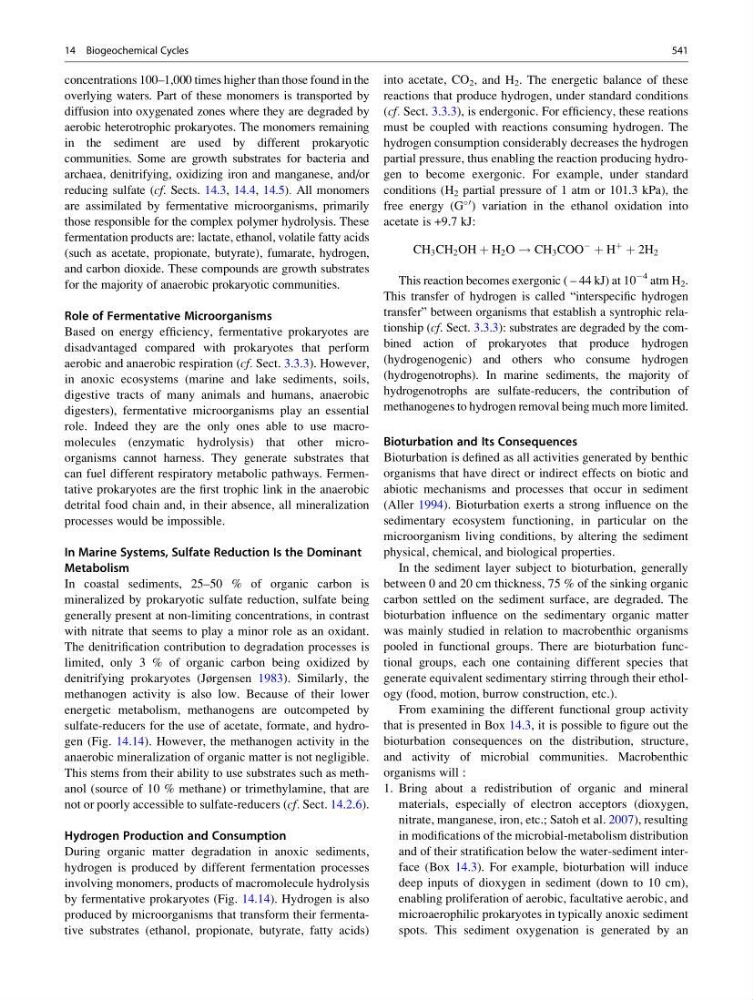
free energy (G
0 ) variation in the ethanol oxidation into
acetate is +9.7 kJ:
CH 3 CH 2 OH þ H 2 O ! CH 3 COO
À
þ H
þ
þ 2H 2
This reaction becomes exergonic ( – 44 kJ) at 10
À4 atm H 2 .
This transfer of hydrogen is called “interspecific hydrogen
transfer” between organisms that establish a syntrophic relationship (cf. Sect. 3.3.3): substrates are degraded by the combined action of prokaryotes that produce hydrogen
(hydrogenogenic) and others who consume hydrogen
(hydrogenotrophs). In marine sediments, the majority of
hydrogenotrophs are sulfate-reducers, the contribution of
methanogenes to hydrogen removal being much more limited.
Bioturbation and Its Consequences
Bioturbation is defined as all activities generated by benthic
organisms that have direct or indirect effects on biotic and
abiotic mechanisms and processes that occur in sediment
(Aller 1994). Bioturbation exerts a strong influence on the
sedimentary ecosystem functioning, in particular on the
microorganism living conditions, by altering the sediment
physical, chemical, and biological properties.
In the sediment layer subject to bioturbation, generally
between 0 and 20 cm thickness, 75 % of the sinking organic
carbon settled on the sediment surface, are degraded. The
bioturbation influence on the sedimentary organic matter
was mainly studied in relation to macrobenthic organisms
pooled in functional groups. There are bioturbation functional groups, each one containing different species that
generate equivalent sedimentary stirring through their ethology (food, motion, burrow construction, etc.).
From examining the different functional group activity
that is presented in Box 14.3, it is possible to figure out the
bioturbation consequences on the distribution, structure,
and activity of microbial communities. Macrobenthic
organisms will :
1. Bring about a redistribution of organic and mineral
materials, especially of electron acceptors (dioxygen,
nitrate, manganese, iron, etc.; Satoh et al. 2007), resulting
in modifications of the microbial-metabolism distribution
and of their stratification below the water-sediment interface (Box 14.3). For example, bioturbation will induce
deep inputs of dioxygen in sediment (down to 10 cm),
enabling proliferation of aerobic, facultative aerobic, and
microaerophilic prokaryotes in typically anoxic sediment
spots. This sediment oxygenation is generated by an
14 Biogeochemical Cycles
541
overlying waters. Part of these monomers is transported by
diffusion into oxygenated zones where they are degraded by
aerobic heterotrophic prokaryotes. The monomers remaining
in the sediment are used by different prokaryotic
communities. Some are growth substrates for bacteria and
archaea, denitrifying, oxidizing iron and manganese, and/or
reducing sulfate (cf. Sects. 14.3, 14.4, 14.5). All monomers
are assimilated by fermentative microorganisms, primarily
those responsible for the complex polymer hydrolysis. These
fermentation products are: lactate, ethanol, volatile fatty acids
(such as acetate, propionate, butyrate), fumarate, hydrogen,
and carbon dioxide. These compounds are growth substrates
for the majority of anaerobic prokaryotic communities.
Role of Fermentative Microorganisms
Based on energy efficiency, fermentative prokaryotes are
disadvantaged compared with prokaryotes that perform
aerobic and anaerobic respiration (cf. Sect. 3.3.3). However,
in anoxic ecosystems (marine and lake sediments, soils,
digestive tracts of many animals and humans, anaerobic
digesters), fermentative microorganisms play an essential
role. Indeed they are the only ones able to use macromolecules (enzymatic hydrolysis) that other microorganisms cannot harness. They generate substrates that
can fuel different respiratory metabolic pathways. Fermentative prokaryotes are the first trophic link in the anaerobic
detrital food chain and, in their absence, all mineralization
processes would be impossible.
In Marine Systems, Sulfate Reduction Is the Dominant
Metabolism
In coastal sediments, 25–50 % of organic carbon is
mineralized by prokaryotic sulfate reduction, sulfate being
generally present at non-limiting concentrations, in contrast
with nitrate that seems to play a minor role as an oxidant.
The denitrification contribution to degradation processes is
limited, only 3 % of organic carbon being oxidized by
denitrifying prokaryotes (Jørgensen 1983). Similarly, the
methanogen activity is also low. Because of their lower
energetic metabolism, methanogens are outcompeted by
sulfate-reducers for the use of acetate, formate, and hydrogen (Fig. 14.14). However, the methanogen activity in the
anaerobic mineralization of organic matter is not negligible.
This stems from their ability to use substrates such as methanol (source of 10 % methane) or trimethylamine, that are
not or poorly accessible to sulfate-reducers (cf. Sect. 14.2.6).
Hydrogen Production and Consumption
During organic matter degradation in anoxic sediments,
hydrogen is produced by different fermentation processes
involving monomers, products of macromolecule hydrolysis
by fermentative prokaryotes (Fig. 14.14). Hydrogen is also
produced by microorganisms that transform their fermentative substrates (ethanol, propionate, butyrate, fatty acids)
into acetate, CO 2 , and H 2 . The energetic balance of these
reactions that produce hydrogen, under standard conditions
(cf. Sect. 3.3.3), is endergonic. For efficiency, these reations
must be coupled with reactions consuming hydrogen. The
hydrogen consumption considerably decreases the hydrogen
partial pressure, thus enabling the reaction producing hydrogen to become exergonic. For example, under standard
conditions (H 2 partial pressure of 1 atm or 101.3 kPa), the
free energy (G
0 ) variation in the ethanol oxidation into
acetate is +9.7 kJ:
CH 3 CH 2 OH þ H 2 O ! CH 3 COO
À
þ H
þ
þ 2H 2
This reaction becomes exergonic ( – 44 kJ) at 10
À4 atm H 2 .
This transfer of hydrogen is called “interspecific hydrogen
transfer” between organisms that establish a syntrophic relationship (cf. Sect. 3.3.3): substrates are degraded by the combined action of prokaryotes that produce hydrogen
(hydrogenogenic) and others who consume hydrogen
(hydrogenotrophs). In marine sediments, the majority of
hydrogenotrophs are sulfate-reducers, the contribution of
methanogenes to hydrogen removal being much more limited.
Bioturbation and Its Consequences
Bioturbation is defined as all activities generated by benthic
organisms that have direct or indirect effects on biotic and
abiotic mechanisms and processes that occur in sediment
(Aller 1994). Bioturbation exerts a strong influence on the
sedimentary ecosystem functioning, in particular on the
microorganism living conditions, by altering the sediment
physical, chemical, and biological properties.
In the sediment layer subject to bioturbation, generally
between 0 and 20 cm thickness, 75 % of the sinking organic
carbon settled on the sediment surface, are degraded. The
bioturbation influence on the sedimentary organic matter
was mainly studied in relation to macrobenthic organisms
pooled in functional groups. There are bioturbation functional groups, each one containing different species that
generate equivalent sedimentary stirring through their ethology (food, motion, burrow construction, etc.).
From examining the different functional group activity
that is presented in Box 14.3, it is possible to figure out the
bioturbation consequences on the distribution, structure,
and activity of microbial communities. Macrobenthic
organisms will :
1. Bring about a redistribution of organic and mineral
materials, especially of electron acceptors (dioxygen,
nitrate, manganese, iron, etc.; Satoh et al. 2007), resulting
in modifications of the microbial-metabolism distribution
and of their stratification below the water-sediment interface (Box 14.3). For example, bioturbation will induce
deep inputs of dioxygen in sediment (down to 10 cm),
enabling proliferation of aerobic, facultative aerobic, and
microaerophilic prokaryotes in typically anoxic sediment
spots. This sediment oxygenation is generated by an
14 Biogeochemical Cycles
541