

In organic-matter rich-sediments (coastal zones), the activity of aerobic heterotrophic prokaryotes is intense and the
dioxygen provided by the overlying waters is rapidly depleted,
before full oxidation of all organic carbon. Thus, below a thin
(1–10 mm) and oxygenated sediment layer, anoxic conditions
quickly take place. The situation is different in the open ocean
deep sediments that are weakly supplied with organic matter
and where the oxygenated layer thickness can exceed 1 m.
Organic Matter Degradation in the Absence
of Dioxygen
The amount of retrieved energy depends on the used substrate (cf. Sect. 3.3.2) and it will be especially higher as the
OR potential difference between electron donor and acceptor is larger.
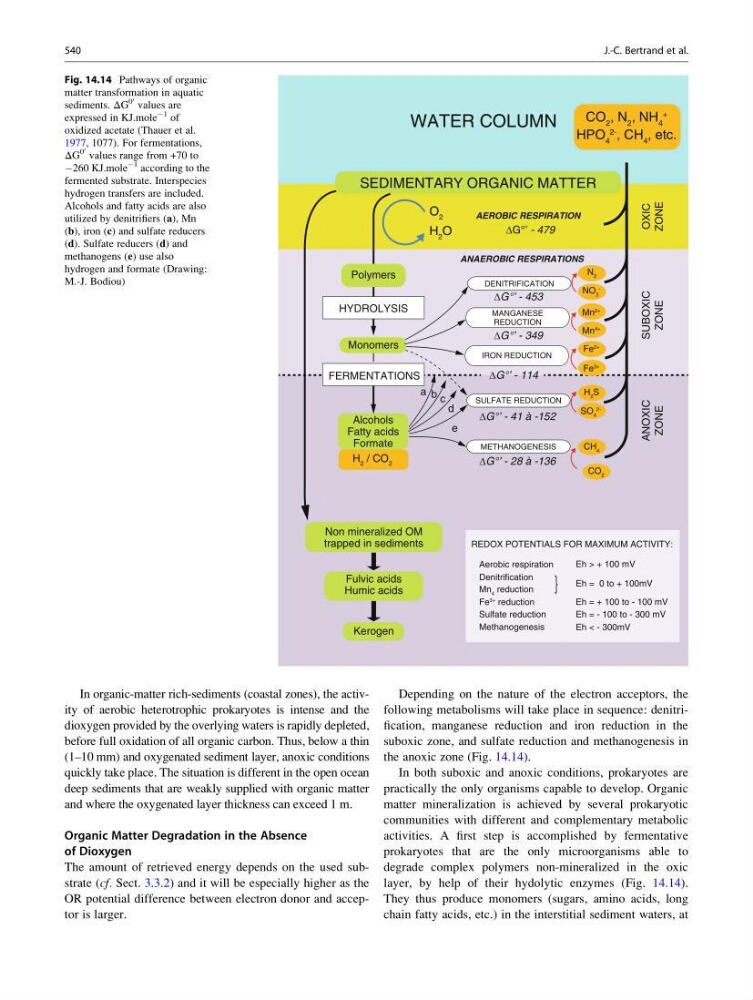
Depending on the nature of the electron acceptors, the
following metabolisms will take place in sequence: denitrification, manganese reduction and iron reduction in the
suboxic zone, and sulfate reduction and methanogenesis in
the anoxic zone (Fig. 14.14).
In both suboxic and anoxic conditions, prokaryotes are
practically the only organisms capable to develop. Organic
matter mineralization is achieved by several prokaryotic
communities with different and complementary metabolic
activities. A first step is accomplished by fermentative
prokaryotes that are the only microorganisms able to
degrade complex polymers non-mineralized in the oxic
layer, by help of their hydolytic enzymes (Fig. 14.14).
They thus produce monomers (sugars, amino acids, long
chain fatty acids, etc.) in the interstitial sediment waters, at
WATER COLUMN
OXIC
ZONE
SUBOXIC
ZONE
ANOXIC
ZONE
Aerobic respiration
Denitrification
Mn 4 reduction
Fe
3+ reduction
Sulfate reduction
Methanogenesis
Eh > + 100 mV
Eh = 0 to + 100mV
Eh = + 100 to - 100 mV
Eh = - 100 to - 300 mV
Eh < - 300mV
REDOX POTENTIALS FOR MAXIMUM ACTIVITY:
}
a b c
d
e
AEROBIC RESPIRATION
ANAEROBIC RESPIRATIONS
∆G°’ - 479
∆G°’ - 453
∆G°’ - 349
∆G°’ - 114
∆G°’ - 41 à -152
∆G°’ - 28 à -136
O 2
H 2 O
CO 2 , N 2 , NH 4
+
HPO 4
2, CH 4 , etc.
DENITRIFICATION
MANGANESE
REDUCTION
IRON REDUCTION
SULFATE REDUCTION
METHANOGENESIS
SEDIMENTARY ORGANIC MATTER
Non mineralized OM
trapped in sediments
Fulvic acids
Humic acids
Kerogen
H 2 / CO 2
Alcohols
Fatty acids
Formate
FERMENTATIONS
HYDROLYSIS
Polymers
Monomers
N 2
NO 3
-
Mn
2+
Mn
4+
Fe
2+
Fe
3+
H 2 S
SO 4
2CH 4
CO 2
Fig. 14.14 Pathways of organic
matter transformation in aquatic
sediments. ΔG
0
0
values are
expressed in KJ.mole
À1 of
oxidized acetate (Thauer et al.
1977, 1077). For fermentations,
ΔG
0
0
values range from +70 to
À260 KJ.mole
À1 according to the
fermented substrate. Interspecies
hydrogen transfers are included.
Alcohols and fatty acids are also
utilized by denitrifiers (a), Mn
(b), iron (c) and sulfate reducers
(d). Sulfate reducers (d) and
methanogens (e) use also
hydrogen and formate (Drawing:
M.-J. Bodiou)
540
J.-C. Bertrand et al.
dioxygen provided by the overlying waters is rapidly depleted,
before full oxidation of all organic carbon. Thus, below a thin
(1–10 mm) and oxygenated sediment layer, anoxic conditions
quickly take place. The situation is different in the open ocean
deep sediments that are weakly supplied with organic matter
and where the oxygenated layer thickness can exceed 1 m.
Organic Matter Degradation in the Absence
of Dioxygen
The amount of retrieved energy depends on the used substrate (cf. Sect. 3.3.2) and it will be especially higher as the
OR potential difference between electron donor and acceptor is larger.
Depending on the nature of the electron acceptors, the
following metabolisms will take place in sequence: denitrification, manganese reduction and iron reduction in the
suboxic zone, and sulfate reduction and methanogenesis in
the anoxic zone (Fig. 14.14).
In both suboxic and anoxic conditions, prokaryotes are
practically the only organisms capable to develop. Organic
matter mineralization is achieved by several prokaryotic
communities with different and complementary metabolic
activities. A first step is accomplished by fermentative
prokaryotes that are the only microorganisms able to
degrade complex polymers non-mineralized in the oxic
layer, by help of their hydolytic enzymes (Fig. 14.14).
They thus produce monomers (sugars, amino acids, long
chain fatty acids, etc.) in the interstitial sediment waters, at
WATER COLUMN
OXIC
ZONE
SUBOXIC
ZONE
ANOXIC
ZONE
Aerobic respiration
Denitrification
Mn 4 reduction
Fe
3+ reduction
Sulfate reduction
Methanogenesis
Eh > + 100 mV
Eh = 0 to + 100mV
Eh = + 100 to - 100 mV
Eh = - 100 to - 300 mV
Eh < - 300mV
REDOX POTENTIALS FOR MAXIMUM ACTIVITY:
}
a b c
d
e
AEROBIC RESPIRATION
ANAEROBIC RESPIRATIONS
∆G°’ - 479
∆G°’ - 453
∆G°’ - 349
∆G°’ - 114
∆G°’ - 41 à -152
∆G°’ - 28 à -136
O 2
H 2 O
CO 2 , N 2 , NH 4
+
HPO 4
2, CH 4 , etc.
DENITRIFICATION
MANGANESE
REDUCTION
IRON REDUCTION
SULFATE REDUCTION
METHANOGENESIS
SEDIMENTARY ORGANIC MATTER
Non mineralized OM
trapped in sediments
Fulvic acids
Humic acids
Kerogen
H 2 / CO 2
Alcohols
Fatty acids
Formate
FERMENTATIONS
HYDROLYSIS
Polymers
Monomers
N 2
NO 3
-
Mn
2+
Mn
4+
Fe
2+
Fe
3+
H 2 S
SO 4
2CH 4
CO 2
Fig. 14.14 Pathways of organic
matter transformation in aquatic
sediments. ΔG
0
0
values are
expressed in KJ.mole
À1 of
oxidized acetate (Thauer et al.
1977, 1077). For fermentations,
ΔG
0
0
values range from +70 to
À260 KJ.mole
À1 according to the
fermented substrate. Interspecies
hydrogen transfers are included.
Alcohols and fatty acids are also
utilized by denitrifiers (a), Mn
(b), iron (c) and sulfate reducers
(d). Sulfate reducers (d) and
methanogens (e) use also
hydrogen and formate (Drawing:
M.-J. Bodiou)
540
J.-C. Bertrand et al.