

14.2.4.3 Organic Matter Degradation in Sediment
According to oxido-reduction (OR) potential values, three
zones are distinguished (Fig. 14.14): an oxic zone in which
OR potentials are greater than +100 mV, where aerobic,
facultative anaerobic, and microaerophilic organisms live.
Below, there are two dioxygen-depleted sediment layers:
one suboxic layer where OR potential is in the range À100
to +100 mV, and an anoxic zone where OR values are lower
than À100 mV. Both areas are typical environments for the
expression of anaerobic metabolisms. Their distribution will
depend on the OR potential of the electron donor-acceptor
couple that is considered (Lovley 1991; Jørgensen 2000).
Under non-limiting conditions of substrates and terminal
electron acceptors, the metabolism vertical distribution in
sediments is typically stratified, on the basis of their thermodynamic efficiency (Fig. 14.14). The metabolism gradient
from surface to deeper sediments comprises successively:
aerobic respiration, denitrification, respirations that use manganese and iron as terminal electron acceptors, sulfate
reduction, and methanogenesis (cf. Sect. 3.3.2). This vertical
distribution is theoretical because there is no clear boundary
between the expression levels of the different metabolisms,
but there are instead levels separated by gradual transitions.
Thus, in the same sediment layer, different respiratory
activities can be detected, especially in coastal areas receiving
large organic matter inputs.
Organic Matter Degradation in the Presence
of Dioxygen
The organic matter degradation by microorganisms mainly
depends on the energy efficiency of their metabolism, when
the electron donor (growth substrates) and the terminal electron
acceptors are abundant enough in the environment. Thermodynamically, aerobic respiration is the most efficient metabolism;
when dioxygen is present, it is preferably used as the terminal
electron acceptor by heterotrophic aerobic prokaryotes.
Some of these latter will firstly attack macromolecules
(cellulose, chitin, proteins, lipids, etc.) by means of hydrolytic
enzymes (cellulases, chitinases, proteases, lipases, etc.). These
enzymes are usually located outside the cytoplasmic membrane or in the periplasmic space and are rarely free or adsorbed
on particles. In the first case, the hydrolytic enzymes are
labeled “ecto-enzymes” and, in the second case, “extracellular”
enzymes. Heterotrophic prokaryotes will then mineralize
molecules produced by enzymatic hydrolysis.
Box 14.3 (continued)
and to subsidence of the sediment column into the
ingestion cavity.
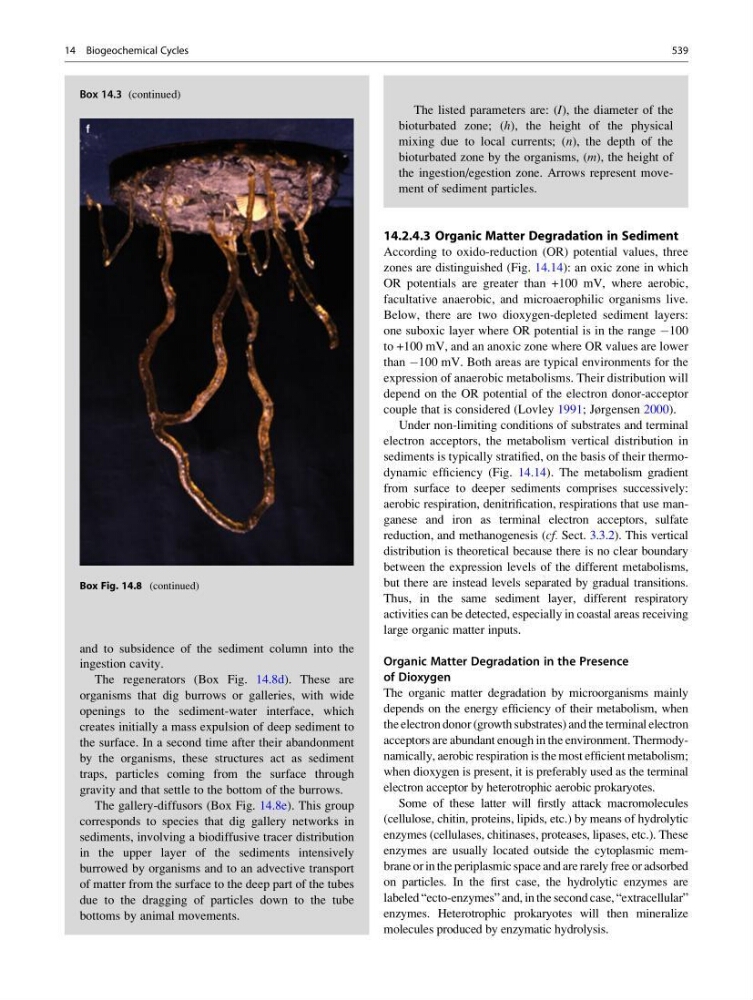
The regenerators (Box Fig. 14.8d). These are
organisms that dig burrows or galleries, with wide
openings to the sediment-water interface, which
creates initially a mass expulsion of deep sediment to
the surface. In a second time after their abandonment
by the organisms, these structures act as sediment
traps, particles coming from the surface through
gravity and that settle to the bottom of the burrows.
The gallery-diffusors (Box Fig. 14.8e). This group
corresponds to species that dig gallery networks in
sediments, involving a biodiffusive tracer distribution
in the upper layer of the sediments intensively
burrowed by organisms and to an advective transport
of matter from the surface to the deep part of the tubes
due to the dragging of particles down to the tube
bottoms by animal movements.
(continued)
Box 14.3 (continued)
The listed parameters are: (I), the diameter of the
bioturbated zone; (h), the height of the physical
mixing due to local currents; (n), the depth of the
bioturbated zone by the organisms, (m), the height of
the ingestion/egestion zone. Arrows represent movement of sediment particles.
Box Fig. 14.8 (continued)
14 Biogeochemical Cycles
539
According to oxido-reduction (OR) potential values, three
zones are distinguished (Fig. 14.14): an oxic zone in which
OR potentials are greater than +100 mV, where aerobic,
facultative anaerobic, and microaerophilic organisms live.
Below, there are two dioxygen-depleted sediment layers:
one suboxic layer where OR potential is in the range À100
to +100 mV, and an anoxic zone where OR values are lower
than À100 mV. Both areas are typical environments for the
expression of anaerobic metabolisms. Their distribution will
depend on the OR potential of the electron donor-acceptor
couple that is considered (Lovley 1991; Jørgensen 2000).
Under non-limiting conditions of substrates and terminal
electron acceptors, the metabolism vertical distribution in
sediments is typically stratified, on the basis of their thermodynamic efficiency (Fig. 14.14). The metabolism gradient
from surface to deeper sediments comprises successively:
aerobic respiration, denitrification, respirations that use manganese and iron as terminal electron acceptors, sulfate
reduction, and methanogenesis (cf. Sect. 3.3.2). This vertical
distribution is theoretical because there is no clear boundary
between the expression levels of the different metabolisms,
but there are instead levels separated by gradual transitions.
Thus, in the same sediment layer, different respiratory
activities can be detected, especially in coastal areas receiving
large organic matter inputs.
Organic Matter Degradation in the Presence
of Dioxygen
The organic matter degradation by microorganisms mainly
depends on the energy efficiency of their metabolism, when
the electron donor (growth substrates) and the terminal electron
acceptors are abundant enough in the environment. Thermodynamically, aerobic respiration is the most efficient metabolism;
when dioxygen is present, it is preferably used as the terminal
electron acceptor by heterotrophic aerobic prokaryotes.
Some of these latter will firstly attack macromolecules
(cellulose, chitin, proteins, lipids, etc.) by means of hydrolytic
enzymes (cellulases, chitinases, proteases, lipases, etc.). These
enzymes are usually located outside the cytoplasmic membrane or in the periplasmic space and are rarely free or adsorbed
on particles. In the first case, the hydrolytic enzymes are
labeled “ecto-enzymes” and, in the second case, “extracellular”
enzymes. Heterotrophic prokaryotes will then mineralize
molecules produced by enzymatic hydrolysis.
Box 14.3 (continued)
and to subsidence of the sediment column into the
ingestion cavity.
The regenerators (Box Fig. 14.8d). These are
organisms that dig burrows or galleries, with wide
openings to the sediment-water interface, which
creates initially a mass expulsion of deep sediment to
the surface. In a second time after their abandonment
by the organisms, these structures act as sediment
traps, particles coming from the surface through
gravity and that settle to the bottom of the burrows.
The gallery-diffusors (Box Fig. 14.8e). This group
corresponds to species that dig gallery networks in
sediments, involving a biodiffusive tracer distribution
in the upper layer of the sediments intensively
burrowed by organisms and to an advective transport
of matter from the surface to the deep part of the tubes
due to the dragging of particles down to the tube
bottoms by animal movements.
(continued)
Box 14.3 (continued)
The listed parameters are: (I), the diameter of the
bioturbated zone; (h), the height of the physical
mixing due to local currents; (n), the depth of the
bioturbated zone by the organisms, (m), the height of
the ingestion/egestion zone. Arrows represent movement of sediment particles.
Box Fig. 14.8 (continued)
14 Biogeochemical Cycles
539