

root exudates and root- and aboveground-litter (Fig. 14.15),
microorganisms have a fundamental role in the carbon cycle
in soil, since they are strongly involved in the transformation
of organic carbon compounds. In particular, they are known
to assimilate root exudates very quickly (Hutsch et al. 2002).
In addition, most of the roots are tightly linked to mycorrhizal fungi, so that the carbon assimilated by plants goes
through these mycorrhizal fungi.
The organic matter content is critical for biological
activities and is often used as an indicator of soil quality
(De Bona et al. 2008), both for agricultural purposes (such
as fertility) and for environmental issues as such carbon
sequestration in soils, which can influence carbon concentration in the atmosphere and therefore the greenhouse effect.
The abundance, diversity, and activity of soil fauna and
microorganisms are generally closely related to organic matter concentration and quality. In addition, organic matter and
the related biological activities have a major influence on the
physical and chemical properties of soils: water retention
capacity, aerobic conditions, aggregation, and stability of
soil structure, all increase with its organic matter content.
The latter also affects the dynamics and availability of the
main nutrients and key toxic elements (pesticides, heavy
metals, etc.) (Farenhorst 2006; van Herwijnen et al. 2007).
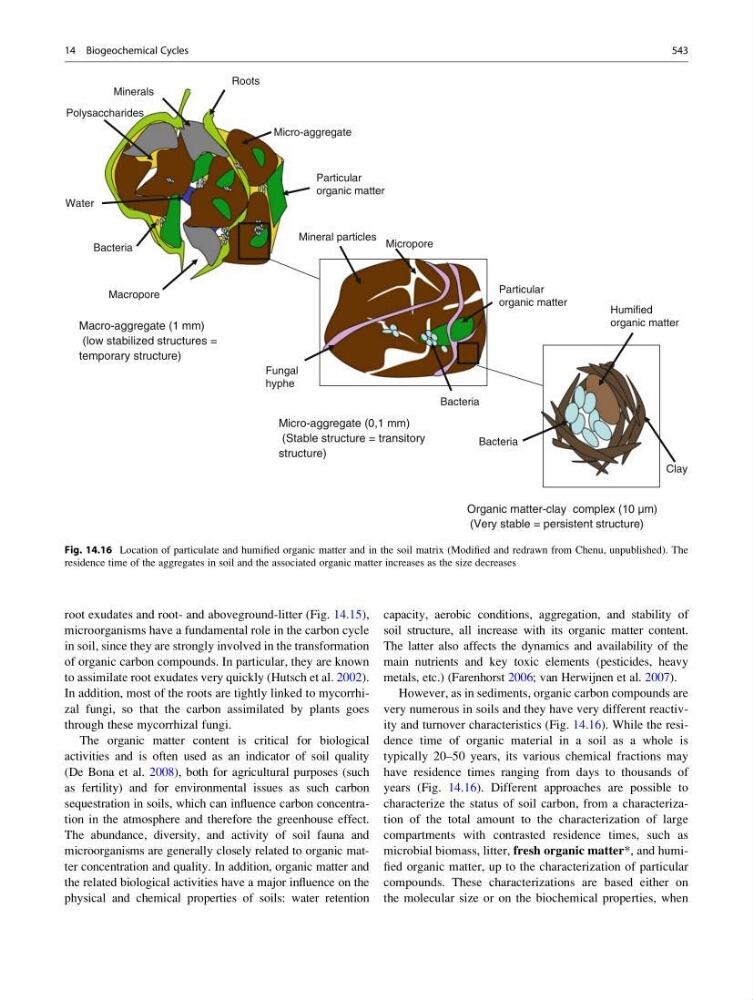
However, as in sediments, organic carbon compounds are
very numerous in soils and they have very different reactivity and turnover characteristics (Fig. 14.16). While the residence time of organic material in a soil as a whole is
typically 20–50 years, its various chemical fractions may
have residence times ranging from days to thousands of
years (Fig. 14.16). Different approaches are possible to
characterize the status of soil carbon, from a characterization of the total amount to the characterization of large
compartments with contrasted residence times, such as
microbial biomass, litter, fresh organic matter*, and humified organic matter, up to the characterization of particular
compounds. These characterizations are based either on
the molecular size or on the biochemical properties, when
Bacteria
Roots
Minerals
Micro-aggregate
Macropore
Water
Particular
organic matter
Polysaccharides
Particular
organic matter
Humified
organic matter
Bacteria
Clay
Fungal
hyphe
Micropore
Bacteria
Macro-aggregate (1 mm)
(low stabilized structures =
temporary structure)
Micro-aggregate (0,1 mm)
(Stable structure = transitory
structure)
Organic matter-clay complex (10 μm)
(Very stable = persistent structure)
Mineral particles
Fig. 14.16 Location of particulate and humified organic matter and in the soil matrix (Modified and redrawn from Chenu, unpublished). The
residence time of the aggregates in soil and the associated organic matter increases as the size decreases
14 Biogeochemical Cycles
543
microorganisms have a fundamental role in the carbon cycle
in soil, since they are strongly involved in the transformation
of organic carbon compounds. In particular, they are known
to assimilate root exudates very quickly (Hutsch et al. 2002).
In addition, most of the roots are tightly linked to mycorrhizal fungi, so that the carbon assimilated by plants goes
through these mycorrhizal fungi.
The organic matter content is critical for biological
activities and is often used as an indicator of soil quality
(De Bona et al. 2008), both for agricultural purposes (such
as fertility) and for environmental issues as such carbon
sequestration in soils, which can influence carbon concentration in the atmosphere and therefore the greenhouse effect.
The abundance, diversity, and activity of soil fauna and
microorganisms are generally closely related to organic matter concentration and quality. In addition, organic matter and
the related biological activities have a major influence on the
physical and chemical properties of soils: water retention
capacity, aerobic conditions, aggregation, and stability of
soil structure, all increase with its organic matter content.
The latter also affects the dynamics and availability of the
main nutrients and key toxic elements (pesticides, heavy
metals, etc.) (Farenhorst 2006; van Herwijnen et al. 2007).
However, as in sediments, organic carbon compounds are
very numerous in soils and they have very different reactivity and turnover characteristics (Fig. 14.16). While the residence time of organic material in a soil as a whole is
typically 20–50 years, its various chemical fractions may
have residence times ranging from days to thousands of
years (Fig. 14.16). Different approaches are possible to
characterize the status of soil carbon, from a characterization of the total amount to the characterization of large
compartments with contrasted residence times, such as
microbial biomass, litter, fresh organic matter*, and humified organic matter, up to the characterization of particular
compounds. These characterizations are based either on
the molecular size or on the biochemical properties, when
Bacteria
Roots
Minerals
Micro-aggregate
Macropore
Water
Particular
organic matter
Polysaccharides
Particular
organic matter
Humified
organic matter
Bacteria
Clay
Fungal
hyphe
Micropore
Bacteria
Macro-aggregate (1 mm)
(low stabilized structures =
temporary structure)
Micro-aggregate (0,1 mm)
(Stable structure = transitory
structure)
Organic matter-clay complex (10 μm)
(Very stable = persistent structure)
Mineral particles
Fig. 14.16 Location of particulate and humified organic matter and in the soil matrix (Modified and redrawn from Chenu, unpublished). The
residence time of the aggregates in soil and the associated organic matter increases as the size decreases
14 Biogeochemical Cycles
543