

reaction, RuBisCo, glycolate oxidase, chlororespiration,
cytochrome oxidase and other oxidases (del Giorgio and
Williams 2005).
The main goal of cell respiration is to produce the energy
required by cell needs. To survive, cell needs a continuous
supply of energy to achieve the various cell works (mechanical
work for moving; chemical work in the biosynthesis of
biological macromolecules, osmotic work during active
transports of molecules across membranes). In heterotrophic
organisms, these energy requirements are covered by catabolism, that is to say all reactions that break down and transform
complex organic compounds (carbohydrates, lipids, and
proteins) into smaller and simpler molecules. The biological
oxidation metabolisms lead to the formation of reduced
compounds (NADH and NADPH) that fuel electron transport
systems, resulting in the reduction of a terminal electron
acceptor which is usually supplied by diffusion from the
external environment (cf. Sect. 3.3.1). Fifteen electron
acceptors were described in the ocean, but oxygen is the
main one in the water column where it is almost always the
terminal acceptor (cf. Sect. 3.3.2). Electron transfer is coupled
to proton translocation through bioenergetic membranes,
namely the mitochondrial inner membrane in eukaryotic
cells, and the plasmic membrane in prokaryotic cells. The
resulting difference in the electrochemical potential of the
proton activates the phosphorylation of adenosine diphosphate
(ADP) into adenosine triphosphate (ATP) via the activity of
ATP synthase. These mechanisms of energy conversion are
described by the chemio-osmotic theory of Mitchell (1961).
ATP is the main energy vector for living cells and its hydrolysis into ADP and inorganic phosphate (Pi) during subsequent
couplings enables the recovery of the reaction free energy to
perform most of the cellular functions.
Respiration is the most important sink of organic matter
on the planet. In addition, its reagents (O 2 , NO 3
À SO 4
2À ) and
end-products (e.g., CO 2 , CH 4 , N 2 , H 2 S) play a major role in
biogeochemical cycles. It is therefore surprising that marine
respiration has received little attention compared with the
reverse process of primary production. Though respiration
would be impossible without primary production, coupling
between both processes is far from being as tight as thought
until very recently. Production and respiration can be
decoupled with respect to time (during the transfer of
organic matter into the trophic network) and space, because
a large fraction of respiration takes place away from the
surface where organic matter is produced.
Respiration at the Ecosystem Scale
Respiration in the main aquatic ecosystems was reviewed by
Williams and del Giorgio (2005). Values related to the
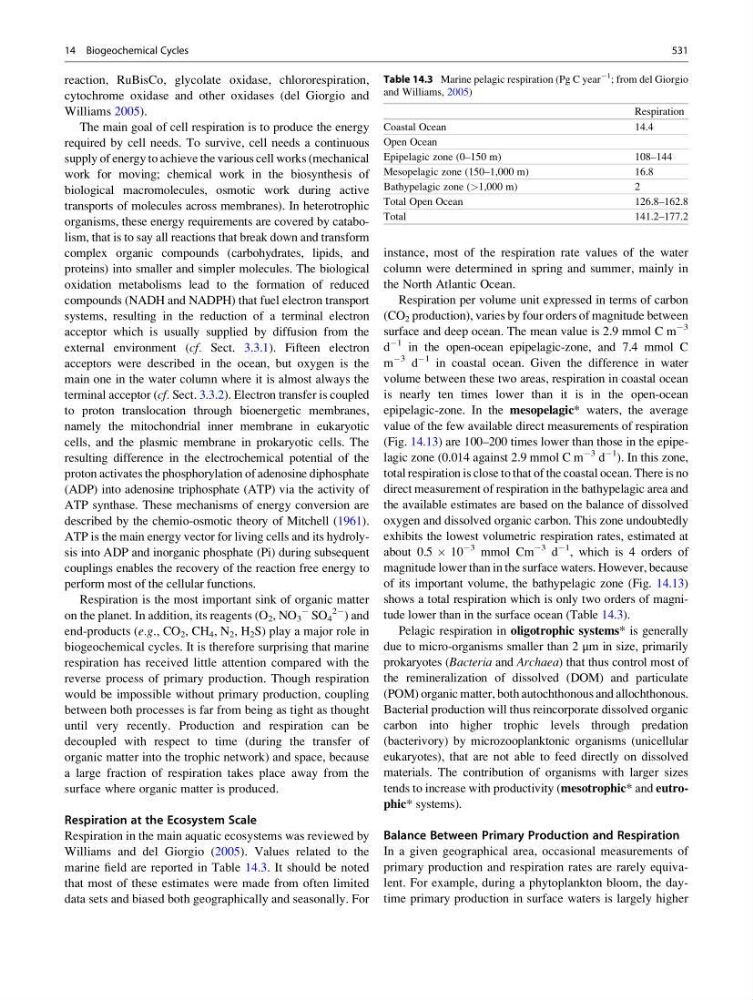
marine field are reported in Table 14.3. It should be noted
that most of these estimates were made from often limited
data sets and biased both geographically and seasonally. For
instance, most of the respiration rate values of the water
column were determined in spring and summer, mainly in
the North Atlantic Ocean.
Respiration per volume unit expressed in terms of carbon
(CO 2 production), varies by four orders of magnitude between
surface and deep ocean. The mean value is 2.9 mmol C m
À3
d
À1 in the open-ocean epipelagic-zone, and 7.4 mmol C
m
À3 d
À1 in coastal ocean. Given the difference in water
volume between these two areas, respiration in coastal ocean
is nearly ten times lower than it is in the open-ocean
epipelagic-zone. In the mesopelagic* waters, the average
value of the few available direct measurements of respiration
(Fig. 14.13) are 100–200 times lower than those in the epipelagic zone (0.014 against 2.9 mmol C m
À3 d
À1
). In this zone,
total respiration is close to that of the coastal ocean. There is no
direct measurement of respiration in the bathypelagic area and
the available estimates are based on the balance of dissolved
oxygen and dissolved organic carbon. This zone undoubtedly
exhibits the lowest volumetric respiration rates, estimated at
about 0.5 Â 10
À3 mmol Cm
À3 d
À1
, which is 4 orders of
magnitude lower than in the surface waters. However, because
of its important volume, the bathypelagic zone (Fig. 14.13)
shows a total respiration which is only two orders of magnitude lower than in the surface ocean (Table 14.3).
Pelagic respiration in oligotrophic systems* is generally
due to micro-organisms smaller than 2 μm in size, primarily
prokaryotes (Bacteria and Archaea) that thus control most of
the remineralization of dissolved (DOM) and particulate
(POM) organic matter, both autochthonous and allochthonous.
Bacterial production will thus reincorporate dissolved organic
carbon into higher trophic levels through predation
(bacterivory) by microzooplanktonic organisms (unicellular
eukaryotes), that are not able to feed directly on dissolved
materials. The contribution of organisms with larger sizes
tends to increase with productivity (mesotrophic* and eutrophic* systems).
Balance Between Primary Production and Respiration
In a given geographical area, occasional measurements of
primary production and respiration rates are rarely equivalent. For example, during a phytoplankton bloom, the daytime primary production in surface waters is largely higher
Table 14.3 Marine pelagic respiration (Pg C year
À1
; from del Giorgio
and Williams, 2005)
Respiration
Coastal Ocean
14.4
Open Ocean
Epipelagic zone (0–150 m)
108–144
Mesopelagic zone (150–1,000 m)
16.8
Bathypelagic zone (>1,000 m)
2
Total Open Ocean
126.8–162.8
Total
141.2–177.2
14 Biogeochemical Cycles
531
cytochrome oxidase and other oxidases (del Giorgio and
Williams 2005).
The main goal of cell respiration is to produce the energy
required by cell needs. To survive, cell needs a continuous
supply of energy to achieve the various cell works (mechanical
work for moving; chemical work in the biosynthesis of
biological macromolecules, osmotic work during active
transports of molecules across membranes). In heterotrophic
organisms, these energy requirements are covered by catabolism, that is to say all reactions that break down and transform
complex organic compounds (carbohydrates, lipids, and
proteins) into smaller and simpler molecules. The biological
oxidation metabolisms lead to the formation of reduced
compounds (NADH and NADPH) that fuel electron transport
systems, resulting in the reduction of a terminal electron
acceptor which is usually supplied by diffusion from the
external environment (cf. Sect. 3.3.1). Fifteen electron
acceptors were described in the ocean, but oxygen is the
main one in the water column where it is almost always the
terminal acceptor (cf. Sect. 3.3.2). Electron transfer is coupled
to proton translocation through bioenergetic membranes,
namely the mitochondrial inner membrane in eukaryotic
cells, and the plasmic membrane in prokaryotic cells. The
resulting difference in the electrochemical potential of the
proton activates the phosphorylation of adenosine diphosphate
(ADP) into adenosine triphosphate (ATP) via the activity of
ATP synthase. These mechanisms of energy conversion are
described by the chemio-osmotic theory of Mitchell (1961).
ATP is the main energy vector for living cells and its hydrolysis into ADP and inorganic phosphate (Pi) during subsequent
couplings enables the recovery of the reaction free energy to
perform most of the cellular functions.
Respiration is the most important sink of organic matter
on the planet. In addition, its reagents (O 2 , NO 3
À SO 4
2À ) and
end-products (e.g., CO 2 , CH 4 , N 2 , H 2 S) play a major role in
biogeochemical cycles. It is therefore surprising that marine
respiration has received little attention compared with the
reverse process of primary production. Though respiration
would be impossible without primary production, coupling
between both processes is far from being as tight as thought
until very recently. Production and respiration can be
decoupled with respect to time (during the transfer of
organic matter into the trophic network) and space, because
a large fraction of respiration takes place away from the
surface where organic matter is produced.
Respiration at the Ecosystem Scale
Respiration in the main aquatic ecosystems was reviewed by
Williams and del Giorgio (2005). Values related to the
marine field are reported in Table 14.3. It should be noted
that most of these estimates were made from often limited
data sets and biased both geographically and seasonally. For
instance, most of the respiration rate values of the water
column were determined in spring and summer, mainly in
the North Atlantic Ocean.
Respiration per volume unit expressed in terms of carbon
(CO 2 production), varies by four orders of magnitude between
surface and deep ocean. The mean value is 2.9 mmol C m
À3
d
À1 in the open-ocean epipelagic-zone, and 7.4 mmol C
m
À3 d
À1 in coastal ocean. Given the difference in water
volume between these two areas, respiration in coastal ocean
is nearly ten times lower than it is in the open-ocean
epipelagic-zone. In the mesopelagic* waters, the average
value of the few available direct measurements of respiration
(Fig. 14.13) are 100–200 times lower than those in the epipelagic zone (0.014 against 2.9 mmol C m
À3 d
À1
). In this zone,
total respiration is close to that of the coastal ocean. There is no
direct measurement of respiration in the bathypelagic area and
the available estimates are based on the balance of dissolved
oxygen and dissolved organic carbon. This zone undoubtedly
exhibits the lowest volumetric respiration rates, estimated at
about 0.5 Â 10
À3 mmol Cm
À3 d
À1
, which is 4 orders of
magnitude lower than in the surface waters. However, because
of its important volume, the bathypelagic zone (Fig. 14.13)
shows a total respiration which is only two orders of magnitude lower than in the surface ocean (Table 14.3).
Pelagic respiration in oligotrophic systems* is generally
due to micro-organisms smaller than 2 μm in size, primarily
prokaryotes (Bacteria and Archaea) that thus control most of
the remineralization of dissolved (DOM) and particulate
(POM) organic matter, both autochthonous and allochthonous.
Bacterial production will thus reincorporate dissolved organic
carbon into higher trophic levels through predation
(bacterivory) by microzooplanktonic organisms (unicellular
eukaryotes), that are not able to feed directly on dissolved
materials. The contribution of organisms with larger sizes
tends to increase with productivity (mesotrophic* and eutrophic* systems).
Balance Between Primary Production and Respiration
In a given geographical area, occasional measurements of
primary production and respiration rates are rarely equivalent. For example, during a phytoplankton bloom, the daytime primary production in surface waters is largely higher
Table 14.3 Marine pelagic respiration (Pg C year
À1
; from del Giorgio
and Williams, 2005)
Respiration
Coastal Ocean
14.4
Open Ocean
Epipelagic zone (0–150 m)
108–144
Mesopelagic zone (150–1,000 m)
16.8
Bathypelagic zone (>1,000 m)
2
Total Open Ocean
126.8–162.8
Total
141.2–177.2
14 Biogeochemical Cycles
531