

The main environmental parameters that control photosynthesis in the ocean are light and nutrient concentration.
Control by Light
Light is absorbed and scattered by seawater and also by
dissolved and particulate matter (including phytoplankton
itself). The penetrating light decreases exponentially with
depth. The layer where light is sufficient to enable a positive
net primary production is called euphotic zone (Fig. 14.11).
Its lower limit is called compensation depth because the
specific production balances the specific respiration. The
thickness of the euphotic layer varies from a few meters to
over 100 m depth, depending on seawater turbidity. The
lower limit of the euphotic layer is often defined as the
depth at which light intensity is 1 % of the surface irradiance,
but photosynthesis remains possible at lower light intensity.
This is particularly the case in oceanic regions with very low
nutrient concentrations (Oligotrophic areas) such as, for
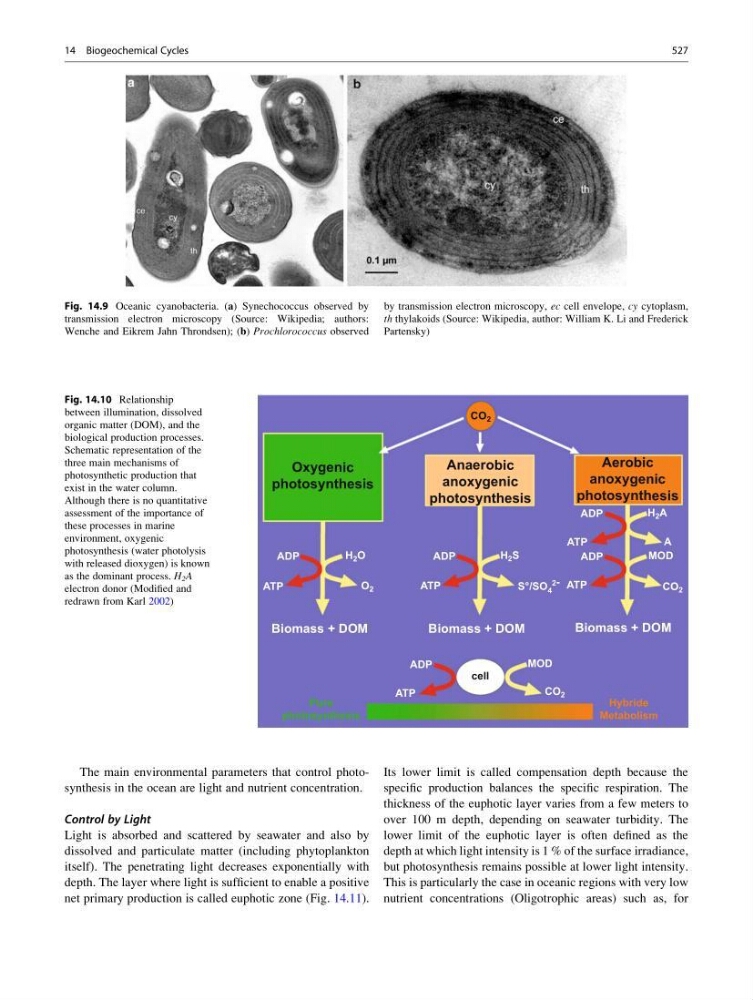
Fig. 14.9 Oceanic cyanobacteria. (a) Synechococcus observed by
transmission electron microscopy (Source: Wikipedia; authors:
Wenche and Eikrem Jahn Throndsen); (b) Prochlorococcus observed
by transmission electron microscopy, ec cell envelope, cy cytoplasm,
th thylakoids (Source: Wikipedia, author: William K. Li and Frederick
Partensky)
ADP
AT
Pure
photosynthesis
P
MO
Hybride
Metabolism
D
cell
Oxygenic
photosynthesis
H 2 O
O 2
ADP
ATP
Biomass + DOM
Anaerobic
anoxygenic
photosynthesis
H 2 S
S°/SO 4
2ADP
ATP
Biomass + DOM
CO 2
Aerobic
anoxygenic
photosynthesis
H 2 A
A
ADP
ATP
Biomass + DOM
MOD
ADP
ATP
CO 2
CO 2
Fig. 14.10 Relationship
between illumination, dissolved
organic matter (DOM), and the
biological production processes.
Schematic representation of the
three main mechanisms of
photosynthetic production that
exist in the water column.
Although there is no quantitative
assessment of the importance of
these processes in marine
environment, oxygenic
photosynthesis (water photolysis
with released dioxygen) is known
as the dominant process. H 2 A
electron donor (Modified and
redrawn from Karl 2002)
14 Biogeochemical Cycles
527
Control by Light
Light is absorbed and scattered by seawater and also by
dissolved and particulate matter (including phytoplankton
itself). The penetrating light decreases exponentially with
depth. The layer where light is sufficient to enable a positive
net primary production is called euphotic zone (Fig. 14.11).
Its lower limit is called compensation depth because the
specific production balances the specific respiration. The
thickness of the euphotic layer varies from a few meters to
over 100 m depth, depending on seawater turbidity. The
lower limit of the euphotic layer is often defined as the
depth at which light intensity is 1 % of the surface irradiance,
but photosynthesis remains possible at lower light intensity.
This is particularly the case in oceanic regions with very low
nutrient concentrations (Oligotrophic areas) such as, for
Fig. 14.9 Oceanic cyanobacteria. (a) Synechococcus observed by
transmission electron microscopy (Source: Wikipedia; authors:
Wenche and Eikrem Jahn Throndsen); (b) Prochlorococcus observed
by transmission electron microscopy, ec cell envelope, cy cytoplasm,
th thylakoids (Source: Wikipedia, author: William K. Li and Frederick
Partensky)
ADP
AT
Pure
photosynthesis
P
MO
Hybride
Metabolism
D
cell
Oxygenic
photosynthesis
H 2 O
O 2
ADP
ATP
Biomass + DOM
Anaerobic
anoxygenic
photosynthesis
H 2 S
S°/SO 4
2ADP
ATP
Biomass + DOM
CO 2
Aerobic
anoxygenic
photosynthesis
H 2 A
A
ADP
ATP
Biomass + DOM
MOD
ADP
ATP
CO 2
CO 2
Fig. 14.10 Relationship
between illumination, dissolved
organic matter (DOM), and the
biological production processes.
Schematic representation of the
three main mechanisms of
photosynthetic production that
exist in the water column.
Although there is no quantitative
assessment of the importance of
these processes in marine
environment, oxygenic
photosynthesis (water photolysis
with released dioxygen) is known
as the dominant process. H 2 A
electron donor (Modified and
redrawn from Karl 2002)
14 Biogeochemical Cycles
527