

example, in the Pacific Ocean where the deepest euphotic
layer depth ever measured was recorded (about 170 m;
Morel et al. 2007).
The quantity of light received by phytoplankton depends
not only on light penetration into the water column, but also
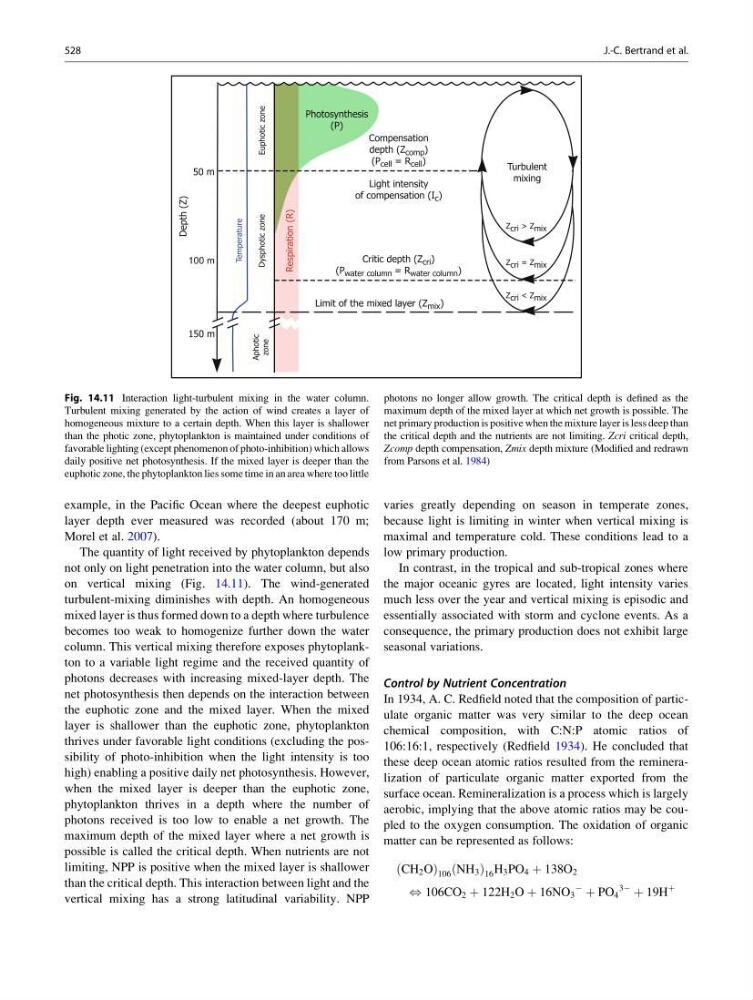
on vertical mixing (Fig. 14.11). The wind-generated
turbulent-mixing diminishes with depth. An homogeneous
mixed layer is thus formed down to a depth where turbulence
becomes too weak to homogenize further down the water
column. This vertical mixing therefore exposes phytoplankton to a variable light regime and the received quantity of
photons decreases with increasing mixed-layer depth. The
net photosynthesis then depends on the interaction between
the euphotic zone and the mixed layer. When the mixed
layer is shallower than the euphotic zone, phytoplankton
thrives under favorable light conditions (excluding the possibility of photo-inhibition when the light intensity is too
high) enabling a positive daily net photosynthesis. However,
when the mixed layer is deeper than the euphotic zone,
phytoplankton thrives in a depth where the number of
photons received is too low to enable a net growth. The
maximum depth of the mixed layer where a net growth is
possible is called the critical depth. When nutrients are not
limiting, NPP is positive when the mixed layer is shallower
than the critical depth. This interaction between light and the
vertical mixing has a strong latitudinal variability. NPP
varies greatly depending on season in temperate zones,
because light is limiting in winter when vertical mixing is
maximal and temperature cold. These conditions lead to a
low primary production.
In contrast, in the tropical and sub-tropical zones where
the major oceanic gyres are located, light intensity varies
much less over the year and vertical mixing is episodic and
essentially associated with storm and cyclone events. As a
consequence, the primary production does not exhibit large
seasonal variations.
Control by Nutrient Concentration
In 1934, A. C. Redfield noted that the composition of particulate organic matter was very similar to the deep ocean
chemical composition, with C:N:P atomic ratios of
106:16:1, respectively (Redfield 1934). He concluded that
these deep ocean atomic ratios resulted from the remineralization of particulate organic matter exported from the
surface ocean. Remineralization is a process which is largely
aerobic, implying that the above atomic ratios may be coupled to the oxygen consumption. The oxidation of organic
matter can be represented as follows:
CH 2 O
ð
Þ 106 NH 3
ð
Þ 16 H 3 PO 4 þ 138O 2
, 106CO 2 þ 122H 2 O þ 16NO 3
À
þ PO 4
3À
þ 19H
þ
Fig. 14.11 Interaction light-turbulent mixing in the water column.
Turbulent mixing generated by the action of wind creates a layer of
homogeneous mixture to a certain depth. When this layer is shallower
than the photic zone, phytoplankton is maintained under conditions of
favorable lighting (except phenomenon of photo-inhibition) which allows
daily positive net photosynthesis. If the mixed layer is deeper than the
euphotic zone, the phytoplankton lies some time in an area where too little
photons no longer allow growth. The critical depth is defined as the
maximum depth of the mixed layer at which net growth is possible. The
net primary production is positive when the mixture layer is less deep than
the critical depth and the nutrients are not limiting. Zcri critical depth,
Zcomp depth compensation, Zmix depth mixture (Modified and redrawn
from Parsons et al. 1984)
528
J.-C. Bertrand et al.
layer depth ever measured was recorded (about 170 m;
Morel et al. 2007).
The quantity of light received by phytoplankton depends
not only on light penetration into the water column, but also
on vertical mixing (Fig. 14.11). The wind-generated
turbulent-mixing diminishes with depth. An homogeneous
mixed layer is thus formed down to a depth where turbulence
becomes too weak to homogenize further down the water
column. This vertical mixing therefore exposes phytoplankton to a variable light regime and the received quantity of
photons decreases with increasing mixed-layer depth. The
net photosynthesis then depends on the interaction between
the euphotic zone and the mixed layer. When the mixed
layer is shallower than the euphotic zone, phytoplankton
thrives under favorable light conditions (excluding the possibility of photo-inhibition when the light intensity is too
high) enabling a positive daily net photosynthesis. However,
when the mixed layer is deeper than the euphotic zone,
phytoplankton thrives in a depth where the number of
photons received is too low to enable a net growth. The
maximum depth of the mixed layer where a net growth is
possible is called the critical depth. When nutrients are not
limiting, NPP is positive when the mixed layer is shallower
than the critical depth. This interaction between light and the
vertical mixing has a strong latitudinal variability. NPP
varies greatly depending on season in temperate zones,
because light is limiting in winter when vertical mixing is
maximal and temperature cold. These conditions lead to a
low primary production.
In contrast, in the tropical and sub-tropical zones where
the major oceanic gyres are located, light intensity varies
much less over the year and vertical mixing is episodic and
essentially associated with storm and cyclone events. As a
consequence, the primary production does not exhibit large
seasonal variations.
Control by Nutrient Concentration
In 1934, A. C. Redfield noted that the composition of particulate organic matter was very similar to the deep ocean
chemical composition, with C:N:P atomic ratios of
106:16:1, respectively (Redfield 1934). He concluded that
these deep ocean atomic ratios resulted from the remineralization of particulate organic matter exported from the
surface ocean. Remineralization is a process which is largely
aerobic, implying that the above atomic ratios may be coupled to the oxygen consumption. The oxidation of organic
matter can be represented as follows:
CH 2 O
ð
Þ 106 NH 3
ð
Þ 16 H 3 PO 4 þ 138O 2
, 106CO 2 þ 122H 2 O þ 16NO 3
À
þ PO 4
3À
þ 19H
þ
Fig. 14.11 Interaction light-turbulent mixing in the water column.
Turbulent mixing generated by the action of wind creates a layer of
homogeneous mixture to a certain depth. When this layer is shallower
than the photic zone, phytoplankton is maintained under conditions of
favorable lighting (except phenomenon of photo-inhibition) which allows
daily positive net photosynthesis. If the mixed layer is deeper than the
euphotic zone, the phytoplankton lies some time in an area where too little
photons no longer allow growth. The critical depth is defined as the
maximum depth of the mixed layer at which net growth is possible. The
net primary production is positive when the mixture layer is less deep than
the critical depth and the nutrients are not limiting. Zcri critical depth,
Zcomp depth compensation, Zmix depth mixture (Modified and redrawn
from Parsons et al. 1984)
528
J.-C. Bertrand et al.