

14.2.3.1 The Importance of Planktonic
Microorganisms
Primary production from the phytoplankton photosynthetic
activity can be considered as a major biological process
compared with the primary production from benthic
organisms that only thrive on the littoral fringe representing
less than 3 % of the World Ocean surface.
In the neritic zone (including both littoral fringe and continental shelf) that is shallow (less 200 m depth), organic matter
mineralization is mainly due to the activity of benthic
microorganisms. In the open ocean, about 90 % of the World
Ocean surface, mineralization occurs primarily in the water
column where planktonic microorganisms play a major role.
Since the years 1970–1990, significant technological
advances (epifluorescence microscopy, flow cytometry,
etc.) (cf. Chap. 17) lead to an increasing understanding of
the structure and functioning of planktonic microbial
communities and their importance in the carbon cycle.
Microorganisms
(autotrophic,
heterotrophic,
and
mixotrophic*) are the major actors in the production and
mineralization of organic matter and represent the bulk of
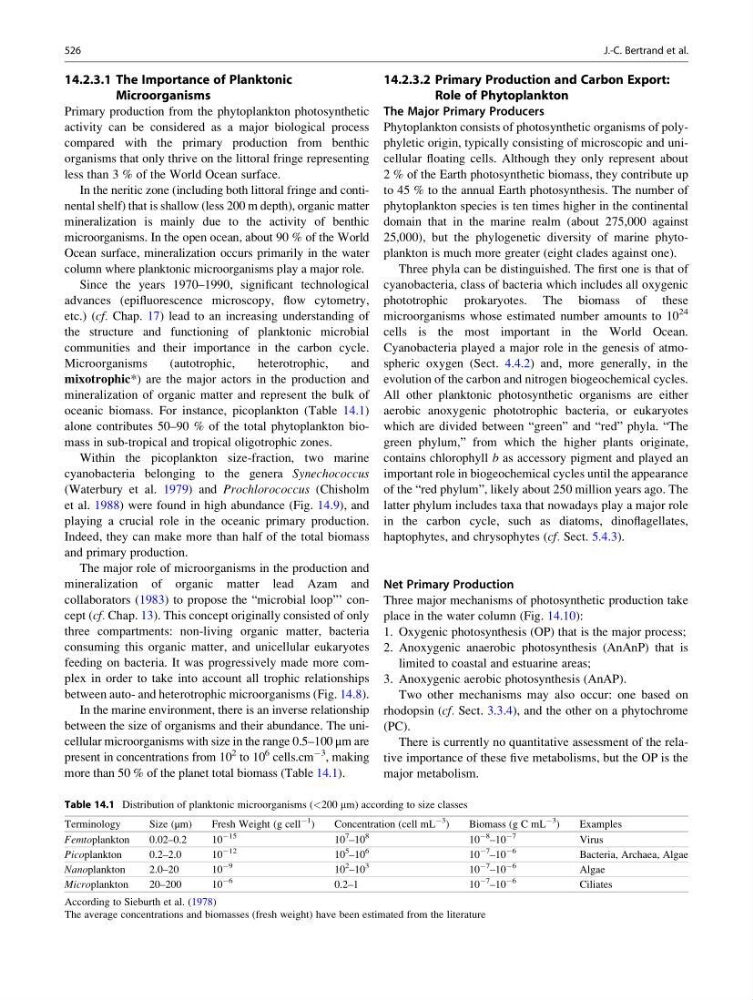
oceanic biomass. For instance, picoplankton (Table 14.1)
alone contributes 50–90 % of the total phytoplankton biomass in sub-tropical and tropical oligotrophic zones.
Within the picoplankton size-fraction, two marine
cyanobacteria belonging to the genera Synechococcus
(Waterbury et al. 1979) and Prochlorococcus (Chisholm
et al. 1988) were found in high abundance (Fig. 14.9), and
playing a crucial role in the oceanic primary production.
Indeed, they can make more than half of the total biomass
and primary production.
The major role of microorganisms in the production and
mineralization of organic matter lead Azam and
collaborators (1983) to propose the “microbial loop”’ concept (cf. Chap. 13). This concept originally consisted of only
three compartments: non-living organic matter, bacteria
consuming this organic matter, and unicellular eukaryotes
feeding on bacteria. It was progressively made more complex in order to take into account all trophic relationships
between auto- and heterotrophic microorganisms (Fig. 14.8).
In the marine environment, there is an inverse relationship
between the size of organisms and their abundance. The unicellular microorganisms with size in the range 0.5–100 μm are
present in concentrations from 10
2 to 10
6 cells.cm
À3
, making
more than 50 % of the planet total biomass (Table 14.1).
14.2.3.2 Primary Production and Carbon Export:
Role of Phytoplankton
The Major Primary Producers
Phytoplankton consists of photosynthetic organisms of polyphyletic origin, typically consisting of microscopic and unicellular floating cells. Although they only represent about
2 % of the Earth photosynthetic biomass, they contribute up
to 45 % to the annual Earth photosynthesis. The number of
phytoplankton species is ten times higher in the continental
domain that in the marine realm (about 275,000 against
25,000), but the phylogenetic diversity of marine phytoplankton is much more greater (eight clades against one).
Three phyla can be distinguished. The first one is that of
cyanobacteria, class of bacteria which includes all oxygenic
phototrophic prokaryotes. The biomass of these
microorganisms whose estimated number amounts to 10
24
cells is the most important in the World Ocean.
Cyanobacteria played a major role in the genesis of atmospheric oxygen (Sect. 4.4.2) and, more generally, in the
evolution of the carbon and nitrogen biogeochemical cycles.
All other planktonic photosynthetic organisms are either
aerobic anoxygenic phototrophic bacteria, or eukaryotes
which are divided between “green” and “red” phyla. “The
green phylum,” from which the higher plants originate,
contains chlorophyll b as accessory pigment and played an
important role in biogeochemical cycles until the appearance
of the “red phylum”, likely about 250 million years ago. The
latter phylum includes taxa that nowadays play a major role
in the carbon cycle, such as diatoms, dinoflagellates,
haptophytes, and chrysophytes (cf. Sect. 5.4.3).
Net Primary Production
Three major mechanisms of photosynthetic production take
place in the water column (Fig. 14.10):
1. Oxygenic photosynthesis (OP) that is the major process;
2. Anoxygenic anaerobic photosynthesis (AnAnP) that is
limited to coastal and estuarine areas;
3. Anoxygenic aerobic photosynthesis (AnAP).
Two other mechanisms may also occur: one based on
rhodopsin (cf. Sect. 3.3.4), and the other on a phytochrome
(PC).
There is currently no quantitative assessment of the relative importance of these five metabolisms, but the OP is the
major metabolism.
Table 14.1 Distribution of planktonic microorganisms (<200 mm) according to size classes
Terminology
Size (μm)
Fresh Weight (g cell
À1
)
Concentration (cell mL
À3 )
Biomass (g C mL
À3
)
Examples
Femtoplankton
0.02–0.2
10
À15
10
7
–10
8
10
À8
–10
À7
Virus
Picoplankton
0.2–2.0
10
À12
10
5
–10
6
10
À7
–10
À6
Bacteria, Archaea, Algae
Nanoplankton
2.0–20
10
À9
10
2
–10
3
10
À7
–10
À6
Algae
Microplankton
20–200
10
À6
0.2–1
10
À7
–10
À6
Ciliates
According to Sieburth et al. (1978)
The average concentrations and biomasses (fresh weight) have been estimated from the literature
526
J.-C. Bertrand et al.
Microorganisms
Primary production from the phytoplankton photosynthetic
activity can be considered as a major biological process
compared with the primary production from benthic
organisms that only thrive on the littoral fringe representing
less than 3 % of the World Ocean surface.
In the neritic zone (including both littoral fringe and continental shelf) that is shallow (less 200 m depth), organic matter
mineralization is mainly due to the activity of benthic
microorganisms. In the open ocean, about 90 % of the World
Ocean surface, mineralization occurs primarily in the water
column where planktonic microorganisms play a major role.
Since the years 1970–1990, significant technological
advances (epifluorescence microscopy, flow cytometry,
etc.) (cf. Chap. 17) lead to an increasing understanding of
the structure and functioning of planktonic microbial
communities and their importance in the carbon cycle.
Microorganisms
(autotrophic,
heterotrophic,
and
mixotrophic*) are the major actors in the production and
mineralization of organic matter and represent the bulk of
oceanic biomass. For instance, picoplankton (Table 14.1)
alone contributes 50–90 % of the total phytoplankton biomass in sub-tropical and tropical oligotrophic zones.
Within the picoplankton size-fraction, two marine
cyanobacteria belonging to the genera Synechococcus
(Waterbury et al. 1979) and Prochlorococcus (Chisholm
et al. 1988) were found in high abundance (Fig. 14.9), and
playing a crucial role in the oceanic primary production.
Indeed, they can make more than half of the total biomass
and primary production.
The major role of microorganisms in the production and
mineralization of organic matter lead Azam and
collaborators (1983) to propose the “microbial loop”’ concept (cf. Chap. 13). This concept originally consisted of only
three compartments: non-living organic matter, bacteria
consuming this organic matter, and unicellular eukaryotes
feeding on bacteria. It was progressively made more complex in order to take into account all trophic relationships
between auto- and heterotrophic microorganisms (Fig. 14.8).
In the marine environment, there is an inverse relationship
between the size of organisms and their abundance. The unicellular microorganisms with size in the range 0.5–100 μm are
present in concentrations from 10
2 to 10
6 cells.cm
À3
, making
more than 50 % of the planet total biomass (Table 14.1).
14.2.3.2 Primary Production and Carbon Export:
Role of Phytoplankton
The Major Primary Producers
Phytoplankton consists of photosynthetic organisms of polyphyletic origin, typically consisting of microscopic and unicellular floating cells. Although they only represent about
2 % of the Earth photosynthetic biomass, they contribute up
to 45 % to the annual Earth photosynthesis. The number of
phytoplankton species is ten times higher in the continental
domain that in the marine realm (about 275,000 against
25,000), but the phylogenetic diversity of marine phytoplankton is much more greater (eight clades against one).
Three phyla can be distinguished. The first one is that of
cyanobacteria, class of bacteria which includes all oxygenic
phototrophic prokaryotes. The biomass of these
microorganisms whose estimated number amounts to 10
24
cells is the most important in the World Ocean.
Cyanobacteria played a major role in the genesis of atmospheric oxygen (Sect. 4.4.2) and, more generally, in the
evolution of the carbon and nitrogen biogeochemical cycles.
All other planktonic photosynthetic organisms are either
aerobic anoxygenic phototrophic bacteria, or eukaryotes
which are divided between “green” and “red” phyla. “The
green phylum,” from which the higher plants originate,
contains chlorophyll b as accessory pigment and played an
important role in biogeochemical cycles until the appearance
of the “red phylum”, likely about 250 million years ago. The
latter phylum includes taxa that nowadays play a major role
in the carbon cycle, such as diatoms, dinoflagellates,
haptophytes, and chrysophytes (cf. Sect. 5.4.3).
Net Primary Production
Three major mechanisms of photosynthetic production take
place in the water column (Fig. 14.10):
1. Oxygenic photosynthesis (OP) that is the major process;
2. Anoxygenic anaerobic photosynthesis (AnAnP) that is
limited to coastal and estuarine areas;
3. Anoxygenic aerobic photosynthesis (AnAP).
Two other mechanisms may also occur: one based on
rhodopsin (cf. Sect. 3.3.4), and the other on a phytochrome
(PC).
There is currently no quantitative assessment of the relative importance of these five metabolisms, but the OP is the
major metabolism.
Table 14.1 Distribution of planktonic microorganisms (<200 mm) according to size classes
Terminology
Size (μm)
Fresh Weight (g cell
À1
)
Concentration (cell mL
À3 )
Biomass (g C mL
À3
)
Examples
Femtoplankton
0.02–0.2
10
À15
10
7
–10
8
10
À8
–10
À7
Virus
Picoplankton
0.2–2.0
10
À12
10
5
–10
6
10
À7
–10
À6
Bacteria, Archaea, Algae
Nanoplankton
2.0–20
10
À9
10
2
–10
3
10
À7
–10
À6
Algae
Microplankton
20–200
10
À6
0.2–1
10
À7
–10
À6
Ciliates
According to Sieburth et al. (1978)
The average concentrations and biomasses (fresh weight) have been estimated from the literature
526
J.-C. Bertrand et al.