

Box 14.1: The Biogeochemical Cycle of Silicon
Bernard Que ´guiner
Silicon alone constitutes 27 % of the Earth’s lithosphere. It is also an important component of the biogenic material that accumulates in coastal and deep-sea
sediments. The role of this element in the marine biogeochemical cycles is directly correlated to its necessary requirement by diatoms. These organisms are a
major component of marine phytoplankton, ensuring
alone more than 40 % of the gross primary production
of carbon on a global scale. However, this global contribution reflects highly contrasting situations since
diatoms provide an average of 35 % of the primary
production of the poorest oligotrophic areas, against
nearly 75 % of highly fertilized ecosystems (coastal
ecosystems, upwellings, etc.). Individual situations are
even more contrasted as recent studies have shown that
the contribution of diatoms is almost zero in the ultraoligotrophic South Pacific area as opposed to situations
of spring blooms in temperate systems where they
represent almost all of the autochthonous production
of organic carbon. One of the main characteristics of
diatoms is the presence of a siliceous wall (the frustule)
surrounding the cell. This wall shows significant morphological differentiation and is composed of biogenic
silica (or opal), whose general formula is (SiO 2 nH 2 O).
These unicellular algae are dependent for their development of silicon and DNA replication, a prelude to cell
division, is impossible in the absence of this element
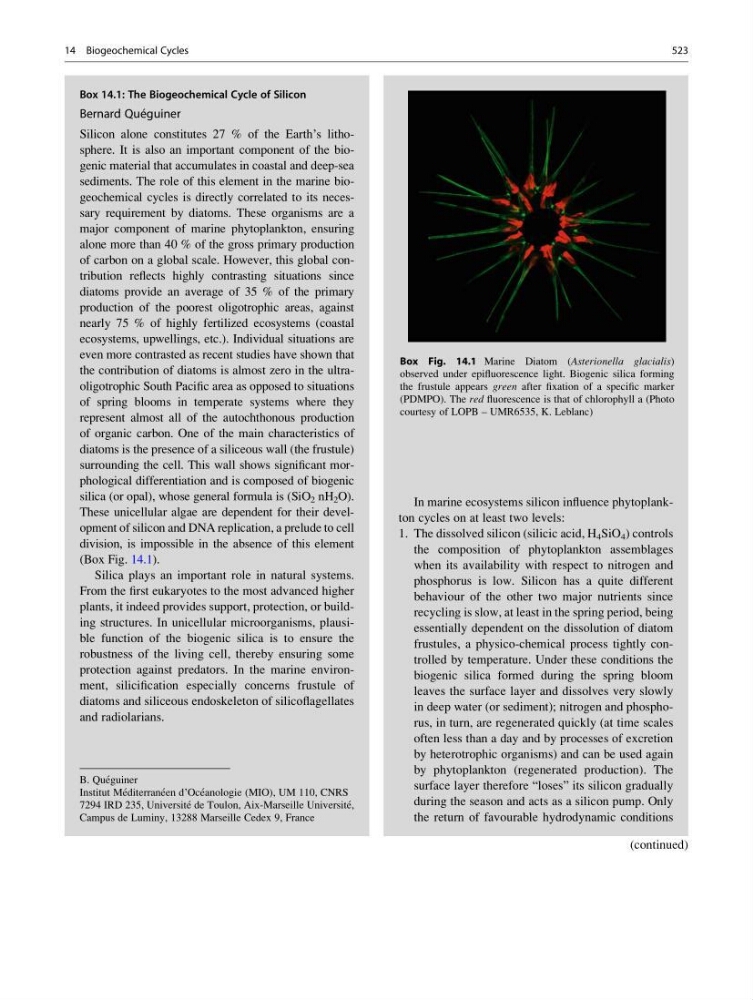
(Box Fig. 14.1).
Silica plays an important role in natural systems.
From the first eukaryotes to the most advanced higher
plants, it indeed provides support, protection, or building structures. In unicellular microorganisms, plausible function of the biogenic silica is to ensure the
robustness of the living cell, thereby ensuring some
protection against predators. In the marine environment, silicification especially concerns frustule of
diatoms and siliceous endoskeleton of silicoflagellates
and radiolarians.
B. Que ´guiner
Institut Me ´diterrane ´en d’Oce ´anologie (MIO), UM 110, CNRS
7294 IRD 235, Universite ´ de Toulon, Aix-Marseille Universite ´,
Campus de Luminy, 13288 Marseille Cedex 9, France
(continued)
Box 14.1 (continued)
In marine ecosystems silicon influence phytoplankton cycles on at least two levels:
1. The dissolved silicon (silicic acid, H 4 SiO 4 ) controls
the composition of phytoplankton assemblages
when its availability with respect to nitrogen and
phosphorus is low. Silicon has a quite different
behaviour of the other two major nutrients since
recycling is slow, at least in the spring period, being
essentially dependent on the dissolution of diatom
frustules, a physico-chemical process tightly controlled by temperature. Under these conditions the
biogenic silica formed during the spring bloom
leaves the surface layer and dissolves very slowly
in deep water (or sediment); nitrogen and phosphorus, in turn, are regenerated quickly (at time scales
often less than a day and by processes of excretion
by heterotrophic organisms) and can be used again
by phytoplankton (regenerated production). The
surface layer therefore “loses” its silicon gradually
during the season and acts as a silicon pump. Only
the return of favourable hydrodynamic conditions
(continued)
Box Fig. 14.1 Marine Diatom (Asterionella glacialis)
observed under epifluorescence light. Biogenic silica forming
the frustule appears green after fixation of a specific marker
(PDMPO). The red fluorescence is that of chlorophyll a (Photo
courtesy of LOPB – UMR6535, K. Leblanc)
14 Biogeochemical Cycles
523
Bernard Que ´guiner
Silicon alone constitutes 27 % of the Earth’s lithosphere. It is also an important component of the biogenic material that accumulates in coastal and deep-sea
sediments. The role of this element in the marine biogeochemical cycles is directly correlated to its necessary requirement by diatoms. These organisms are a
major component of marine phytoplankton, ensuring
alone more than 40 % of the gross primary production
of carbon on a global scale. However, this global contribution reflects highly contrasting situations since
diatoms provide an average of 35 % of the primary
production of the poorest oligotrophic areas, against
nearly 75 % of highly fertilized ecosystems (coastal
ecosystems, upwellings, etc.). Individual situations are
even more contrasted as recent studies have shown that
the contribution of diatoms is almost zero in the ultraoligotrophic South Pacific area as opposed to situations
of spring blooms in temperate systems where they
represent almost all of the autochthonous production
of organic carbon. One of the main characteristics of
diatoms is the presence of a siliceous wall (the frustule)
surrounding the cell. This wall shows significant morphological differentiation and is composed of biogenic
silica (or opal), whose general formula is (SiO 2 nH 2 O).
These unicellular algae are dependent for their development of silicon and DNA replication, a prelude to cell
division, is impossible in the absence of this element
(Box Fig. 14.1).
Silica plays an important role in natural systems.
From the first eukaryotes to the most advanced higher
plants, it indeed provides support, protection, or building structures. In unicellular microorganisms, plausible function of the biogenic silica is to ensure the
robustness of the living cell, thereby ensuring some
protection against predators. In the marine environment, silicification especially concerns frustule of
diatoms and siliceous endoskeleton of silicoflagellates
and radiolarians.
B. Que ´guiner
Institut Me ´diterrane ´en d’Oce ´anologie (MIO), UM 110, CNRS
7294 IRD 235, Universite ´ de Toulon, Aix-Marseille Universite ´,
Campus de Luminy, 13288 Marseille Cedex 9, France
(continued)
Box 14.1 (continued)
In marine ecosystems silicon influence phytoplankton cycles on at least two levels:
1. The dissolved silicon (silicic acid, H 4 SiO 4 ) controls
the composition of phytoplankton assemblages
when its availability with respect to nitrogen and
phosphorus is low. Silicon has a quite different
behaviour of the other two major nutrients since
recycling is slow, at least in the spring period, being
essentially dependent on the dissolution of diatom
frustules, a physico-chemical process tightly controlled by temperature. Under these conditions the
biogenic silica formed during the spring bloom
leaves the surface layer and dissolves very slowly
in deep water (or sediment); nitrogen and phosphorus, in turn, are regenerated quickly (at time scales
often less than a day and by processes of excretion
by heterotrophic organisms) and can be used again
by phytoplankton (regenerated production). The
surface layer therefore “loses” its silicon gradually
during the season and acts as a silicon pump. Only
the return of favourable hydrodynamic conditions
(continued)
Box Fig. 14.1 Marine Diatom (Asterionella glacialis)
observed under epifluorescence light. Biogenic silica forming
the frustule appears green after fixation of a specific marker
(PDMPO). The red fluorescence is that of chlorophyll a (Photo
courtesy of LOPB – UMR6535, K. Leblanc)
14 Biogeochemical Cycles
523