

Box 14.1 (continued)
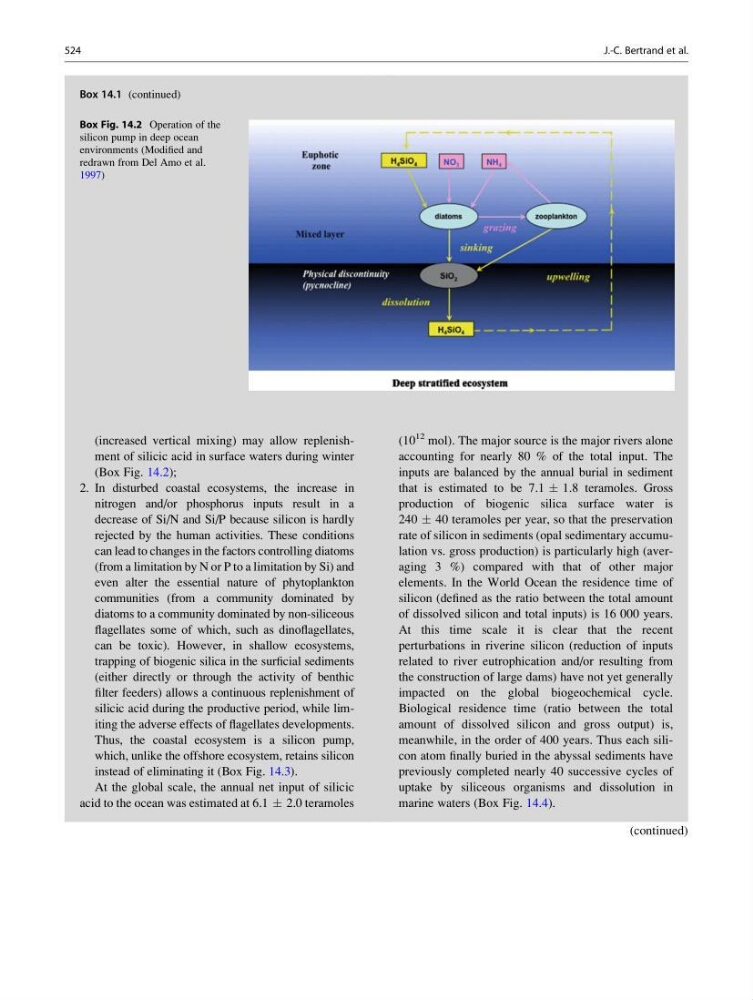
(increased vertical mixing) may allow replenishment of silicic acid in surface waters during winter
(Box Fig. 14.2);
2. In disturbed coastal ecosystems, the increase in
nitrogen and/or phosphorus inputs result in a
decrease of Si/N and Si/P because silicon is hardly
rejected by the human activities. These conditions
can lead to changes in the factors controlling diatoms
(from a limitation by N or P to a limitation by Si) and
even alter the essential nature of phytoplankton
communities (from a community dominated by
diatoms to a community dominated by non-siliceous
flagellates some of which, such as dinoflagellates,
can be toxic). However, in shallow ecosystems,
trapping of biogenic silica in the surficial sediments
(either directly or through the activity of benthic
filter feeders) allows a continuous replenishment of
silicic acid during the productive period, while limiting the adverse effects of flagellates developments.
Thus, the coastal ecosystem is a silicon pump,
which, unlike the offshore ecosystem, retains silicon
instead of eliminating it (Box Fig. 14.3).
At the global scale, the annual net input of silicic
acid to the ocean was estimated at 6.1 Æ 2.0 teramoles
(continued)
Box 14.1 (continued)
(10
12 mol). The major source is the major rivers alone
accounting for nearly 80 % of the total input. The
inputs are balanced by the annual burial in sediment
that is estimated to be 7.1 Æ 1.8 teramoles. Gross
production of biogenic silica surface water is
240 Æ 40 teramoles per year, so that the preservation
rate of silicon in sediments (opal sedimentary accumulation vs. gross production) is particularly high (averaging 3 %) compared with that of other major
elements. In the World Ocean the residence time of
silicon (defined as the ratio between the total amount
of dissolved silicon and total inputs) is 16 000 years.
At this time scale it is clear that the recent
perturbations in riverine silicon (reduction of inputs
related to river eutrophication and/or resulting from
the construction of large dams) have not yet generally
impacted on the global biogeochemical cycle.
Biological residence time (ratio between the total
amount of dissolved silicon and gross output) is,
meanwhile, in the order of 400 years. Thus each silicon atom finally buried in the abyssal sediments have
previously completed nearly 40 successive cycles of
uptake by siliceous organisms and dissolution in
marine waters (Box Fig. 14.4).
(continued)
Box Fig. 14.2 Operation of the
silicon pump in deep ocean
environments (Modified and
redrawn from Del Amo et al.
1997)
524
J.-C. Bertrand et al.
(increased vertical mixing) may allow replenishment of silicic acid in surface waters during winter
(Box Fig. 14.2);
2. In disturbed coastal ecosystems, the increase in
nitrogen and/or phosphorus inputs result in a
decrease of Si/N and Si/P because silicon is hardly
rejected by the human activities. These conditions
can lead to changes in the factors controlling diatoms
(from a limitation by N or P to a limitation by Si) and
even alter the essential nature of phytoplankton
communities (from a community dominated by
diatoms to a community dominated by non-siliceous
flagellates some of which, such as dinoflagellates,
can be toxic). However, in shallow ecosystems,
trapping of biogenic silica in the surficial sediments
(either directly or through the activity of benthic
filter feeders) allows a continuous replenishment of
silicic acid during the productive period, while limiting the adverse effects of flagellates developments.
Thus, the coastal ecosystem is a silicon pump,
which, unlike the offshore ecosystem, retains silicon
instead of eliminating it (Box Fig. 14.3).
At the global scale, the annual net input of silicic
acid to the ocean was estimated at 6.1 Æ 2.0 teramoles
(continued)
Box 14.1 (continued)
(10
12 mol). The major source is the major rivers alone
accounting for nearly 80 % of the total input. The
inputs are balanced by the annual burial in sediment
that is estimated to be 7.1 Æ 1.8 teramoles. Gross
production of biogenic silica surface water is
240 Æ 40 teramoles per year, so that the preservation
rate of silicon in sediments (opal sedimentary accumulation vs. gross production) is particularly high (averaging 3 %) compared with that of other major
elements. In the World Ocean the residence time of
silicon (defined as the ratio between the total amount
of dissolved silicon and total inputs) is 16 000 years.
At this time scale it is clear that the recent
perturbations in riverine silicon (reduction of inputs
related to river eutrophication and/or resulting from
the construction of large dams) have not yet generally
impacted on the global biogeochemical cycle.
Biological residence time (ratio between the total
amount of dissolved silicon and gross output) is,
meanwhile, in the order of 400 years. Thus each silicon atom finally buried in the abyssal sediments have
previously completed nearly 40 successive cycles of
uptake by siliceous organisms and dissolution in
marine waters (Box Fig. 14.4).
(continued)
Box Fig. 14.2 Operation of the
silicon pump in deep ocean
environments (Modified and
redrawn from Del Amo et al.
1997)
524
J.-C. Bertrand et al.