

14.2.3 Carbon Cycle in the Oceanic
Water Column
The carbon cycle in the coastal and open ocean water column is dominated by two subsets each involving a couple of
antagonistic processes: photosynthesis/respiration (for
organic carbon) and precipitation/dissolution of calcium
carbonate (for inorganic carbon). These processes are coupled because they involve in some cases the same types of
microorganisms. The cycle of organic carbon is by far the
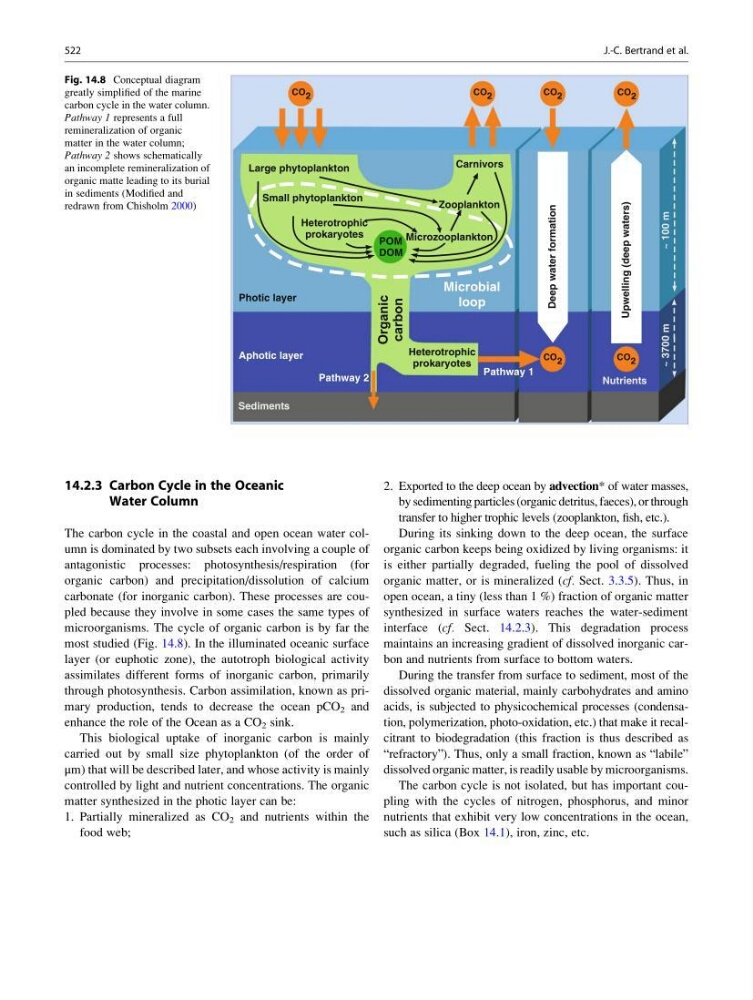
most studied (Fig. 14.8). In the illuminated oceanic surface
layer (or euphotic zone), the autotroph biological activity
assimilates different forms of inorganic carbon, primarily
through photosynthesis. Carbon assimilation, known as primary production, tends to decrease the ocean pCO 2 and
enhance the role of the Ocean as a CO 2 sink.
This biological uptake of inorganic carbon is mainly
carried out by small size phytoplankton (of the order of
μm) that will be described later, and whose activity is mainly
controlled by light and nutrient concentrations. The organic
matter synthesized in the photic layer can be:
1. Partially mineralized as CO 2 and nutrients within the
food web;
2. Exported to the deep ocean by advection* of water masses,
by sedimenting particles (organic detritus, faeces), or through
transfer to higher trophic levels (zooplankton, fish, etc.).
During its sinking down to the deep ocean, the surface
organic carbon keeps being oxidized by living organisms: it
is either partially degraded, fueling the pool of dissolved
organic matter, or is mineralized (cf. Sect. 3.3.5). Thus, in
open ocean, a tiny (less than 1 %) fraction of organic matter
synthesized in surface waters reaches the water-sediment
interface (cf. Sect. 14.2.3). This degradation process
maintains an increasing gradient of dissolved inorganic carbon and nutrients from surface to bottom waters.
During the transfer from surface to sediment, most of the
dissolved organic material, mainly carbohydrates and amino
acids, is subjected to physicochemical processes (condensation, polymerization, photo-oxidation, etc.) that make it recalcitrant to biodegradation (this fraction is thus described as
“refractory”). Thus, only a small fraction, known as “labile”
dissolved organic matter, is readily usable by microorganisms.
The carbon cycle is not isolated, but has important coupling with the cycles of nitrogen, phosphorus, and minor
nutrients that exhibit very low concentrations in the ocean,
such as silica (Box 14.1), iron, zinc, etc.
Large phytoplankton
Small phytoplankton
Heterotrophic
prokaryotes
POM
DOM
Microzooplankton
Zooplankton
Carnivors
Photic layer
Aphotic layer
Pathway 2
Pathway 1
Microbial
loop
Sediments
Deep water formation
CO 2
Upwelling (deep waters)
CO 2
Nutrients
~ 100 m
~ 3700 m
Heterotrophic
prokaryotes
CO 2
CO 2
CO 2
CO 2
Fig. 14.8 Conceptual diagram
greatly simplified of the marine
carbon cycle in the water column.
Pathway 1 represents a full
remineralization of organic
matter in the water column;
Pathway 2 shows schematically
an incomplete remineralization of
organic matte leading to its burial
in sediments (Modified and
redrawn from Chisholm 2000)
522
J.-C. Bertrand et al.
Water Column
The carbon cycle in the coastal and open ocean water column is dominated by two subsets each involving a couple of
antagonistic processes: photosynthesis/respiration (for
organic carbon) and precipitation/dissolution of calcium
carbonate (for inorganic carbon). These processes are coupled because they involve in some cases the same types of
microorganisms. The cycle of organic carbon is by far the
most studied (Fig. 14.8). In the illuminated oceanic surface
layer (or euphotic zone), the autotroph biological activity
assimilates different forms of inorganic carbon, primarily
through photosynthesis. Carbon assimilation, known as primary production, tends to decrease the ocean pCO 2 and
enhance the role of the Ocean as a CO 2 sink.
This biological uptake of inorganic carbon is mainly
carried out by small size phytoplankton (of the order of
μm) that will be described later, and whose activity is mainly
controlled by light and nutrient concentrations. The organic
matter synthesized in the photic layer can be:
1. Partially mineralized as CO 2 and nutrients within the
food web;
2. Exported to the deep ocean by advection* of water masses,
by sedimenting particles (organic detritus, faeces), or through
transfer to higher trophic levels (zooplankton, fish, etc.).
During its sinking down to the deep ocean, the surface
organic carbon keeps being oxidized by living organisms: it
is either partially degraded, fueling the pool of dissolved
organic matter, or is mineralized (cf. Sect. 3.3.5). Thus, in
open ocean, a tiny (less than 1 %) fraction of organic matter
synthesized in surface waters reaches the water-sediment
interface (cf. Sect. 14.2.3). This degradation process
maintains an increasing gradient of dissolved inorganic carbon and nutrients from surface to bottom waters.
During the transfer from surface to sediment, most of the
dissolved organic material, mainly carbohydrates and amino
acids, is subjected to physicochemical processes (condensation, polymerization, photo-oxidation, etc.) that make it recalcitrant to biodegradation (this fraction is thus described as
“refractory”). Thus, only a small fraction, known as “labile”
dissolved organic matter, is readily usable by microorganisms.
The carbon cycle is not isolated, but has important coupling with the cycles of nitrogen, phosphorus, and minor
nutrients that exhibit very low concentrations in the ocean,
such as silica (Box 14.1), iron, zinc, etc.
Large phytoplankton
Small phytoplankton
Heterotrophic
prokaryotes
POM
DOM
Microzooplankton
Zooplankton
Carnivors
Photic layer
Aphotic layer
Pathway 2
Pathway 1
Microbial
loop
Sediments
Deep water formation
CO 2
Upwelling (deep waters)
CO 2
Nutrients
~ 100 m
~ 3700 m
Heterotrophic
prokaryotes
CO 2
CO 2
CO 2
CO 2
Fig. 14.8 Conceptual diagram
greatly simplified of the marine
carbon cycle in the water column.
Pathway 1 represents a full
remineralization of organic
matter in the water column;
Pathway 2 shows schematically
an incomplete remineralization of
organic matte leading to its burial
in sediments (Modified and
redrawn from Chisholm 2000)
522
J.-C. Bertrand et al.