

resulting net balance over the period 1850–2000 is a carbon
source of 140 Pg C, which is much greater than the amount
of carbon accumulated in the continental biosphere
(40 Pg C). This difference can be explained by a terrestrial
reservoir of carbon in the order of 100 Pg C linked to the
stimulation of primary production by environmental changes
and/or the underestimation of carbon storage by human
practices. A projection of the future continental carbon reservoir is difficult and is far beyond the scope of this chapter.
Only a few major points are given below:
1. CO 2 increase. While there is no doubt that elevated CO 2
stimulates photosynthesis of many plants, long-term
enrichment experiments conducted at the community
level do not always increase CO 2 uptake and when the
uptake is detected, it does not necessarily lead to an
accumulation of carbon;
2. Nitrogen availability. Photosynthesis is often limited by
nitrogen, the availability of which is increased by human
activities, especially by the use of fertilizers. It should in
principle lead to an increase in biomass production, but
again, the long-term effect on plant communities is uncertain. Nitrogen enrichment indeed results in an increase or
a decrease in growth rates depending on the case study
and, at times, can increase the residence time of carbon in
soils;
3. Atmosphere chemistry. Plants are very sensitive to the
concentration of atmospheric ozone that reduces the efficiency of photosynthesis. Soil acidification resulting from
the input of nitrate and sulfate by rain decreases the concentration of ions essential to plant metabolism (Ca
2+
,
Mg
2+
, K
+
). This can cause a decrease in primary production
and therefore in the carbon storage capacity of many
ecosystems;
4. Climatic factors. Climatic variables (temperature, humidity, light) influence carbon storage in the terrestrial biosphere via their impact on plant photosynthesis,
respiration, and growth, and on the oxidation of organic
matter in soils as well;
5. Plant regrowth. The continental carbon reservoir also
includes carbon storage due to the regrowth of plants
in ecosystems which is disturbed by human activities
such as fire prevention, reforestation of agricultural
lands, etc. This component seems to have been largely
underestimated.
Modeling the numerous impacts and feedbacks detailed
above is complicated by the lack of information on their
interactions: For example, the impact of a parameter can be
strengthened or inhibited by the impact of another parameter. Finally, most perturbation experiments have been
performed over short periods of time (a few weeks or
months, rarely a few years), which does not take into account
the biological processes of acclimatization and adaptation.
Oceanic Absorption of CO 2
The future evolution of the oceanic carbon sink depends, as
the land sink, on several parameters and feedback:
1. Buffering effect and the carbonate chemistry. The fact that
less than 1 % of the dissolved inorganic carbon (DIC) is
present in the form of CO 2 in the ocean implies that the DIC
increases ten times less than CO 2 . This explains why the
ability of the global ocean to absorb CO 2 is lower than
might be expected from its considerable size. Thus, the
increase in atmospheric CO 2 of about 30 % since 1850
has resulted in an increase of only 3 % of the DIC in surface
waters. Hence, the oceanic reservoir will absorb less and
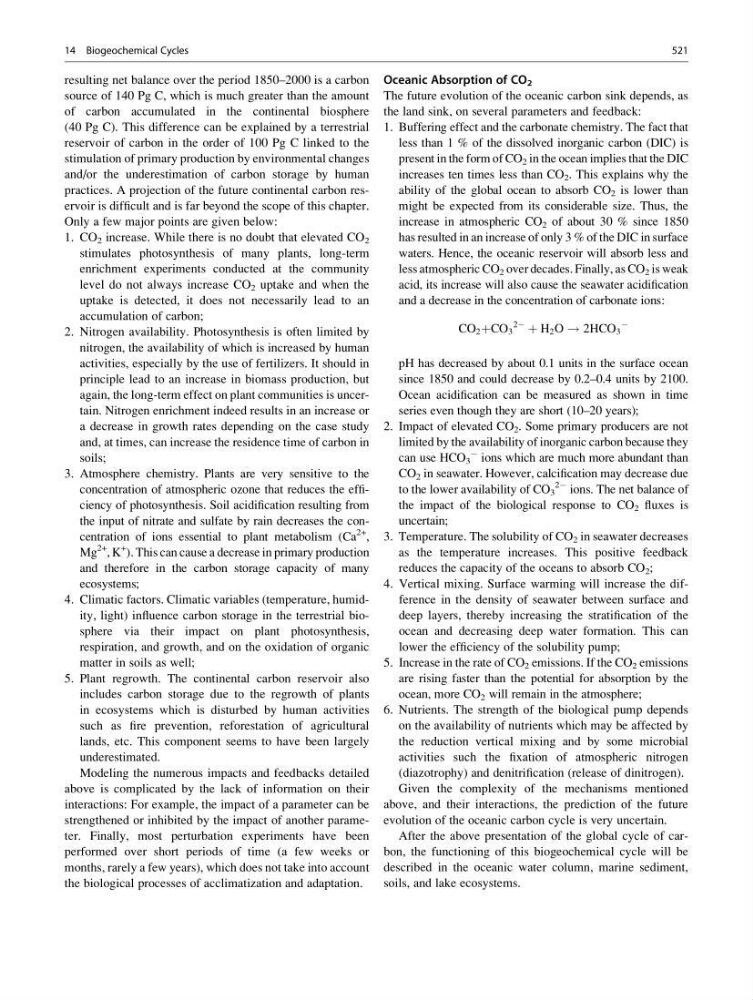
less atmospheric CO 2 over decades. Finally, as CO 2 is weak
acid, its increase will also cause the seawater acidification
and a decrease in the concentration of carbonate ions:
CO 2 þCO 3
2À
þ H 2 O ! 2HCO 3
À
pH has decreased by about 0.1 units in the surface ocean
since 1850 and could decrease by 0.2–0.4 units by 2100.
Ocean acidification can be measured as shown in time
series even though they are short (10–20 years);
2. Impact of elevated CO 2 . Some primary producers are not
limited by the availability of inorganic carbon because they
can use HCO 3
À ions which are much more abundant than
CO 2 in seawater. However, calcification may decrease due
to the lower availability of CO 3
2À ions. The net balance of
the impact of the biological response to CO 2 fluxes is
uncertain;
3. Temperature. The solubility of CO 2 in seawater decreases
as the temperature increases. This positive feedback
reduces the capacity of the oceans to absorb CO 2 ;
4. Vertical mixing. Surface warming will increase the difference in the density of seawater between surface and
deep layers, thereby increasing the stratification of the
ocean and decreasing deep water formation. This can
lower the efficiency of the solubility pump;
5. Increase in the rate of CO 2 emissions. If the CO 2 emissions
are rising faster than the potential for absorption by the
ocean, more CO 2 will remain in the atmosphere;
6. Nutrients. The strength of the biological pump depends
on the availability of nutrients which may be affected by
the reduction vertical mixing and by some microbial
activities such the fixation of atmospheric nitrogen
(diazotrophy) and denitrification (release of dinitrogen).
Given the complexity of the mechanisms mentioned
above, and their interactions, the prediction of the future
evolution of the oceanic carbon cycle is very uncertain.
After the above presentation of the global cycle of carbon, the functioning of this biogeochemical cycle will be
described in the oceanic water column, marine sediment,
soils, and lake ecosystems.
14 Biogeochemical Cycles
521
source of 140 Pg C, which is much greater than the amount
of carbon accumulated in the continental biosphere
(40 Pg C). This difference can be explained by a terrestrial
reservoir of carbon in the order of 100 Pg C linked to the
stimulation of primary production by environmental changes
and/or the underestimation of carbon storage by human
practices. A projection of the future continental carbon reservoir is difficult and is far beyond the scope of this chapter.
Only a few major points are given below:
1. CO 2 increase. While there is no doubt that elevated CO 2
stimulates photosynthesis of many plants, long-term
enrichment experiments conducted at the community
level do not always increase CO 2 uptake and when the
uptake is detected, it does not necessarily lead to an
accumulation of carbon;
2. Nitrogen availability. Photosynthesis is often limited by
nitrogen, the availability of which is increased by human
activities, especially by the use of fertilizers. It should in
principle lead to an increase in biomass production, but
again, the long-term effect on plant communities is uncertain. Nitrogen enrichment indeed results in an increase or
a decrease in growth rates depending on the case study
and, at times, can increase the residence time of carbon in
soils;
3. Atmosphere chemistry. Plants are very sensitive to the
concentration of atmospheric ozone that reduces the efficiency of photosynthesis. Soil acidification resulting from
the input of nitrate and sulfate by rain decreases the concentration of ions essential to plant metabolism (Ca
2+
,
Mg
2+
, K
+
). This can cause a decrease in primary production
and therefore in the carbon storage capacity of many
ecosystems;
4. Climatic factors. Climatic variables (temperature, humidity, light) influence carbon storage in the terrestrial biosphere via their impact on plant photosynthesis,
respiration, and growth, and on the oxidation of organic
matter in soils as well;
5. Plant regrowth. The continental carbon reservoir also
includes carbon storage due to the regrowth of plants
in ecosystems which is disturbed by human activities
such as fire prevention, reforestation of agricultural
lands, etc. This component seems to have been largely
underestimated.
Modeling the numerous impacts and feedbacks detailed
above is complicated by the lack of information on their
interactions: For example, the impact of a parameter can be
strengthened or inhibited by the impact of another parameter. Finally, most perturbation experiments have been
performed over short periods of time (a few weeks or
months, rarely a few years), which does not take into account
the biological processes of acclimatization and adaptation.
Oceanic Absorption of CO 2
The future evolution of the oceanic carbon sink depends, as
the land sink, on several parameters and feedback:
1. Buffering effect and the carbonate chemistry. The fact that
less than 1 % of the dissolved inorganic carbon (DIC) is
present in the form of CO 2 in the ocean implies that the DIC
increases ten times less than CO 2 . This explains why the
ability of the global ocean to absorb CO 2 is lower than
might be expected from its considerable size. Thus, the
increase in atmospheric CO 2 of about 30 % since 1850
has resulted in an increase of only 3 % of the DIC in surface
waters. Hence, the oceanic reservoir will absorb less and
less atmospheric CO 2 over decades. Finally, as CO 2 is weak
acid, its increase will also cause the seawater acidification
and a decrease in the concentration of carbonate ions:
CO 2 þCO 3
2À
þ H 2 O ! 2HCO 3
À
pH has decreased by about 0.1 units in the surface ocean
since 1850 and could decrease by 0.2–0.4 units by 2100.
Ocean acidification can be measured as shown in time
series even though they are short (10–20 years);
2. Impact of elevated CO 2 . Some primary producers are not
limited by the availability of inorganic carbon because they
can use HCO 3
À ions which are much more abundant than
CO 2 in seawater. However, calcification may decrease due
to the lower availability of CO 3
2À ions. The net balance of
the impact of the biological response to CO 2 fluxes is
uncertain;
3. Temperature. The solubility of CO 2 in seawater decreases
as the temperature increases. This positive feedback
reduces the capacity of the oceans to absorb CO 2 ;
4. Vertical mixing. Surface warming will increase the difference in the density of seawater between surface and
deep layers, thereby increasing the stratification of the
ocean and decreasing deep water formation. This can
lower the efficiency of the solubility pump;
5. Increase in the rate of CO 2 emissions. If the CO 2 emissions
are rising faster than the potential for absorption by the
ocean, more CO 2 will remain in the atmosphere;
6. Nutrients. The strength of the biological pump depends
on the availability of nutrients which may be affected by
the reduction vertical mixing and by some microbial
activities such the fixation of atmospheric nitrogen
(diazotrophy) and denitrification (release of dinitrogen).
Given the complexity of the mechanisms mentioned
above, and their interactions, the prediction of the future
evolution of the oceanic carbon cycle is very uncertain.
After the above presentation of the global cycle of carbon, the functioning of this biogeochemical cycle will be
described in the oceanic water column, marine sediment,
soils, and lake ecosystems.
14 Biogeochemical Cycles
521