

atmosphere. The reason is that the inorganic carbon is present in various forms, in equilibrium with each other:
CO 2 þ H 2 O , HCO 3
À
þ H
þ
, CO 3
2À
þ 2H
þ
Because of this equilibrium, the concentration of inorganic
carbon in seawater is much larger than that of other gases. For
example, the ratio of oxygen between the atmosphere and
ocean is 99:1, while it is 1.5:98.5 for inorganic carbon. CO 2
gas is less than 1 % of the inorganic carbon in seawater, the
rest being in the form of bicarbonate and carbonate.
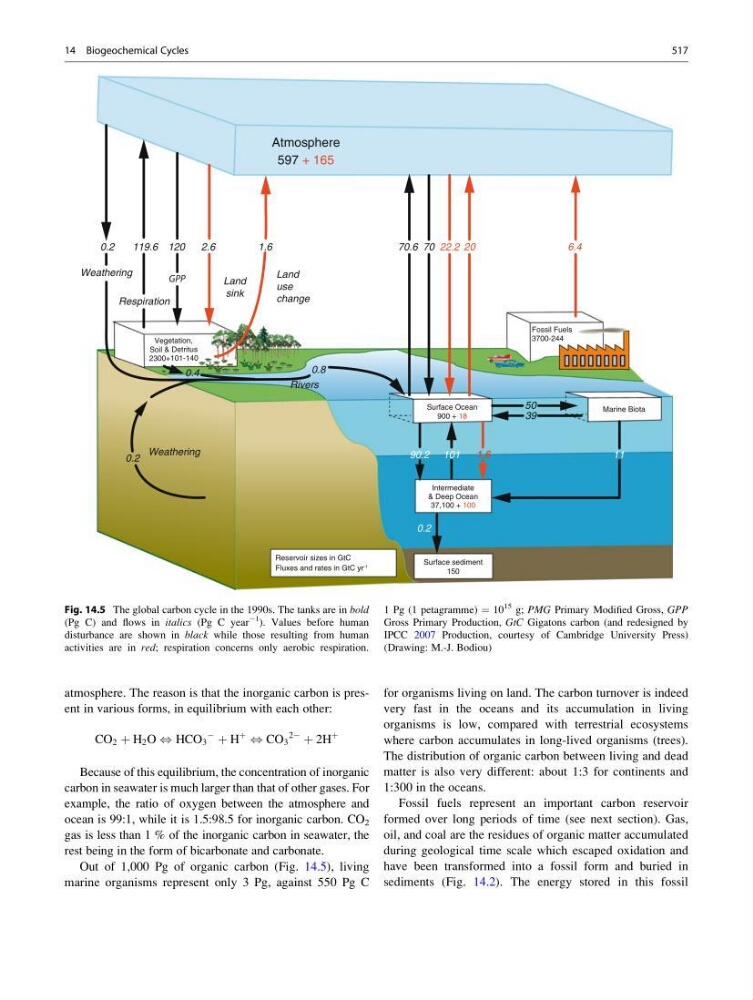
Out of 1,000 Pg of organic carbon (Fig. 14.5), living
marine organisms represent only 3 Pg, against 550 Pg C
for organisms living on land. The carbon turnover is indeed
very fast in the oceans and its accumulation in living
organisms is low, compared with terrestrial ecosystems
where carbon accumulates in long-lived organisms (trees).
The distribution of organic carbon between living and dead
matter is also very different: about 1:3 for continents and
1:300 in the oceans.
Fossil fuels represent an important carbon reservoir
formed over long periods of time (see next section). Gas,
oil, and coal are the residues of organic matter accumulated
during geological time scale which escaped oxidation and
have been transformed into a fossil form and buried in
sediments (Fig. 14.2). The energy stored in this fossil
Vegetation,
Soil & Detritus
2300+101-140
Fossil Fuels
3700-244
Intermediate
& Deep Ocean
900 +
Surface sediment
150
Surface Ocean
Marine Biota
37,100 +
Atmosphere
597 + 165
18
100
119.6 120
GPP
2.6
70.6 70 22.2 20
6.4
0.2
0.2
Respiration
1.6
0.4
0.8
50
39
Reservoir sizes in GtC
Fluxes and rates in GtC yr -1
0.2
90.2 101
1.6
11
Land
sink
Land
use
change
Weathering
Weathering
Rivers
Fig. 14.5 The global carbon cycle in the 1990s. The tanks are in bold
(Pg C) and flows in italics (Pg C year
À1
). Values before human
disturbance are shown in black while those resulting from human
activities are in red; respiration concerns only aerobic respiration.
1 Pg (1 petagramme) ¼ 10
15 g; PMG Primary Modified Gross, GPP
Gross Primary Production, GtC Gigatons carbon (and redesigned by
IPCC 2007 Production, courtesy of Cambridge University Press)
(Drawing: M.-J. Bodiou)
14 Biogeochemical Cycles
517
CO 2 þ H 2 O , HCO 3
À
þ H
þ
, CO 3
2À
þ 2H
þ
Because of this equilibrium, the concentration of inorganic
carbon in seawater is much larger than that of other gases. For
example, the ratio of oxygen between the atmosphere and
ocean is 99:1, while it is 1.5:98.5 for inorganic carbon. CO 2
gas is less than 1 % of the inorganic carbon in seawater, the
rest being in the form of bicarbonate and carbonate.
Out of 1,000 Pg of organic carbon (Fig. 14.5), living
marine organisms represent only 3 Pg, against 550 Pg C
for organisms living on land. The carbon turnover is indeed
very fast in the oceans and its accumulation in living
organisms is low, compared with terrestrial ecosystems
where carbon accumulates in long-lived organisms (trees).
The distribution of organic carbon between living and dead
matter is also very different: about 1:3 for continents and
1:300 in the oceans.
Fossil fuels represent an important carbon reservoir
formed over long periods of time (see next section). Gas,
oil, and coal are the residues of organic matter accumulated
during geological time scale which escaped oxidation and
have been transformed into a fossil form and buried in
sediments (Fig. 14.2). The energy stored in this fossil
Vegetation,
Soil & Detritus
2300+101-140
Fossil Fuels
3700-244
Intermediate
& Deep Ocean
900 +
Surface sediment
150
Surface Ocean
Marine Biota
37,100 +
Atmosphere
597 + 165
18
100
119.6 120
GPP
2.6
70.6 70 22.2 20
6.4
0.2
0.2
Respiration
1.6
0.4
0.8
50
39
Reservoir sizes in GtC
Fluxes and rates in GtC yr -1
0.2
90.2 101
1.6
11
Land
sink
Land
use
change
Weathering
Weathering
Rivers
Fig. 14.5 The global carbon cycle in the 1990s. The tanks are in bold
(Pg C) and flows in italics (Pg C year
À1
). Values before human
disturbance are shown in black while those resulting from human
activities are in red; respiration concerns only aerobic respiration.
1 Pg (1 petagramme) ¼ 10
15 g; PMG Primary Modified Gross, GPP
Gross Primary Production, GtC Gigatons carbon (and redesigned by
IPCC 2007 Production, courtesy of Cambridge University Press)
(Drawing: M.-J. Bodiou)
14 Biogeochemical Cycles
517