

material is released during combustion. The reservoir of
fossil carbon is the second in size after the deep ocean.
14.2.2.2 Long Term Carbon Cycle
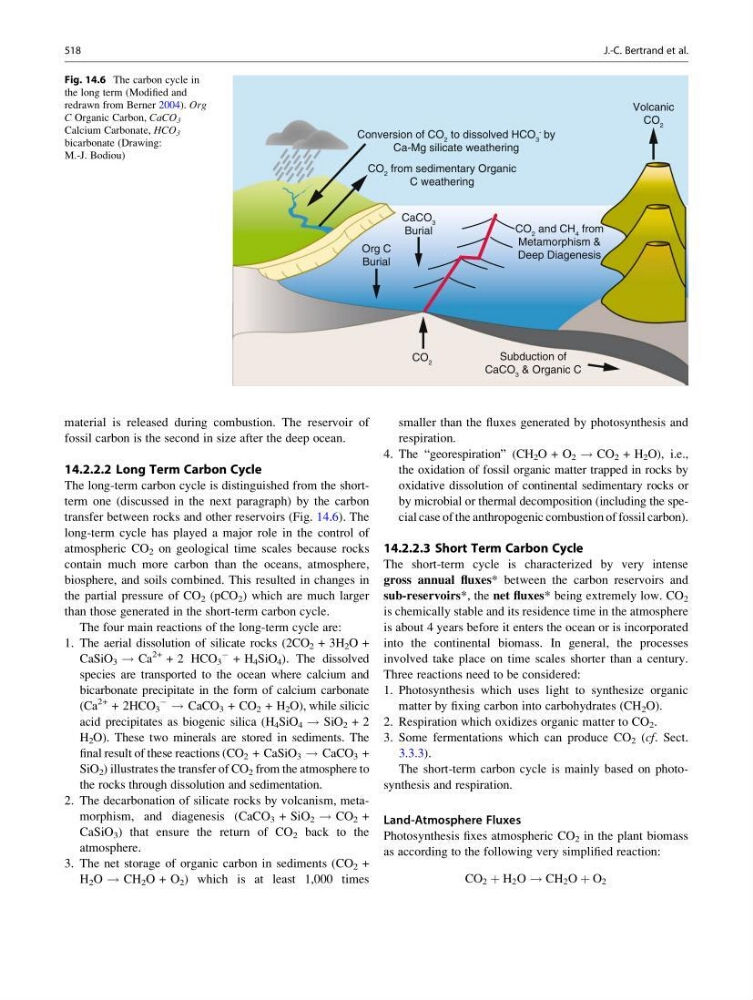
The long-term carbon cycle is distinguished from the shortterm one (discussed in the next paragraph) by the carbon
transfer between rocks and other reservoirs (Fig. 14.6). The
long-term cycle has played a major role in the control of
atmospheric CO 2 on geological time scales because rocks
contain much more carbon than the oceans, atmosphere,
biosphere, and soils combined. This resulted in changes in
the partial pressure of CO 2 (pCO 2 ) which are much larger
than those generated in the short-term carbon cycle.
The four main reactions of the long-term cycle are:
1. The aerial dissolution of silicate rocks (2CO 2 + 3H 2 O +
CaSiO 3 ! Ca
2+ + 2 HCO 3
À + H 4 SiO 4 ). The dissolved
species are transported to the ocean where calcium and
bicarbonate precipitate in the form of calcium carbonate
(Ca
2+ + 2HCO 3
À
! CaCO 3 + CO 2 + H 2 O), while silicic
acid precipitates as biogenic silica (H 4 SiO 4 ! SiO 2 + 2
H 2 O). These two minerals are stored in sediments. The
final result of these reactions (CO 2 + CaSiO 3 ! CaCO 3 +
SiO 2 ) illustrates the transfer of CO 2 from the atmosphere to
the rocks through dissolution and sedimentation.
2. The decarbonation of silicate rocks by volcanism, metamorphism, and diagenesis (CaCO 3 + SiO 2 ! CO 2 +
CaSiO 3 ) that ensure the return of CO 2 back to the
atmosphere.
3. The net storage of organic carbon in sediments (CO 2 +
H 2 O ! CH 2 O + O 2 ) which is at least 1,000 times
smaller than the fluxes generated by photosynthesis and
respiration.
4. The “georespiration” (CH 2 O + O 2 ! CO 2 + H 2 O), i.e.,
the oxidation of fossil organic matter trapped in rocks by
oxidative dissolution of continental sedimentary rocks or
by microbial or thermal decomposition (including the special case of the anthropogenic combustion of fossil carbon).
14.2.2.3 Short Term Carbon Cycle
The short-term cycle is characterized by very intense
gross annual fluxes* between the carbon reservoirs and
sub-reservoirs*, the net fluxes* being extremely low. CO 2
is chemically stable and its residence time in the atmosphere
is about 4 years before it enters the ocean or is incorporated
into the continental biomass. In general, the processes
involved take place on time scales shorter than a century.
Three reactions need to be considered:
1. Photosynthesis which uses light to synthesize organic
matter by fixing carbon into carbohydrates (CH 2 O).
2. Respiration which oxidizes organic matter to CO 2 .
3. Some fermentations which can produce CO 2 (cf. Sect.
3.3.3).
The short-term carbon cycle is mainly based on photosynthesis and respiration.
Land-Atmosphere Fluxes
Photosynthesis fixes atmospheric CO 2 in the plant biomass
as according to the following very simplified reaction:
CO 2 þ H 2 O ! CH 2 O þ O 2
Conversion of CO 2 to dissolved HCO 3
- by
Ca-Mg silicate weathering
CO 2 from sedimentary Organic
C weathering
CaCO 3
Burial
Org C
Burial
CO 2 and CH 4 from
Metamorphism &
Deep Diagenesis
Volcanic
CO 2
CO 2
Subduction of
CaCO 3 & Organic C
Fig. 14.6 The carbon cycle in
the long term (Modified and
redrawn from Berner 2004). Org
C Organic Carbon, CaCO 3
Calcium Carbonate, HCO 3
bicarbonate (Drawing:
M.-J. Bodiou)
518
J.-C. Bertrand et al.
fossil carbon is the second in size after the deep ocean.
14.2.2.2 Long Term Carbon Cycle
The long-term carbon cycle is distinguished from the shortterm one (discussed in the next paragraph) by the carbon
transfer between rocks and other reservoirs (Fig. 14.6). The
long-term cycle has played a major role in the control of
atmospheric CO 2 on geological time scales because rocks
contain much more carbon than the oceans, atmosphere,
biosphere, and soils combined. This resulted in changes in
the partial pressure of CO 2 (pCO 2 ) which are much larger
than those generated in the short-term carbon cycle.
The four main reactions of the long-term cycle are:
1. The aerial dissolution of silicate rocks (2CO 2 + 3H 2 O +
CaSiO 3 ! Ca
2+ + 2 HCO 3
À + H 4 SiO 4 ). The dissolved
species are transported to the ocean where calcium and
bicarbonate precipitate in the form of calcium carbonate
(Ca
2+ + 2HCO 3
À
! CaCO 3 + CO 2 + H 2 O), while silicic
acid precipitates as biogenic silica (H 4 SiO 4 ! SiO 2 + 2
H 2 O). These two minerals are stored in sediments. The
final result of these reactions (CO 2 + CaSiO 3 ! CaCO 3 +
SiO 2 ) illustrates the transfer of CO 2 from the atmosphere to
the rocks through dissolution and sedimentation.
2. The decarbonation of silicate rocks by volcanism, metamorphism, and diagenesis (CaCO 3 + SiO 2 ! CO 2 +
CaSiO 3 ) that ensure the return of CO 2 back to the
atmosphere.
3. The net storage of organic carbon in sediments (CO 2 +
H 2 O ! CH 2 O + O 2 ) which is at least 1,000 times
smaller than the fluxes generated by photosynthesis and
respiration.
4. The “georespiration” (CH 2 O + O 2 ! CO 2 + H 2 O), i.e.,
the oxidation of fossil organic matter trapped in rocks by
oxidative dissolution of continental sedimentary rocks or
by microbial or thermal decomposition (including the special case of the anthropogenic combustion of fossil carbon).
14.2.2.3 Short Term Carbon Cycle
The short-term cycle is characterized by very intense
gross annual fluxes* between the carbon reservoirs and
sub-reservoirs*, the net fluxes* being extremely low. CO 2
is chemically stable and its residence time in the atmosphere
is about 4 years before it enters the ocean or is incorporated
into the continental biomass. In general, the processes
involved take place on time scales shorter than a century.
Three reactions need to be considered:
1. Photosynthesis which uses light to synthesize organic
matter by fixing carbon into carbohydrates (CH 2 O).
2. Respiration which oxidizes organic matter to CO 2 .
3. Some fermentations which can produce CO 2 (cf. Sect.
3.3.3).
The short-term carbon cycle is mainly based on photosynthesis and respiration.
Land-Atmosphere Fluxes
Photosynthesis fixes atmospheric CO 2 in the plant biomass
as according to the following very simplified reaction:
CO 2 þ H 2 O ! CH 2 O þ O 2
Conversion of CO 2 to dissolved HCO 3
- by
Ca-Mg silicate weathering
CO 2 from sedimentary Organic
C weathering
CaCO 3
Burial
Org C
Burial
CO 2 and CH 4 from
Metamorphism &
Deep Diagenesis
Volcanic
CO 2
CO 2
Subduction of
CaCO 3 & Organic C
Fig. 14.6 The carbon cycle in
the long term (Modified and
redrawn from Berner 2004). Org
C Organic Carbon, CaCO 3
Calcium Carbonate, HCO 3
bicarbonate (Drawing:
M.-J. Bodiou)
518
J.-C. Bertrand et al.