

trophic level of different environments, the seasons, and the
depth and structure of populations (Amblard et al. 1995;
Carrias et al. 1998). For example, it is known that lacustrine
cladocera, particularly Daphnia, can directly consume bacterial communities with great efficacy, making them highly
competitive with protozooplankton. In this case, there is a
direct trophic link between picoplankton and metazooplankton
communities.
Moreover, because of their biochemical composition,
microorganisms are the source of essential elements (fatty
acid, sterols, amino acids, etc.) vital for the development of
their predators. Any deficiency of these essential elements
reduces the growth and fertility of animal predators. In this
context, heterotrophic protists of the microbial loop improve
the nutritional quality of autotrophic picoplankton which
they ingest, thanks to their capacity to convert fatty acids
by trophic upgrading, and this improves the nutritive quality
of biomass throughout the food chain (Bec et al. 2006).
More generally, this trophic upgrading seems to play a
major role in the functioning of lake ecosystems.
13.3.2.2 Nutrient Recycling
Inorganic nutrients, particularly N and P, are essential for
phytoplankton growth. Although they may be airborne
(atmospheric transport, precipitations), allochtonic inorganic nutrients issue mainly from the earth, directly via
rivers or by seepage into a river’s catchment area. The
resuspension of sediments may also constitute an important
source of inorganic nutrients.
Heterotrophic microorganisms are also highly involved in
the biogeochemical cycles of N and P, some acting as
assimilators and others as regenerators. Long seen as the
only mineralizer of OM in stagnant aquatic ecosystems, bacteria are considered of capital importance for phytoplankton
growth, especially when minerals are limited. However, bacteria can incorporate more inorganic nutrients than they produce. It has been demonstrated that bacteria, because of their
high surface/volume ratio, are more competitive than phytoplankton in assimilating inorganic nutrients, particularly at
low concentrations. Thus, bacteria constitute a pool of P and
N that cannot be used by strictly autotrophic phytoplankton.
ALLOCHTHONOUS
ORGANIC MATTER
INORGANIC
NUTRIENTS
PRIMARY
PRODUCERS
Micro, nano and pico
- algae
- cyanobacteria
AUTOCHTHONOUS
ORGANIC
MATTER
METAZOAN
ZOOPLANKTON
Crustaceans
Rotifers
PREDATORS
DISSOLVED
and
PARTICULATE
ORGANIC
MATTER
MICROBIAL
LOOP
CILIATES
10 1 à 10 2 cell ml -1
NAKED AMOEBA
10 2 à 10 5 cell ml -1
VIRUSES
10 4 à 10 8 ml -1
FLAGELLATES
10 2 à 10 5 cell ml -1
BACTERIA and ARCHAEA
10 5 à 10 7 cell ml -1
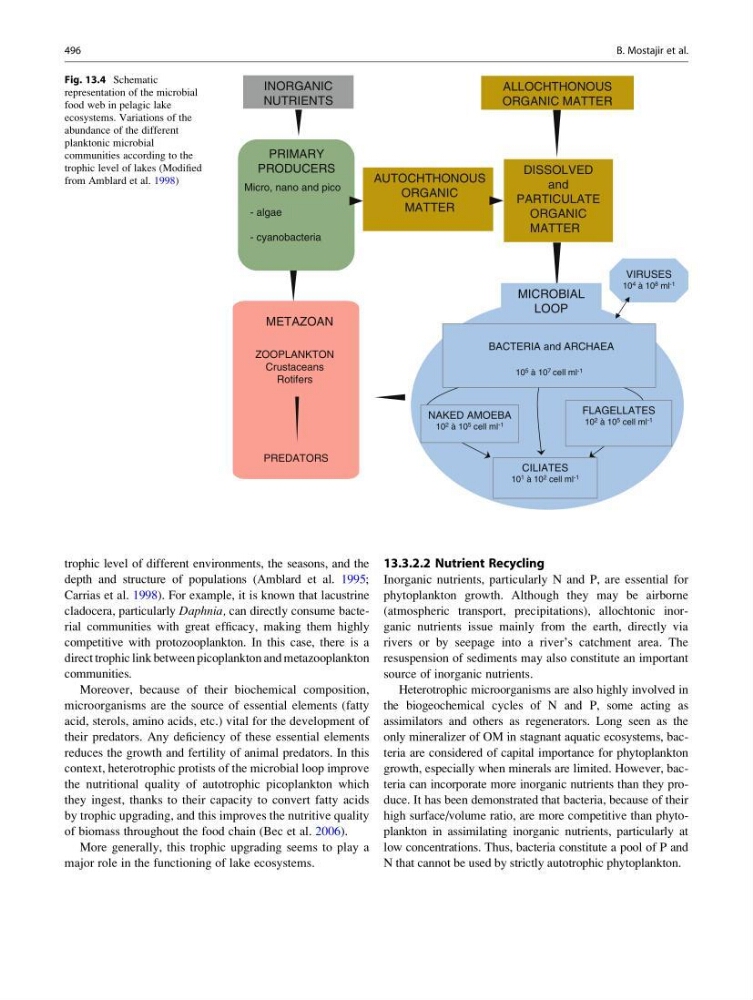
Fig. 13.4 Schematic
representation of the microbial
food web in pelagic lake
ecosystems. Variations of the
abundance of the different
planktonic microbial
communities according to the
trophic level of lakes (Modified
from Amblard et al. 1998)
496
B. Mostajir et al.
depth and structure of populations (Amblard et al. 1995;
Carrias et al. 1998). For example, it is known that lacustrine
cladocera, particularly Daphnia, can directly consume bacterial communities with great efficacy, making them highly
competitive with protozooplankton. In this case, there is a
direct trophic link between picoplankton and metazooplankton
communities.
Moreover, because of their biochemical composition,
microorganisms are the source of essential elements (fatty
acid, sterols, amino acids, etc.) vital for the development of
their predators. Any deficiency of these essential elements
reduces the growth and fertility of animal predators. In this
context, heterotrophic protists of the microbial loop improve
the nutritional quality of autotrophic picoplankton which
they ingest, thanks to their capacity to convert fatty acids
by trophic upgrading, and this improves the nutritive quality
of biomass throughout the food chain (Bec et al. 2006).
More generally, this trophic upgrading seems to play a
major role in the functioning of lake ecosystems.
13.3.2.2 Nutrient Recycling
Inorganic nutrients, particularly N and P, are essential for
phytoplankton growth. Although they may be airborne
(atmospheric transport, precipitations), allochtonic inorganic nutrients issue mainly from the earth, directly via
rivers or by seepage into a river’s catchment area. The
resuspension of sediments may also constitute an important
source of inorganic nutrients.
Heterotrophic microorganisms are also highly involved in
the biogeochemical cycles of N and P, some acting as
assimilators and others as regenerators. Long seen as the
only mineralizer of OM in stagnant aquatic ecosystems, bacteria are considered of capital importance for phytoplankton
growth, especially when minerals are limited. However, bacteria can incorporate more inorganic nutrients than they produce. It has been demonstrated that bacteria, because of their
high surface/volume ratio, are more competitive than phytoplankton in assimilating inorganic nutrients, particularly at
low concentrations. Thus, bacteria constitute a pool of P and
N that cannot be used by strictly autotrophic phytoplankton.
ALLOCHTHONOUS
ORGANIC MATTER
INORGANIC
NUTRIENTS
PRIMARY
PRODUCERS
Micro, nano and pico
- algae
- cyanobacteria
AUTOCHTHONOUS
ORGANIC
MATTER
METAZOAN
ZOOPLANKTON
Crustaceans
Rotifers
PREDATORS
DISSOLVED
and
PARTICULATE
ORGANIC
MATTER
MICROBIAL
LOOP
CILIATES
10 1 à 10 2 cell ml -1
NAKED AMOEBA
10 2 à 10 5 cell ml -1
VIRUSES
10 4 à 10 8 ml -1
FLAGELLATES
10 2 à 10 5 cell ml -1
BACTERIA and ARCHAEA
10 5 à 10 7 cell ml -1
Fig. 13.4 Schematic
representation of the microbial
food web in pelagic lake
ecosystems. Variations of the
abundance of the different
planktonic microbial
communities according to the
trophic level of lakes (Modified
from Amblard et al. 1998)
496
B. Mostajir et al.