

Certain experiments (Dolan 1997) have showed that heterotrophic flagellates could play a major role in the mineralization of OM. Indeed, by excreting a part of the assimilated
nutrients, principally in the form of ammonia for N and
soluble phosphates in the case of P, heterotrophic flagellates
contribute to phytoplanktonic growth in two ways:
1. By their bacterivorous activity, limiting bacterial
populations and hence reducing their competition with
phytoplankton
2. By producing inorganic nutrients stimulating phytoplanktonic growth
13.3.3 Functioning of Microbial Food Webs in
Oceanic and Lake Benthic Ecosystems
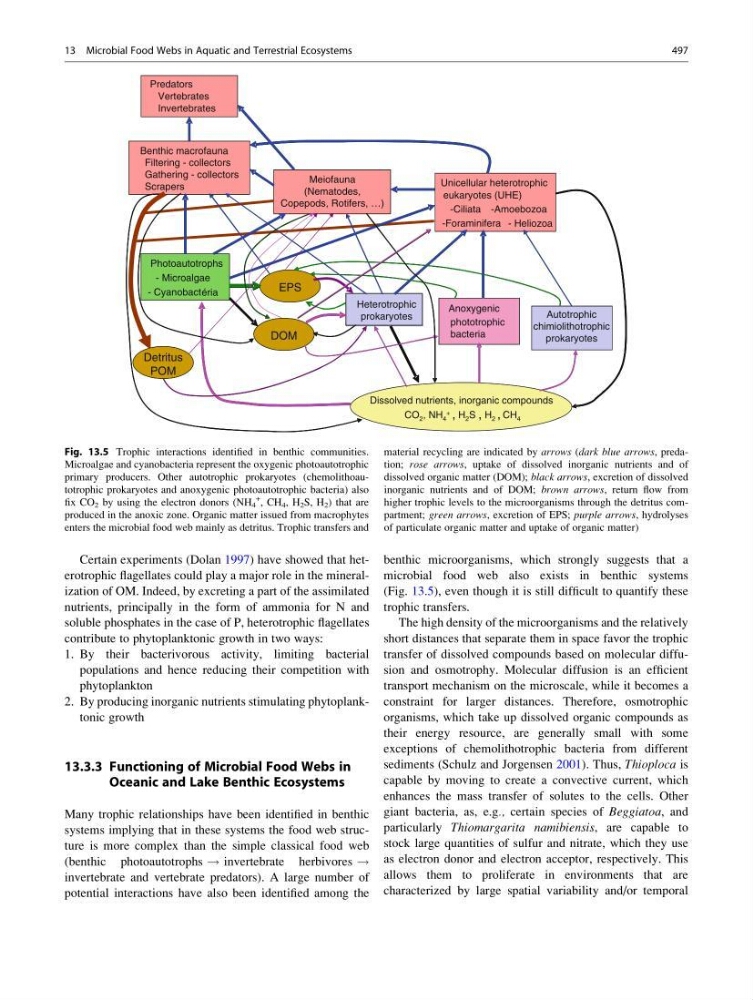
Many trophic relationships have been identified in benthic
systems implying that in these systems the food web structure is more complex than the simple classical food web
(benthic photoautotrophs ! invertebrate herbivores !
invertebrate and vertebrate predators). A large number of
potential interactions have also been identified among the
benthic microorganisms, which strongly suggests that a
microbial food web also exists in benthic systems
(Fig. 13.5), even though it is still difficult to quantify these
trophic transfers.
The high density of the microorganisms and the relatively
short distances that separate them in space favor the trophic
transfer of dissolved compounds based on molecular diffusion and osmotrophy. Molecular diffusion is an efficient
transport mechanism on the microscale, while it becomes a
constraint for larger distances. Therefore, osmotrophic
organisms, which take up dissolved organic compounds as
their energy resource, are generally small with some
exceptions of chemolithotrophic bacteria from different
sediments (Schulz and Jorgensen 2001). Thus, Thioploca is
capable by moving to create a convective current, which
enhances the mass transfer of solutes to the cells. Other
giant bacteria, as, e.g., certain species of Beggiatoa, and
particularly Thiomargarita namibiensis, are capable to
stock large quantities of sulfur and nitrate, which they use
as electron donor and electron acceptor, respectively. This
allows them to proliferate in environments that are
characterized by large spatial variability and/or temporal
Photoautrophes
- Microalgues
- Cyanobactéries
Eucaryotes unicellulaires
hétérotrophes (EUH)
-Ciliés – Amibes
-Foraminifères
Sels nutritifs, composés inorganiques
CO 2 , NH 4
+ , H 2 S , H 2 , CH 4
Bactéries
hétérotrophes
EPS
MOD
Méiofaune
(Nématodes,
Copépodes, Rotifères)
Macrofaune benthique
(collecteurs-filtreurs,
collecteur-déposivores,
racleurs)
Bactéries
phototrophes
anoxygéniques
Bactéries
chimiolitoautotrophes
Détritus
MOP
Photoautotrophs
- Microalgae
- Cyanobactéria
Unicellular heterotrophic
eukaryotes (UHE)
-Ciliata -Amoebozoa
- Heliozoa
Dissolved nutrients, inorganic compounds
CO 2 , NH 4
+ , H 2 S , H 2 , CH 4
EPS
DOM
Meiofauna
(Nematodes,
Copepods, Rotifers, …)
Benthic macrofauna
Filtering - collectors
Gathering - collectors
Scrapers
phototrophic
bacteria
Detritus
POM
Heterotrophic
prokaryotes
Anoxygenic
Autotrophic
chimiolithotrophic
prokaryotes
Predators
Vertebrates
Invertebrates
-Foraminifera
Fig. 13.5 Trophic interactions identified in benthic communities.
Microalgae and cyanobacteria represent the oxygenic photoautotrophic
primary producers. Other autotrophic prokaryotes (chemolithoautotrophic prokaryotes and anoxygenic photoautotrophic bacteria) also
fix CO 2 by using the electron donors (NH 4
+ , CH 4 , H 2 S, H 2 ) that are
produced in the anoxic zone. Organic matter issued from macrophytes
enters the microbial food web mainly as detritus. Trophic transfers and
material recycling are indicated by arrows (dark blue arrows, predation; rose arrows, uptake of dissolved inorganic nutrients and of
dissolved organic matter (DOM); black arrows, excretion of dissolved
inorganic nutrients and of DOM; brown arrows, return flow from
higher trophic levels to the microorganisms through the detritus compartment; green arrows, excretion of EPS; purple arrows, hydrolyses
of particulate organic matter and uptake of organic matter)
13 Microbial Food Webs in Aquatic and Terrestrial Ecosystems
497
nutrients, principally in the form of ammonia for N and
soluble phosphates in the case of P, heterotrophic flagellates
contribute to phytoplanktonic growth in two ways:
1. By their bacterivorous activity, limiting bacterial
populations and hence reducing their competition with
phytoplankton
2. By producing inorganic nutrients stimulating phytoplanktonic growth
13.3.3 Functioning of Microbial Food Webs in
Oceanic and Lake Benthic Ecosystems
Many trophic relationships have been identified in benthic
systems implying that in these systems the food web structure is more complex than the simple classical food web
(benthic photoautotrophs ! invertebrate herbivores !
invertebrate and vertebrate predators). A large number of
potential interactions have also been identified among the
benthic microorganisms, which strongly suggests that a
microbial food web also exists in benthic systems
(Fig. 13.5), even though it is still difficult to quantify these
trophic transfers.
The high density of the microorganisms and the relatively
short distances that separate them in space favor the trophic
transfer of dissolved compounds based on molecular diffusion and osmotrophy. Molecular diffusion is an efficient
transport mechanism on the microscale, while it becomes a
constraint for larger distances. Therefore, osmotrophic
organisms, which take up dissolved organic compounds as
their energy resource, are generally small with some
exceptions of chemolithotrophic bacteria from different
sediments (Schulz and Jorgensen 2001). Thus, Thioploca is
capable by moving to create a convective current, which
enhances the mass transfer of solutes to the cells. Other
giant bacteria, as, e.g., certain species of Beggiatoa, and
particularly Thiomargarita namibiensis, are capable to
stock large quantities of sulfur and nitrate, which they use
as electron donor and electron acceptor, respectively. This
allows them to proliferate in environments that are
characterized by large spatial variability and/or temporal
Photoautrophes
- Microalgues
- Cyanobactéries
Eucaryotes unicellulaires
hétérotrophes (EUH)
-Ciliés – Amibes
-Foraminifères
Sels nutritifs, composés inorganiques
CO 2 , NH 4
+ , H 2 S , H 2 , CH 4
Bactéries
hétérotrophes
EPS
MOD
Méiofaune
(Nématodes,
Copépodes, Rotifères)
Macrofaune benthique
(collecteurs-filtreurs,
collecteur-déposivores,
racleurs)
Bactéries
phototrophes
anoxygéniques
Bactéries
chimiolitoautotrophes
Détritus
MOP
Photoautotrophs
- Microalgae
- Cyanobactéria
Unicellular heterotrophic
eukaryotes (UHE)
-Ciliata -Amoebozoa
- Heliozoa
Dissolved nutrients, inorganic compounds
CO 2 , NH 4
+ , H 2 S , H 2 , CH 4
EPS
DOM
Meiofauna
(Nematodes,
Copepods, Rotifers, …)
Benthic macrofauna
Filtering - collectors
Gathering - collectors
Scrapers
phototrophic
bacteria
Detritus
POM
Heterotrophic
prokaryotes
Anoxygenic
Autotrophic
chimiolithotrophic
prokaryotes
Predators
Vertebrates
Invertebrates
-Foraminifera
Fig. 13.5 Trophic interactions identified in benthic communities.
Microalgae and cyanobacteria represent the oxygenic photoautotrophic
primary producers. Other autotrophic prokaryotes (chemolithoautotrophic prokaryotes and anoxygenic photoautotrophic bacteria) also
fix CO 2 by using the electron donors (NH 4
+ , CH 4 , H 2 S, H 2 ) that are
produced in the anoxic zone. Organic matter issued from macrophytes
enters the microbial food web mainly as detritus. Trophic transfers and
material recycling are indicated by arrows (dark blue arrows, predation; rose arrows, uptake of dissolved inorganic nutrients and of
dissolved organic matter (DOM); black arrows, excretion of dissolved
inorganic nutrients and of DOM; brown arrows, return flow from
higher trophic levels to the microorganisms through the detritus compartment; green arrows, excretion of EPS; purple arrows, hydrolyses
of particulate organic matter and uptake of organic matter)
13 Microbial Food Webs in Aquatic and Terrestrial Ecosystems
497