

generally lower than that transferred by the autotrophic
pathway. It is obvious that a part of the matter and energy
required for microorganisms’ metabolic activities is
provided by the return flow of matter from the higher trophic
level activities, such as fecal pellets.
13.3.2 Functioning of Microbial Food Webs
in Lake Pelagic Ecosystems
Research into lake ecosystems has shown that matter and
energy flows are organized not only according to the classical linear food chain, based on photosynthetic assimilation
(Phytoplankton ! Zooplankton ! Fish), but also involve a
microbial loop chain formed of small heterotrophic
organisms (pico- and nanoplankton) that constitute a true
food web (Fig. 13.4; Amblard et al. 1998).
13.3.2.1 Transfer of Matter and Energy Toward
Superior Trophic Levels
It is generally accepted that a highly significant proportion
(10–50 %) of phytoplankton primary production is not consumed directly by metazooplankton but is excreted into the
environment and passes through the microbial loop.
DOC realized by phytoplankton, usually of low molecular weight, is rapidly used by heterotrophic bacteria which
act in transferring energy and matter in aquatic ecosystems
by mineralization and production of biomass. Heterotrophic
flagellated protists are generally regarded as the principal
predators of picoplankton cells and especially of bacteria.
Mixotrophic flagellates, ciliates, cladocera, and, to a
lesser degree, rotifers also prey on picoplankton
communities. Experimental work carried out under controlled conditions has revealed that macrozooplankton,
apart from cladocera, are not capable of consuming
picoplankton cells effectively, because they are too small
with a relatively low density. Predatory activity, which may
be selective depending on the size, mobility, and metabolic
activity of the predator cells, alters the structure of bacterial
communities and promotes large and/or filamentous strains.
The predation of phagotrophic protists guarantees the
transformation of picoplankton production to larger-sized
particles that are accessible to metazooplankton. The microbial loop transforms the DOM issuing from phytoplankton
into particulate matter while moving picoplankton production, via phagotrophic protists, to higher trophic levels due to
the predation of metazooplankton on phagotrophic protists.
While discussing the microbial loop in aquatic food webs,
an important question concerns the relative importance of
the carbon flows due to the protist predation on picoplankton
and of losses due to respiration related to the multiplication
of trophic levels between primary producers and
metazooplankton. This debate, known as “link or sink”
(i.e., trophic link or carbon sink), was very lively in the
1980s–1990s (Sherr and Sherr 1988). The functional importance of the microbial food web, in comparison with the
herbivorous food web (classic), varies according to the
Microbial
loop
Microbial
food web
Multivorus
food web
Herbivorus
food web
Metazooplankton, fish, etc.
DOM
DIM
Heterotrophic
bacteria
Eucaryotic phototrophs large
(diatoms) and small (flagellates)
sizes
Prokaryotic phototrophs
(cyanobacteria)
Aerobic anoxygenic
phototrophic bacteria
PO M (de tritu s)
Heterotrophic
ciliates and
flagellates
Virus
Autotrophic pathway
Heterotrophic pathway
Trophic continuum
Oligotrophic
condition
Eutrophic
condition
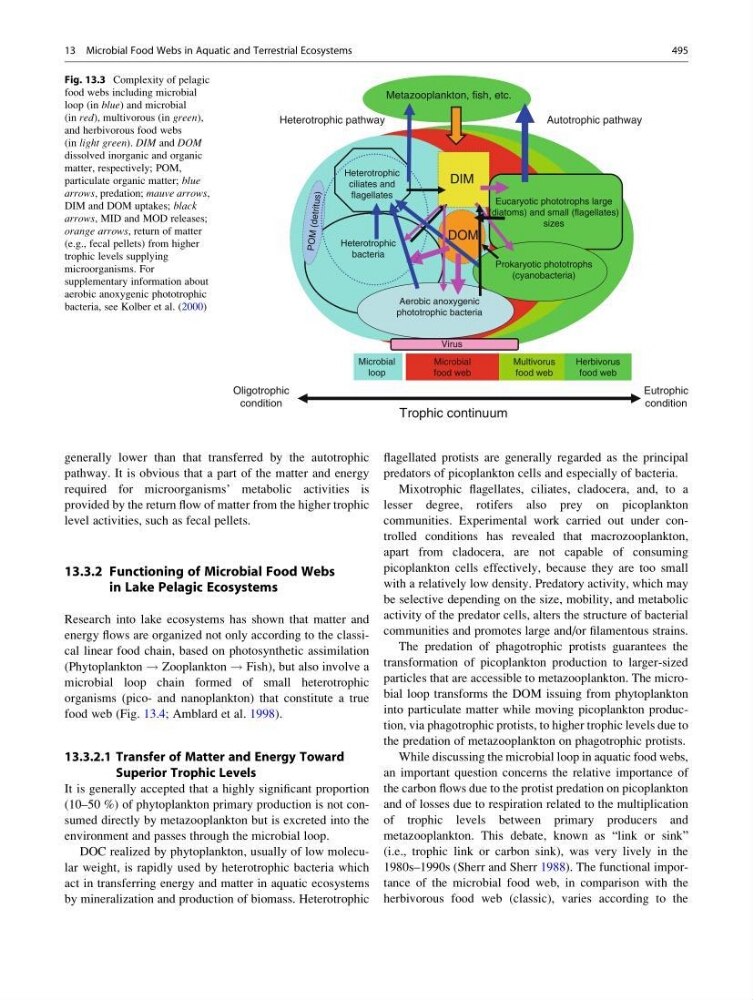
Fig. 13.3 Complexity of pelagic
food webs including microbial
loop (in blue) and microbial
(in red), multivorous (in green),
and herbivorous food webs
(in light green). DIM and DOM
dissolved inorganic and organic
matter, respectively; POM,
particulate organic matter; blue
arrows, predation; mauve arrows,
DIM and DOM uptakes; black
arrows, MID and MOD releases;
orange arrows, return of matter
(e.g., fecal pellets) from higher
trophic levels supplying
microorganisms. For
supplementary information about
aerobic anoxygenic phototrophic
bacteria, see Kolber et al. (2000)
13 Microbial Food Webs in Aquatic and Terrestrial Ecosystems
495
pathway. It is obvious that a part of the matter and energy
required for microorganisms’ metabolic activities is
provided by the return flow of matter from the higher trophic
level activities, such as fecal pellets.
13.3.2 Functioning of Microbial Food Webs
in Lake Pelagic Ecosystems
Research into lake ecosystems has shown that matter and
energy flows are organized not only according to the classical linear food chain, based on photosynthetic assimilation
(Phytoplankton ! Zooplankton ! Fish), but also involve a
microbial loop chain formed of small heterotrophic
organisms (pico- and nanoplankton) that constitute a true
food web (Fig. 13.4; Amblard et al. 1998).
13.3.2.1 Transfer of Matter and Energy Toward
Superior Trophic Levels
It is generally accepted that a highly significant proportion
(10–50 %) of phytoplankton primary production is not consumed directly by metazooplankton but is excreted into the
environment and passes through the microbial loop.
DOC realized by phytoplankton, usually of low molecular weight, is rapidly used by heterotrophic bacteria which
act in transferring energy and matter in aquatic ecosystems
by mineralization and production of biomass. Heterotrophic
flagellated protists are generally regarded as the principal
predators of picoplankton cells and especially of bacteria.
Mixotrophic flagellates, ciliates, cladocera, and, to a
lesser degree, rotifers also prey on picoplankton
communities. Experimental work carried out under controlled conditions has revealed that macrozooplankton,
apart from cladocera, are not capable of consuming
picoplankton cells effectively, because they are too small
with a relatively low density. Predatory activity, which may
be selective depending on the size, mobility, and metabolic
activity of the predator cells, alters the structure of bacterial
communities and promotes large and/or filamentous strains.
The predation of phagotrophic protists guarantees the
transformation of picoplankton production to larger-sized
particles that are accessible to metazooplankton. The microbial loop transforms the DOM issuing from phytoplankton
into particulate matter while moving picoplankton production, via phagotrophic protists, to higher trophic levels due to
the predation of metazooplankton on phagotrophic protists.
While discussing the microbial loop in aquatic food webs,
an important question concerns the relative importance of
the carbon flows due to the protist predation on picoplankton
and of losses due to respiration related to the multiplication
of trophic levels between primary producers and
metazooplankton. This debate, known as “link or sink”
(i.e., trophic link or carbon sink), was very lively in the
1980s–1990s (Sherr and Sherr 1988). The functional importance of the microbial food web, in comparison with the
herbivorous food web (classic), varies according to the
Microbial
loop
Microbial
food web
Multivorus
food web
Herbivorus
food web
Metazooplankton, fish, etc.
DOM
DIM
Heterotrophic
bacteria
Eucaryotic phototrophs large
(diatoms) and small (flagellates)
sizes
Prokaryotic phototrophs
(cyanobacteria)
Aerobic anoxygenic
phototrophic bacteria
PO M (de tritu s)
Heterotrophic
ciliates and
flagellates
Virus
Autotrophic pathway
Heterotrophic pathway
Trophic continuum
Oligotrophic
condition
Eutrophic
condition
Fig. 13.3 Complexity of pelagic
food webs including microbial
loop (in blue) and microbial
(in red), multivorous (in green),
and herbivorous food webs
(in light green). DIM and DOM
dissolved inorganic and organic
matter, respectively; POM,
particulate organic matter; blue
arrows, predation; mauve arrows,
DIM and DOM uptakes; black
arrows, MID and MOD releases;
orange arrows, return of matter
(e.g., fecal pellets) from higher
trophic levels supplying
microorganisms. For
supplementary information about
aerobic anoxygenic phototrophic
bacteria, see Kolber et al. (2000)
13 Microbial Food Webs in Aquatic and Terrestrial Ecosystems
495