

nitrate) and are consequently involved in the new
production.
The classic food web (herbivorous), by its important
productivity, feeds the large size of metazooplankton and
then fishes. The settling rate of microphytoplankton and
associated products (fecal pellets produce by herbivores)
being high, this type of food web is responsible of strong
exportation of OM outside the euphotic zone.
13.3.1.2 Microbial Food Web
The microbial food web, including the auto- and heterotrophic microorganisms, is dominated by pico- and
nanoplankton communities (cyanobacteria, heterotrophic
bacteria, and flagellates) and is characteristic of oligotrophic
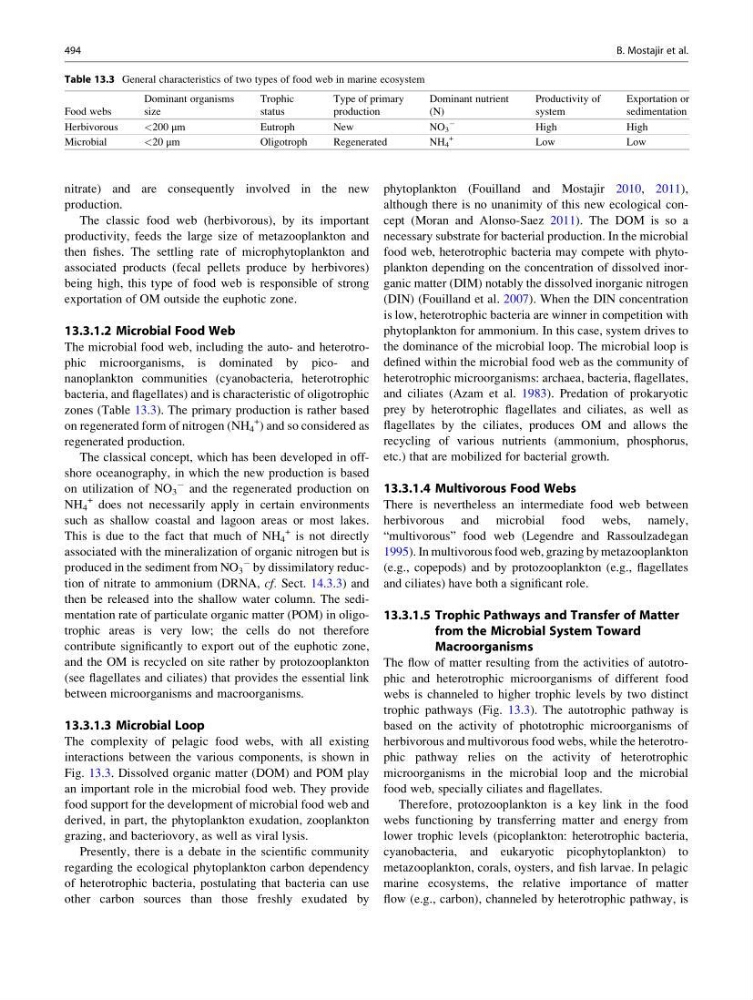
zones (Table 13.3). The primary production is rather based
on regenerated form of nitrogen (NH 4
+
) and so considered as
regenerated production.
The classical concept, which has been developed in offshore oceanography, in which the new production is based
on utilization of NO 3
À and the regenerated production on
NH 4
+ does not necessarily apply in certain environments
such as shallow coastal and lagoon areas or most lakes.
This is due to the fact that much of NH 4
+ is not directly
associated with the mineralization of organic nitrogen but is
produced in the sediment from NO 3
À by dissimilatory reduction of nitrate to ammonium (DRNA, cf. Sect. 14.3.3) and
then be released into the shallow water column. The sedimentation rate of particulate organic matter (POM) in oligotrophic areas is very low; the cells do not therefore
contribute significantly to export out of the euphotic zone,
and the OM is recycled on site rather by protozooplankton
(see flagellates and ciliates) that provides the essential link
between microorganisms and macroorganisms.
13.3.1.3 Microbial Loop
The complexity of pelagic food webs, with all existing
interactions between the various components, is shown in
Fig. 13.3. Dissolved organic matter (DOM) and POM play
an important role in the microbial food web. They provide
food support for the development of microbial food web and
derived, in part, the phytoplankton exudation, zooplankton
grazing, and bacteriovory, as well as viral lysis.
Presently, there is a debate in the scientific community
regarding the ecological phytoplankton carbon dependency
of heterotrophic bacteria, postulating that bacteria can use
other carbon sources than those freshly exudated by
phytoplankton (Fouilland and Mostajir 2010, 2011),
although there is no unanimity of this new ecological concept (Moran and Alonso-Saez 2011). The DOM is so a
necessary substrate for bacterial production. In the microbial
food web, heterotrophic bacteria may compete with phytoplankton depending on the concentration of dissolved inorganic matter (DIM) notably the dissolved inorganic nitrogen
(DIN) (Fouilland et al. 2007). When the DIN concentration
is low, heterotrophic bacteria are winner in competition with
phytoplankton for ammonium. In this case, system drives to
the dominance of the microbial loop. The microbial loop is
defined within the microbial food web as the community of
heterotrophic microorganisms: archaea, bacteria, flagellates,
and ciliates (Azam et al. 1983). Predation of prokaryotic
prey by heterotrophic flagellates and ciliates, as well as
flagellates by the ciliates, produces OM and allows the
recycling of various nutrients (ammonium, phosphorus,
etc.) that are mobilized for bacterial growth.
13.3.1.4 Multivorous Food Webs
There is nevertheless an intermediate food web between
herbivorous and microbial food webs, namely,
“multivorous” food web (Legendre and Rassoulzadegan
1995). In multivorous food web, grazing by metazooplankton
(e.g., copepods) and by protozooplankton (e.g., flagellates
and ciliates) have both a significant role.
13.3.1.5 Trophic Pathways and Transfer of Matter
from the Microbial System Toward
Macroorganisms
The flow of matter resulting from the activities of autotrophic and heterotrophic microorganisms of different food
webs is channeled to higher trophic levels by two distinct
trophic pathways (Fig. 13.3). The autotrophic pathway is
based on the activity of phototrophic microorganisms of
herbivorous and multivorous food webs, while the heterotrophic pathway relies on the activity of heterotrophic
microorganisms in the microbial loop and the microbial
food web, specially ciliates and flagellates.
Therefore, protozooplankton is a key link in the food
webs functioning by transferring matter and energy from
lower trophic levels (picoplankton: heterotrophic bacteria,
cyanobacteria, and eukaryotic picophytoplankton) to
metazooplankton, corals, oysters, and fish larvae. In pelagic
marine ecosystems, the relative importance of matter
flow (e.g., carbon), channeled by heterotrophic pathway, is
Table 13.3 General characteristics of two types of food web in marine ecosystem
Food webs
Dominant organisms
size
Trophic
status
Type of primary
production
Dominant nutrient
(N)
Productivity of
system
Exportation or
sedimentation
Herbivorous
<200 μm
Eutroph
New
NO 3
À
High
High
Microbial
<20 μm
Oligotroph
Regenerated
NH 4
+
Low
Low
494
B. Mostajir et al.
production.
The classic food web (herbivorous), by its important
productivity, feeds the large size of metazooplankton and
then fishes. The settling rate of microphytoplankton and
associated products (fecal pellets produce by herbivores)
being high, this type of food web is responsible of strong
exportation of OM outside the euphotic zone.
13.3.1.2 Microbial Food Web
The microbial food web, including the auto- and heterotrophic microorganisms, is dominated by pico- and
nanoplankton communities (cyanobacteria, heterotrophic
bacteria, and flagellates) and is characteristic of oligotrophic
zones (Table 13.3). The primary production is rather based
on regenerated form of nitrogen (NH 4
+
) and so considered as
regenerated production.
The classical concept, which has been developed in offshore oceanography, in which the new production is based
on utilization of NO 3
À and the regenerated production on
NH 4
+ does not necessarily apply in certain environments
such as shallow coastal and lagoon areas or most lakes.
This is due to the fact that much of NH 4
+ is not directly
associated with the mineralization of organic nitrogen but is
produced in the sediment from NO 3
À by dissimilatory reduction of nitrate to ammonium (DRNA, cf. Sect. 14.3.3) and
then be released into the shallow water column. The sedimentation rate of particulate organic matter (POM) in oligotrophic areas is very low; the cells do not therefore
contribute significantly to export out of the euphotic zone,
and the OM is recycled on site rather by protozooplankton
(see flagellates and ciliates) that provides the essential link
between microorganisms and macroorganisms.
13.3.1.3 Microbial Loop
The complexity of pelagic food webs, with all existing
interactions between the various components, is shown in
Fig. 13.3. Dissolved organic matter (DOM) and POM play
an important role in the microbial food web. They provide
food support for the development of microbial food web and
derived, in part, the phytoplankton exudation, zooplankton
grazing, and bacteriovory, as well as viral lysis.
Presently, there is a debate in the scientific community
regarding the ecological phytoplankton carbon dependency
of heterotrophic bacteria, postulating that bacteria can use
other carbon sources than those freshly exudated by
phytoplankton (Fouilland and Mostajir 2010, 2011),
although there is no unanimity of this new ecological concept (Moran and Alonso-Saez 2011). The DOM is so a
necessary substrate for bacterial production. In the microbial
food web, heterotrophic bacteria may compete with phytoplankton depending on the concentration of dissolved inorganic matter (DIM) notably the dissolved inorganic nitrogen
(DIN) (Fouilland et al. 2007). When the DIN concentration
is low, heterotrophic bacteria are winner in competition with
phytoplankton for ammonium. In this case, system drives to
the dominance of the microbial loop. The microbial loop is
defined within the microbial food web as the community of
heterotrophic microorganisms: archaea, bacteria, flagellates,
and ciliates (Azam et al. 1983). Predation of prokaryotic
prey by heterotrophic flagellates and ciliates, as well as
flagellates by the ciliates, produces OM and allows the
recycling of various nutrients (ammonium, phosphorus,
etc.) that are mobilized for bacterial growth.
13.3.1.4 Multivorous Food Webs
There is nevertheless an intermediate food web between
herbivorous and microbial food webs, namely,
“multivorous” food web (Legendre and Rassoulzadegan
1995). In multivorous food web, grazing by metazooplankton
(e.g., copepods) and by protozooplankton (e.g., flagellates
and ciliates) have both a significant role.
13.3.1.5 Trophic Pathways and Transfer of Matter
from the Microbial System Toward
Macroorganisms
The flow of matter resulting from the activities of autotrophic and heterotrophic microorganisms of different food
webs is channeled to higher trophic levels by two distinct
trophic pathways (Fig. 13.3). The autotrophic pathway is
based on the activity of phototrophic microorganisms of
herbivorous and multivorous food webs, while the heterotrophic pathway relies on the activity of heterotrophic
microorganisms in the microbial loop and the microbial
food web, specially ciliates and flagellates.
Therefore, protozooplankton is a key link in the food
webs functioning by transferring matter and energy from
lower trophic levels (picoplankton: heterotrophic bacteria,
cyanobacteria, and eukaryotic picophytoplankton) to
metazooplankton, corals, oysters, and fish larvae. In pelagic
marine ecosystems, the relative importance of matter
flow (e.g., carbon), channeled by heterotrophic pathway, is
Table 13.3 General characteristics of two types of food web in marine ecosystem
Food webs
Dominant organisms
size
Trophic
status
Type of primary
production
Dominant nutrient
(N)
Productivity of
system
Exportation or
sedimentation
Herbivorous
<200 μm
Eutroph
New
NO 3
À
High
High
Microbial
<20 μm
Oligotroph
Regenerated
NH 4
+
Low
Low
494
B. Mostajir et al.