

pathogenic E. coli. Sequencing of genomes from related
strains provides the material to address this type of question.
For instance, a study aiming at determining how the genetic
variability drives pathogenesis in Streptococcus agalactiae
(Firmicutes) has been performed in 2005 (Tettelin et al.
2005). This pathogenic bacterium is the major cause of bacterial septicemia of newborns. To do so, complete genome
sequences of eight S. agalactiae strains belonging to five of
the nine described serotypes have been obtained. The genomes
are very similar in size (from 2.18 to 2.24 Mb) and code for
2,034–2,481 genes. They display high sequence similarity
(from 85 to 95 % depending on the considered strains). The
core genome of these eight strains is composed of 1,806 genes
(~80 %), whereas the number of unique genes in a genome
varies from 13 to 61 depending on the considered strain. This
shows that although a majority of genes is common to all
S. agalactiae genomes, the genomic variability among strains
is not negligible, underlying rapid genomic evolutionary processes (including gene acquisitions and losses) even at very
small evolutionary scales. The comparison of the gene order in
the S. agalactiae genomes reveals a conserved common structure with large regions of synteny interrupted by 69 genomic
islands. The syntenic regions gather mainly core genes (i.e.,
shared by all genomes), and the order of genes within these
regions is highly conserved. The most parsimonious hypothesis to explain these results is that these syntenic regions have
been inherited by the eight strains from their common ancestor. Their high conservation suggests that they may be functionally important. In contrast, the genomic islands contained
genes that are specific to or shared by a few strains. These
genomic islands result thus of secondary acquisitions and
losses of genetic material that occurred during the diversification of the S. agalactiae strains. Interestingly, although the
gene content of the islands differs from one genome to another,
they are located at similar positions, suggesting that genomes
contain specific regions in which the newly acquired DNA is
inserted preferentially and thus that selective pressures
maintaining the overall structure of genomes exist. Many
comparative genomic studies, including a large-scale survey
of E. coli genomes (Touchon et al. 2009), provide similar
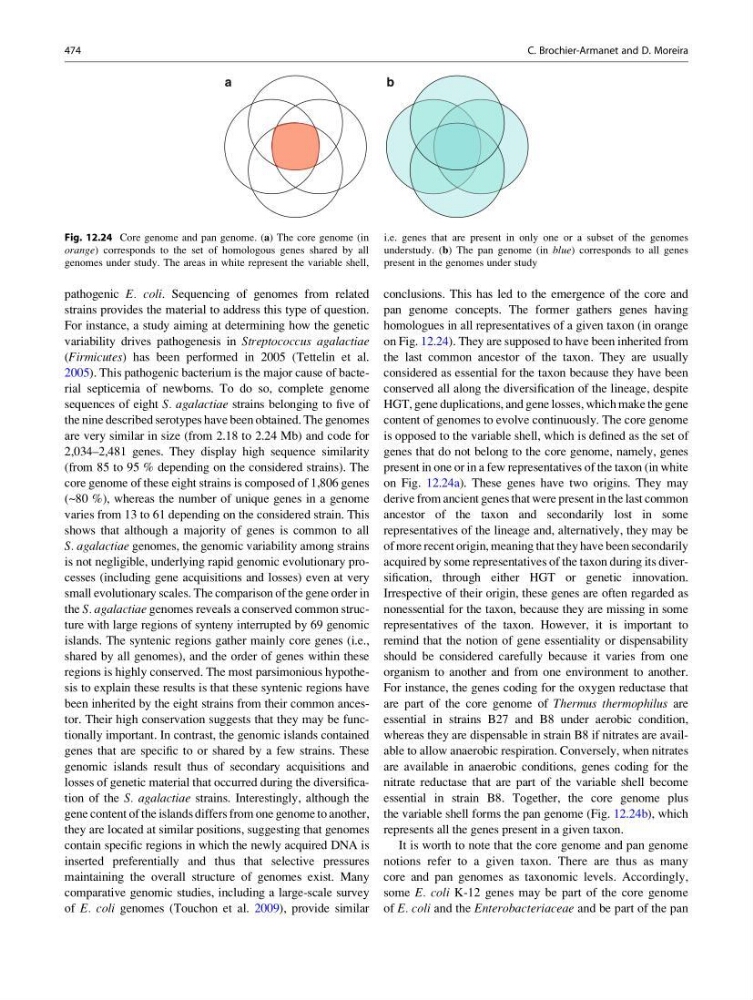
conclusions. This has led to the emergence of the core and
pan genome concepts. The former gathers genes having
homologues in all representatives of a given taxon (in orange
on Fig. 12.24). They are supposed to have been inherited from
the last common ancestor of the taxon. They are usually
considered as essential for the taxon because they have been
conserved all along the diversification of the lineage, despite
HGT, gene duplications, and gene losses, which make the gene
content of genomes to evolve continuously. The core genome
is opposed to the variable shell, which is defined as the set of
genes that do not belong to the core genome, namely, genes
present in one or in a few representatives of the taxon (in white
on Fig. 12.24a). These genes have two origins. They may
derive from ancient genes that were present in the last common
ancestor of the taxon and secondarily lost in some
representatives of the lineage and, alternatively, they may be
of more recent origin, meaning that they have been secondarily
acquired by some representatives of the taxon during its diversification, through either HGT or genetic innovation.
Irrespective of their origin, these genes are often regarded as
nonessential for the taxon, because they are missing in some
representatives of the taxon. However, it is important to
remind that the notion of gene essentiality or dispensability
should be considered carefully because it varies from one
organism to another and from one environment to another.
For instance, the genes coding for the oxygen reductase that
are part of the core genome of Thermus thermophilus are
essential in strains B27 and B8 under aerobic condition,
whereas they are dispensable in strain B8 if nitrates are available to allow anaerobic respiration. Conversely, when nitrates
are available in anaerobic conditions, genes coding for the
nitrate reductase that are part of the variable shell become
essential in strain B8. Together, the core genome plus
the variable shell forms the pan genome (Fig. 12.24b), which
represents all the genes present in a given taxon.
It is worth to note that the core genome and pan genome
notions refer to a given taxon. There are thus as many
core and pan genomes as taxonomic levels. Accordingly,
some E. coli K-12 genes may be part of the core genome
of E. coli and the Enterobacteriaceae and be part of the pan
a
b
Fig. 12.24 Core genome and pan genome. (a) The core genome (in
orange) corresponds to the set of homologous genes shared by all
genomes under study. The areas in white represent the variable shell,
i.e. genes that are present in only one or a subset of the genomes
understudy. (b) The pan genome (in blue) corresponds to all genes
present in the genomes under study
474
C. Brochier-Armanet and D. Moreira
strains provides the material to address this type of question.
For instance, a study aiming at determining how the genetic
variability drives pathogenesis in Streptococcus agalactiae
(Firmicutes) has been performed in 2005 (Tettelin et al.
2005). This pathogenic bacterium is the major cause of bacterial septicemia of newborns. To do so, complete genome
sequences of eight S. agalactiae strains belonging to five of
the nine described serotypes have been obtained. The genomes
are very similar in size (from 2.18 to 2.24 Mb) and code for
2,034–2,481 genes. They display high sequence similarity
(from 85 to 95 % depending on the considered strains). The
core genome of these eight strains is composed of 1,806 genes
(~80 %), whereas the number of unique genes in a genome
varies from 13 to 61 depending on the considered strain. This
shows that although a majority of genes is common to all
S. agalactiae genomes, the genomic variability among strains
is not negligible, underlying rapid genomic evolutionary processes (including gene acquisitions and losses) even at very
small evolutionary scales. The comparison of the gene order in
the S. agalactiae genomes reveals a conserved common structure with large regions of synteny interrupted by 69 genomic
islands. The syntenic regions gather mainly core genes (i.e.,
shared by all genomes), and the order of genes within these
regions is highly conserved. The most parsimonious hypothesis to explain these results is that these syntenic regions have
been inherited by the eight strains from their common ancestor. Their high conservation suggests that they may be functionally important. In contrast, the genomic islands contained
genes that are specific to or shared by a few strains. These
genomic islands result thus of secondary acquisitions and
losses of genetic material that occurred during the diversification of the S. agalactiae strains. Interestingly, although the
gene content of the islands differs from one genome to another,
they are located at similar positions, suggesting that genomes
contain specific regions in which the newly acquired DNA is
inserted preferentially and thus that selective pressures
maintaining the overall structure of genomes exist. Many
comparative genomic studies, including a large-scale survey
of E. coli genomes (Touchon et al. 2009), provide similar
conclusions. This has led to the emergence of the core and
pan genome concepts. The former gathers genes having
homologues in all representatives of a given taxon (in orange
on Fig. 12.24). They are supposed to have been inherited from
the last common ancestor of the taxon. They are usually
considered as essential for the taxon because they have been
conserved all along the diversification of the lineage, despite
HGT, gene duplications, and gene losses, which make the gene
content of genomes to evolve continuously. The core genome
is opposed to the variable shell, which is defined as the set of
genes that do not belong to the core genome, namely, genes
present in one or in a few representatives of the taxon (in white
on Fig. 12.24a). These genes have two origins. They may
derive from ancient genes that were present in the last common
ancestor of the taxon and secondarily lost in some
representatives of the lineage and, alternatively, they may be
of more recent origin, meaning that they have been secondarily
acquired by some representatives of the taxon during its diversification, through either HGT or genetic innovation.
Irrespective of their origin, these genes are often regarded as
nonessential for the taxon, because they are missing in some
representatives of the taxon. However, it is important to
remind that the notion of gene essentiality or dispensability
should be considered carefully because it varies from one
organism to another and from one environment to another.
For instance, the genes coding for the oxygen reductase that
are part of the core genome of Thermus thermophilus are
essential in strains B27 and B8 under aerobic condition,
whereas they are dispensable in strain B8 if nitrates are available to allow anaerobic respiration. Conversely, when nitrates
are available in anaerobic conditions, genes coding for the
nitrate reductase that are part of the variable shell become
essential in strain B8. Together, the core genome plus
the variable shell forms the pan genome (Fig. 12.24b), which
represents all the genes present in a given taxon.
It is worth to note that the core genome and pan genome
notions refer to a given taxon. There are thus as many
core and pan genomes as taxonomic levels. Accordingly,
some E. coli K-12 genes may be part of the core genome
of E. coli and the Enterobacteriaceae and be part of the pan
a
b
Fig. 12.24 Core genome and pan genome. (a) The core genome (in
orange) corresponds to the set of homologous genes shared by all
genomes under study. The areas in white represent the variable shell,
i.e. genes that are present in only one or a subset of the genomes
understudy. (b) The pan genome (in blue) corresponds to all genes
present in the genomes under study
474
C. Brochier-Armanet and D. Moreira