

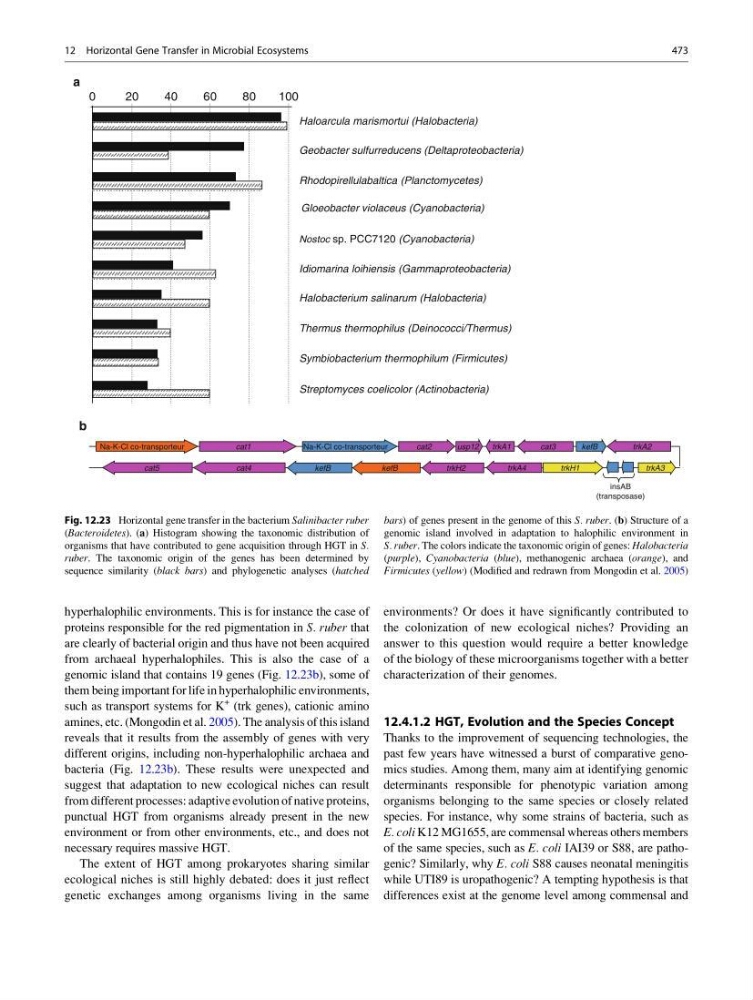
hyperhalophilic environments. This is for instance the case of
proteins responsible for the red pigmentation in S. ruber that
are clearly of bacterial origin and thus have not been acquired
from archaeal hyperhalophiles. This is also the case of a
genomic island that contains 19 genes (Fig. 12.23b), some of
them being important for life in hyperhalophilic environments,
such as transport systems for K
+ (trk genes), cationic amino
amines, etc. (Mongodin et al. 2005). The analysis of this island
reveals that it results from the assembly of genes with very
different origins, including non-hyperhalophilic archaea and
bacteria (Fig. 12.23b). These results were unexpected and
suggest that adaptation to new ecological niches can result
from different processes: adaptive evolution of native proteins,
punctual HGT from organisms already present in the new
environment or from other environments, etc., and does not
necessary requires massive HGT.
The extent of HGT among prokaryotes sharing similar
ecological niches is still highly debated: does it just reflect
genetic exchanges among organisms living in the same
environments? Or does it have significantly contributed to
the colonization of new ecological niches? Providing an
answer to this question would require a better knowledge
of the biology of these microorganisms together with a better
characterization of their genomes.
12.4.1.2 HGT, Evolution and the Species Concept
Thanks to the improvement of sequencing technologies, the
past few years have witnessed a burst of comparative genomics studies. Among them, many aim at identifying genomic
determinants responsible for phenotypic variation among
organisms belonging to the same species or closely related
species. For instance, why some strains of bacteria, such as
E. coli K12 MG1655, are commensal whereas others members
of the same species, such as E. coli IAI39 or S88, are pathogenic? Similarly, why E. coli S88 causes neonatal meningitis
while UTI89 is uropathogenic? A tempting hypothesis is that
differences exist at the genome level among commensal and
a
b
0
20
40
60
80
100
Haloarcula marismortui (Halobacteria)
Geobacter sulfurreducens (Deltaproteobacteria)
Rhodopirellulabaltica (Planctomycetes)
Gloeobacter violaceus (Cyanobacteria)
Nostoc sp. PCC7120 (Cyanobacteria)
Idiomarina loihiensis (Gammaproteobacteria)
Halobacterium salinarum (Halobacteria)
Thermus thermophilus (Deinococci/Thermus)
Symbiobacterium thermophilum (Firmicutes)
Streptomyces coelicolor (Actinobacteria)
Na-K-Cl co-transporteur
Na-K-Cl co-transporteur
kefB
cat1
cat2
trkA2
cat3
trkA1
usp12
insAB
(transposase)
kefB
kefB
trkA4
trkH2
cat4
cat5
trkH1
trkA3
Fig. 12.23 Horizontal gene transfer in the bacterium Salinibacter ruber
(Bacteroidetes). (a) Histogram showing the taxonomic distribution of
organisms that have contributed to gene acquisition through HGT in S.
ruber. The taxonomic origin of the genes has been determined by
sequence similarity (black bars) and phylogenetic analyses (hatched
bars) of genes present in the genome of this S. ruber. (b) Structure of a
genomic island involved in adaptation to halophilic environment in
S. ruber. The colors indicate the taxonomic origin of genes: Halobacteria
(purple), Cyanobacteria (blue), methanogenic archaea (orange), and
Firmicutes (yellow) (Modified and redrawn from Mongodin et al. 2005)
12 Horizontal Gene Transfer in Microbial Ecosystems
473
proteins responsible for the red pigmentation in S. ruber that
are clearly of bacterial origin and thus have not been acquired
from archaeal hyperhalophiles. This is also the case of a
genomic island that contains 19 genes (Fig. 12.23b), some of
them being important for life in hyperhalophilic environments,
such as transport systems for K
+ (trk genes), cationic amino
amines, etc. (Mongodin et al. 2005). The analysis of this island
reveals that it results from the assembly of genes with very
different origins, including non-hyperhalophilic archaea and
bacteria (Fig. 12.23b). These results were unexpected and
suggest that adaptation to new ecological niches can result
from different processes: adaptive evolution of native proteins,
punctual HGT from organisms already present in the new
environment or from other environments, etc., and does not
necessary requires massive HGT.
The extent of HGT among prokaryotes sharing similar
ecological niches is still highly debated: does it just reflect
genetic exchanges among organisms living in the same
environments? Or does it have significantly contributed to
the colonization of new ecological niches? Providing an
answer to this question would require a better knowledge
of the biology of these microorganisms together with a better
characterization of their genomes.
12.4.1.2 HGT, Evolution and the Species Concept
Thanks to the improvement of sequencing technologies, the
past few years have witnessed a burst of comparative genomics studies. Among them, many aim at identifying genomic
determinants responsible for phenotypic variation among
organisms belonging to the same species or closely related
species. For instance, why some strains of bacteria, such as
E. coli K12 MG1655, are commensal whereas others members
of the same species, such as E. coli IAI39 or S88, are pathogenic? Similarly, why E. coli S88 causes neonatal meningitis
while UTI89 is uropathogenic? A tempting hypothesis is that
differences exist at the genome level among commensal and
a
b
0
20
40
60
80
100
Haloarcula marismortui (Halobacteria)
Geobacter sulfurreducens (Deltaproteobacteria)
Rhodopirellulabaltica (Planctomycetes)
Gloeobacter violaceus (Cyanobacteria)
Nostoc sp. PCC7120 (Cyanobacteria)
Idiomarina loihiensis (Gammaproteobacteria)
Halobacterium salinarum (Halobacteria)
Thermus thermophilus (Deinococci/Thermus)
Symbiobacterium thermophilum (Firmicutes)
Streptomyces coelicolor (Actinobacteria)
Na-K-Cl co-transporteur
Na-K-Cl co-transporteur
kefB
cat1
cat2
trkA2
cat3
trkA1
usp12
insAB
(transposase)
kefB
kefB
trkA4
trkH2
cat4
cat5
trkH1
trkA3
Fig. 12.23 Horizontal gene transfer in the bacterium Salinibacter ruber
(Bacteroidetes). (a) Histogram showing the taxonomic distribution of
organisms that have contributed to gene acquisition through HGT in S.
ruber. The taxonomic origin of the genes has been determined by
sequence similarity (black bars) and phylogenetic analyses (hatched
bars) of genes present in the genome of this S. ruber. (b) Structure of a
genomic island involved in adaptation to halophilic environment in
S. ruber. The colors indicate the taxonomic origin of genes: Halobacteria
(purple), Cyanobacteria (blue), methanogenic archaea (orange), and
Firmicutes (yellow) (Modified and redrawn from Mongodin et al. 2005)
12 Horizontal Gene Transfer in Microbial Ecosystems
473