

suggesting high rates of HGT from the two latter to the former
(Fig. 12.19b) (Hallam et al. 2006; Makarova et al. 2007;
Brochier-Armanet et al. 2011). As in the case of hyperthermophilic bacteria, it was proposed that massive HGT of genes
from mesophilic prokaryotes could have help hyperthermophilic archaea to adapt to colder environments.
The hypothesis that massive HGT allows prokaryotes to
colonize new ecological niches is not limited to hot/cold
environments. Similar scenarios have been proposed in the
case of thermoacidophiles (Ruepp et al. 2000). For instance,
Thermoplasmatales (thermoacidophilic heterotrophic aerobic euryarchaeota) share many genes with Sulfolobales
(thermoacidophilic aerobic crenarchaeota) (Futterer et al.
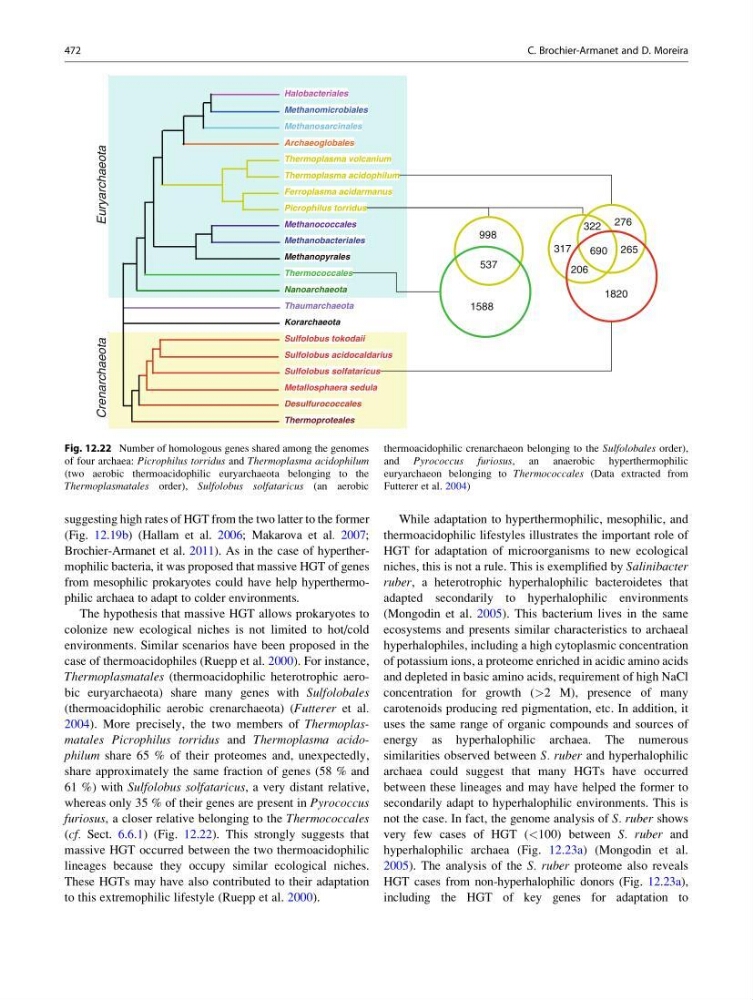
2004). More precisely, the two members of Thermoplasmatales Picrophilus torridus and Thermoplasma acidophilum share 65 % of their proteomes and, unexpectedly,
share approximately the same fraction of genes (58 % and
61 %) with Sulfolobus solfataricus, a very distant relative,
whereas only 35 % of their genes are present in Pyrococcus
furiosus, a closer relative belonging to the Thermococcales
(cf. Sect. 6.6.1) (Fig. 12.22). This strongly suggests that
massive HGT occurred between the two thermoacidophilic
lineages because they occupy similar ecological niches.
These HGTs may have also contributed to their adaptation
to this extremophilic lifestyle (Ruepp et al. 2000).
While adaptation to hyperthermophilic, mesophilic, and
thermoacidophilic lifestyles illustrates the important role of
HGT for adaptation of microorganisms to new ecological
niches, this is not a rule. This is exemplified by Salinibacter
ruber, a heterotrophic hyperhalophilic bacteroidetes that
adapted secondarily to hyperhalophilic environments
(Mongodin et al. 2005). This bacterium lives in the same
ecosystems and presents similar characteristics to archaeal
hyperhalophiles, including a high cytoplasmic concentration
of potassium ions, a proteome enriched in acidic amino acids
and depleted in basic amino acids, requirement of high NaCl
concentration for growth (>2 M), presence of many
carotenoids producing red pigmentation, etc. In addition, it
uses the same range of organic compounds and sources of
energy as hyperhalophilic archaea. The numerous
similarities observed between S. ruber and hyperhalophilic
archaea could suggest that many HGTs have occurred
between these lineages and may have helped the former to
secondarily adapt to hyperhalophilic environments. This is
not the case. In fact, the genome analysis of S. ruber shows
very few cases of HGT (<100) between S. ruber and
hyperhalophilic archaea (Fig. 12.23a) (Mongodin et al.
2005). The analysis of the S. ruber proteome also reveals
HGT cases from non-hyperhalophilic donors (Fig. 12.23a),
including the HGT of key genes for adaptation to
Crenarchaeota
Thermoproteales
Desulfurococcales
Metallosphaera sedula
Sulfolobus solfataricus
Sulfolobus acidocaldarius
Sulfolobus tokodaii
Korarchaeota
Thaumarchaeota
Nanoarchaeota
Thermococcales
Methanopyrales
Methanobacteriales
Methanococcales
Picrophilus torridus
Ferroplasma acidarmanus
Thermoplasma acidophilum
Thermoplasma volcanium
Archaeoglobales
Methanosarcinales
Methanomicrobiales
Halobacteriales
Euryarchaeota
1820
317
276
206
322
690 265
537
998
1588
Fig. 12.22 Number of homologous genes shared among the genomes
of four archaea: Picrophilus torridus and Thermoplasma acidophilum
(two aerobic thermoacidophilic euryarchaeota belonging to the
Thermoplasmatales order), Sulfolobus solfataricus (an aerobic
thermoacidophilic crenarchaeon belonging to the Sulfolobales order),
and Pyrococcus furiosus, an anaerobic hyperthermophilic
euryarchaeon belonging to Thermococcales (Data extracted from
Futterer et al. 2004)
472
C. Brochier-Armanet and D. Moreira
(Fig. 12.19b) (Hallam et al. 2006; Makarova et al. 2007;
Brochier-Armanet et al. 2011). As in the case of hyperthermophilic bacteria, it was proposed that massive HGT of genes
from mesophilic prokaryotes could have help hyperthermophilic archaea to adapt to colder environments.
The hypothesis that massive HGT allows prokaryotes to
colonize new ecological niches is not limited to hot/cold
environments. Similar scenarios have been proposed in the
case of thermoacidophiles (Ruepp et al. 2000). For instance,
Thermoplasmatales (thermoacidophilic heterotrophic aerobic euryarchaeota) share many genes with Sulfolobales
(thermoacidophilic aerobic crenarchaeota) (Futterer et al.
2004). More precisely, the two members of Thermoplasmatales Picrophilus torridus and Thermoplasma acidophilum share 65 % of their proteomes and, unexpectedly,
share approximately the same fraction of genes (58 % and
61 %) with Sulfolobus solfataricus, a very distant relative,
whereas only 35 % of their genes are present in Pyrococcus
furiosus, a closer relative belonging to the Thermococcales
(cf. Sect. 6.6.1) (Fig. 12.22). This strongly suggests that
massive HGT occurred between the two thermoacidophilic
lineages because they occupy similar ecological niches.
These HGTs may have also contributed to their adaptation
to this extremophilic lifestyle (Ruepp et al. 2000).
While adaptation to hyperthermophilic, mesophilic, and
thermoacidophilic lifestyles illustrates the important role of
HGT for adaptation of microorganisms to new ecological
niches, this is not a rule. This is exemplified by Salinibacter
ruber, a heterotrophic hyperhalophilic bacteroidetes that
adapted secondarily to hyperhalophilic environments
(Mongodin et al. 2005). This bacterium lives in the same
ecosystems and presents similar characteristics to archaeal
hyperhalophiles, including a high cytoplasmic concentration
of potassium ions, a proteome enriched in acidic amino acids
and depleted in basic amino acids, requirement of high NaCl
concentration for growth (>2 M), presence of many
carotenoids producing red pigmentation, etc. In addition, it
uses the same range of organic compounds and sources of
energy as hyperhalophilic archaea. The numerous
similarities observed between S. ruber and hyperhalophilic
archaea could suggest that many HGTs have occurred
between these lineages and may have helped the former to
secondarily adapt to hyperhalophilic environments. This is
not the case. In fact, the genome analysis of S. ruber shows
very few cases of HGT (<100) between S. ruber and
hyperhalophilic archaea (Fig. 12.23a) (Mongodin et al.
2005). The analysis of the S. ruber proteome also reveals
HGT cases from non-hyperhalophilic donors (Fig. 12.23a),
including the HGT of key genes for adaptation to
Crenarchaeota
Thermoproteales
Desulfurococcales
Metallosphaera sedula
Sulfolobus solfataricus
Sulfolobus acidocaldarius
Sulfolobus tokodaii
Korarchaeota
Thaumarchaeota
Nanoarchaeota
Thermococcales
Methanopyrales
Methanobacteriales
Methanococcales
Picrophilus torridus
Ferroplasma acidarmanus
Thermoplasma acidophilum
Thermoplasma volcanium
Archaeoglobales
Methanosarcinales
Methanomicrobiales
Halobacteriales
Euryarchaeota
1820
317
276
206
322
690 265
537
998
1588
Fig. 12.22 Number of homologous genes shared among the genomes
of four archaea: Picrophilus torridus and Thermoplasma acidophilum
(two aerobic thermoacidophilic euryarchaeota belonging to the
Thermoplasmatales order), Sulfolobus solfataricus (an aerobic
thermoacidophilic crenarchaeon belonging to the Sulfolobales order),
and Pyrococcus furiosus, an anaerobic hyperthermophilic
euryarchaeon belonging to Thermococcales (Data extracted from
Futterer et al. 2004)
472
C. Brochier-Armanet and D. Moreira