

the 450 genes supposed to have been acquired by HGT from
archaeal donors in T. maritima map in 15 genomic regions
with a gene order similar to that observed in archaea,
suggesting that they result from cotransfer events. Both
observations led to the assumption that acquisition of genes
of archaeal origin occurred rapidly in T. maritima through a
relatively limited number of HGTs (Nelson et al. 1999).
However, the hypothesis of massive HGT from archaeal
to bacterial hyperthermophiles has been criticized. Indeed,
in these first studies, the detection of HGT was based on the
sequence similarity approach, one of the less reliable
approaches for HGT detection (cf. Sect. 12.3.1). Overestimation of HGT rates is thus likely because this approach is
very sensitive to differences in evolutionary rates and taxonomic sampling biases. As a matter of fact, recent studies
have shown that genes of hyperthermophilic prokaryotes
evolve significantly slowly than those of mesophilic
organisms (Fig. 12.19c). Moreover, at the time of the analysis
of the T. maritima and A. aeolicus genomes, hyperthermophilic prokaryotes were underrepresented in public sequence
databases. Both biases may have led to an overestimation of
HGT rates in hyperthermophilic bacteria. Strengthening this
hypothesis, a more recent analysis reveals that the proportion
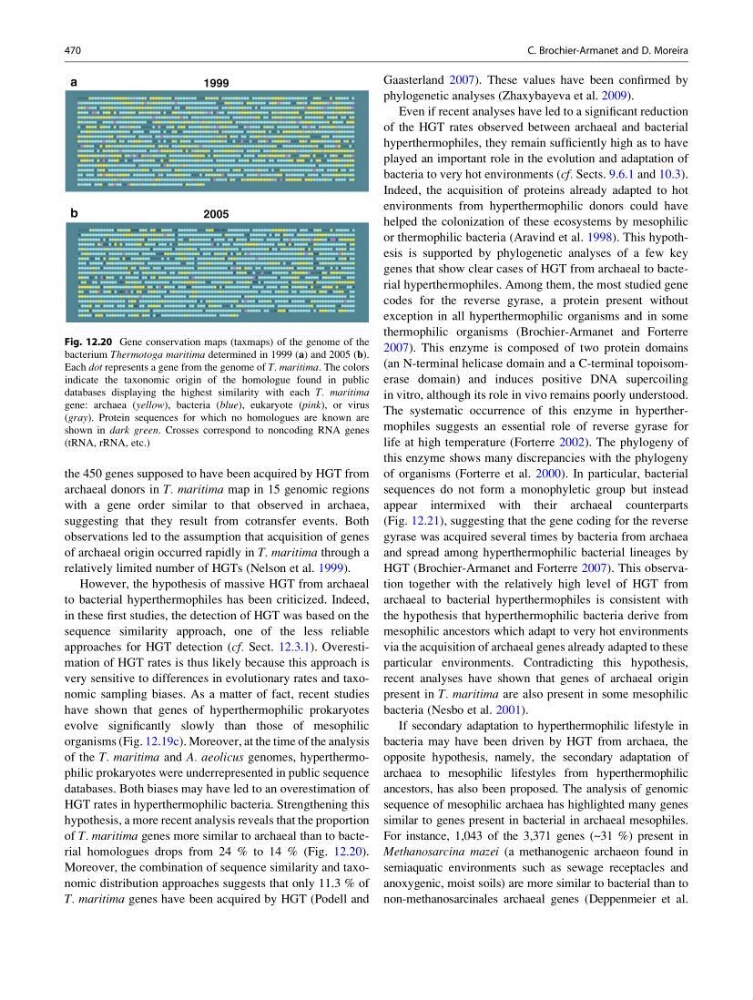
of T. maritima genes more similar to archaeal than to bacterial homologues drops from 24 % to 14 % (Fig. 12.20).
Moreover, the combination of sequence similarity and taxonomic distribution approaches suggests that only 11.3 % of
T. maritima genes have been acquired by HGT (Podell and
Gaasterland 2007). These values have been confirmed by
phylogenetic analyses (Zhaxybayeva et al. 2009).
Even if recent analyses have led to a significant reduction
of the HGT rates observed between archaeal and bacterial
hyperthermophiles, they remain sufficiently high as to have
played an important role in the evolution and adaptation of
bacteria to very hot environments (cf. Sects. 9.6.1 and 10.3).
Indeed, the acquisition of proteins already adapted to hot
environments from hyperthermophilic donors could have
helped the colonization of these ecosystems by mesophilic
or thermophilic bacteria (Aravind et al. 1998). This hypothesis is supported by phylogenetic analyses of a few key
genes that show clear cases of HGT from archaeal to bacterial hyperthermophiles. Among them, the most studied gene
codes for the reverse gyrase, a protein present without
exception in all hyperthermophilic organisms and in some
thermophilic organisms (Brochier-Armanet and Forterre
2007). This enzyme is composed of two protein domains
(an N-terminal helicase domain and a C-terminal topoisomerase domain) and induces positive DNA supercoiling
in vitro, although its role in vivo remains poorly understood.
The systematic occurrence of this enzyme in hyperthermophiles suggests an essential role of reverse gyrase for
life at high temperature (Forterre 2002). The phylogeny of
this enzyme shows many discrepancies with the phylogeny
of organisms (Forterre et al. 2000). In particular, bacterial
sequences do not form a monophyletic group but instead
appear intermixed with their archaeal counterparts
(Fig. 12.21), suggesting that the gene coding for the reverse
gyrase was acquired several times by bacteria from archaea
and spread among hyperthermophilic bacterial lineages by
HGT (Brochier-Armanet and Forterre 2007). This observation together with the relatively high level of HGT from
archaeal to bacterial hyperthermophiles is consistent with
the hypothesis that hyperthermophilic bacteria derive from
mesophilic ancestors which adapt to very hot environments
via the acquisition of archaeal genes already adapted to these
particular environments. Contradicting this hypothesis,
recent analyses have shown that genes of archaeal origin
present in T. maritima are also present in some mesophilic
bacteria (Nesbo et al. 2001).
If secondary adaptation to hyperthermophilic lifestyle in
bacteria may have been driven by HGT from archaea, the
opposite hypothesis, namely, the secondary adaptation of
archaea to mesophilic lifestyles from hyperthermophilic
ancestors, has also been proposed. The analysis of genomic
sequence of mesophilic archaea has highlighted many genes
similar to genes present in bacterial in archaeal mesophiles.
For instance, 1,043 of the 3,371 genes (~31 %) present in
Methanosarcina mazei (a methanogenic archaeon found in
semiaquatic environments such as sewage receptacles and
anoxygenic, moist soils) are more similar to bacterial than to
non-methanosarcinales archaeal genes (Deppenmeier et al.
1999
2005
a
b
Fig. 12.20 Gene conservation maps (taxmaps) of the genome of the
bacterium Thermotoga maritima determined in 1999 (a) and 2005 (b).
Each dot represents a gene from the genome of T. maritima. The colors
indicate the taxonomic origin of the homologue found in public
databases displaying the highest similarity with each T. maritima
gene: archaea (yellow), bacteria (blue), eukaryote (pink), or virus
(gray). Protein sequences for which no homologues are known are
shown in dark green. Crosses correspond to noncoding RNA genes
(tRNA, rRNA, etc.)
470
C. Brochier-Armanet and D. Moreira
archaeal donors in T. maritima map in 15 genomic regions
with a gene order similar to that observed in archaea,
suggesting that they result from cotransfer events. Both
observations led to the assumption that acquisition of genes
of archaeal origin occurred rapidly in T. maritima through a
relatively limited number of HGTs (Nelson et al. 1999).
However, the hypothesis of massive HGT from archaeal
to bacterial hyperthermophiles has been criticized. Indeed,
in these first studies, the detection of HGT was based on the
sequence similarity approach, one of the less reliable
approaches for HGT detection (cf. Sect. 12.3.1). Overestimation of HGT rates is thus likely because this approach is
very sensitive to differences in evolutionary rates and taxonomic sampling biases. As a matter of fact, recent studies
have shown that genes of hyperthermophilic prokaryotes
evolve significantly slowly than those of mesophilic
organisms (Fig. 12.19c). Moreover, at the time of the analysis
of the T. maritima and A. aeolicus genomes, hyperthermophilic prokaryotes were underrepresented in public sequence
databases. Both biases may have led to an overestimation of
HGT rates in hyperthermophilic bacteria. Strengthening this
hypothesis, a more recent analysis reveals that the proportion
of T. maritima genes more similar to archaeal than to bacterial homologues drops from 24 % to 14 % (Fig. 12.20).
Moreover, the combination of sequence similarity and taxonomic distribution approaches suggests that only 11.3 % of
T. maritima genes have been acquired by HGT (Podell and
Gaasterland 2007). These values have been confirmed by
phylogenetic analyses (Zhaxybayeva et al. 2009).
Even if recent analyses have led to a significant reduction
of the HGT rates observed between archaeal and bacterial
hyperthermophiles, they remain sufficiently high as to have
played an important role in the evolution and adaptation of
bacteria to very hot environments (cf. Sects. 9.6.1 and 10.3).
Indeed, the acquisition of proteins already adapted to hot
environments from hyperthermophilic donors could have
helped the colonization of these ecosystems by mesophilic
or thermophilic bacteria (Aravind et al. 1998). This hypothesis is supported by phylogenetic analyses of a few key
genes that show clear cases of HGT from archaeal to bacterial hyperthermophiles. Among them, the most studied gene
codes for the reverse gyrase, a protein present without
exception in all hyperthermophilic organisms and in some
thermophilic organisms (Brochier-Armanet and Forterre
2007). This enzyme is composed of two protein domains
(an N-terminal helicase domain and a C-terminal topoisomerase domain) and induces positive DNA supercoiling
in vitro, although its role in vivo remains poorly understood.
The systematic occurrence of this enzyme in hyperthermophiles suggests an essential role of reverse gyrase for
life at high temperature (Forterre 2002). The phylogeny of
this enzyme shows many discrepancies with the phylogeny
of organisms (Forterre et al. 2000). In particular, bacterial
sequences do not form a monophyletic group but instead
appear intermixed with their archaeal counterparts
(Fig. 12.21), suggesting that the gene coding for the reverse
gyrase was acquired several times by bacteria from archaea
and spread among hyperthermophilic bacterial lineages by
HGT (Brochier-Armanet and Forterre 2007). This observation together with the relatively high level of HGT from
archaeal to bacterial hyperthermophiles is consistent with
the hypothesis that hyperthermophilic bacteria derive from
mesophilic ancestors which adapt to very hot environments
via the acquisition of archaeal genes already adapted to these
particular environments. Contradicting this hypothesis,
recent analyses have shown that genes of archaeal origin
present in T. maritima are also present in some mesophilic
bacteria (Nesbo et al. 2001).
If secondary adaptation to hyperthermophilic lifestyle in
bacteria may have been driven by HGT from archaea, the
opposite hypothesis, namely, the secondary adaptation of
archaea to mesophilic lifestyles from hyperthermophilic
ancestors, has also been proposed. The analysis of genomic
sequence of mesophilic archaea has highlighted many genes
similar to genes present in bacterial in archaeal mesophiles.
For instance, 1,043 of the 3,371 genes (~31 %) present in
Methanosarcina mazei (a methanogenic archaeon found in
semiaquatic environments such as sewage receptacles and
anoxygenic, moist soils) are more similar to bacterial than to
non-methanosarcinales archaeal genes (Deppenmeier et al.
1999
2005
a
b
Fig. 12.20 Gene conservation maps (taxmaps) of the genome of the
bacterium Thermotoga maritima determined in 1999 (a) and 2005 (b).
Each dot represents a gene from the genome of T. maritima. The colors
indicate the taxonomic origin of the homologue found in public
databases displaying the highest similarity with each T. maritima
gene: archaea (yellow), bacteria (blue), eukaryote (pink), or virus
(gray). Protein sequences for which no homologues are known are
shown in dark green. Crosses correspond to noncoding RNA genes
(tRNA, rRNA, etc.)
470
C. Brochier-Armanet and D. Moreira