

Beyond the acquisition of new abilities, massive HGT
may drive more radical changes of lifestyle. A seminal study
was performed on Aquifex aeolicus, a hyperthermophilic
bacterium belonging to the Aquificae. The analysis of its
1,529 genes revealed that 16 % of them (i.e., 246 genes)
were more similar to genes present in hyperthermophilic
archaea than in bacteria, whereas genomes of mesophilic
species show significant lower proportions (<5 %)
(Table 12.2) (Aravind et al. 1998). A similar trend was
observed in Thermotoga maritima, a hyperthermophilic bacterium belonging to the Thermotogae, containing 24 %
genes (450 on 1,877) displaying higher similarity to archaeal
than to bacterial genes (Nelson et al. 1999).
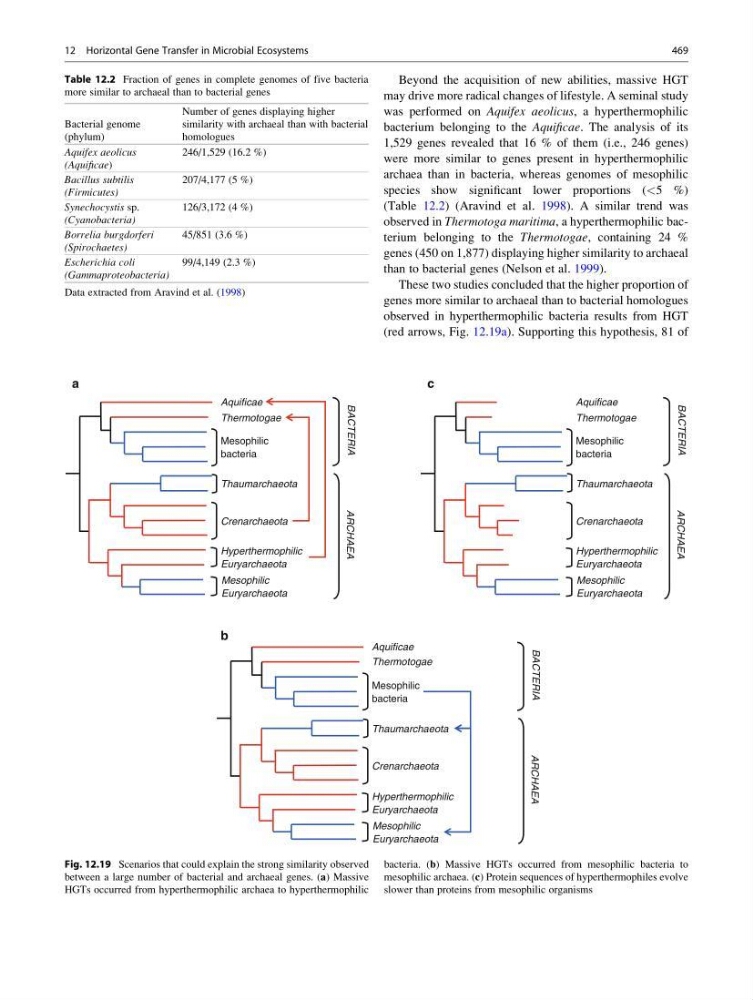
These two studies concluded that the higher proportion of
genes more similar to archaeal than to bacterial homologues
observed in hyperthermophilic bacteria results from HGT
(red arrows, Fig. 12.19a). Supporting this hypothesis, 81 of
a
c
Aquificae
Thermotogae
BACTERIA
ARCHAEA
Hyperthermophilic
Euryarchaeota
Crenarchaeota
Thaumarchaeota
Mesophilic
bacteria
Mesophilic
Euryarchaeota
Aquificae
Thermotogae
BACTERIA
ARCHAEA
Hyperthermophilic
Euryarchaeota
Crenarchaeota
Thaumarchaeota
Mesophilic
bacteria
Mesophilic
Euryarchaeota
Aquificae
Thermotogae
BACTERIA
ARCHAEA
Hyperthermophilic
Euryarchaeota
Crenarchaeota
Thaumarchaeota
Mesophilic
bacteria
Mesophilic
Euryarchaeota
b
Fig. 12.19 Scenarios that could explain the strong similarity observed
between a large number of bacterial and archaeal genes. (a) Massive
HGTs occurred from hyperthermophilic archaea to hyperthermophilic
bacteria. (b) Massive HGTs occurred from mesophilic bacteria to
mesophilic archaea. (c) Protein sequences of hyperthermophiles evolve
slower than proteins from mesophilic organisms
Table 12.2 Fraction of genes in complete genomes of five bacteria
more similar to archaeal than to bacterial genes
Bacterial genome
(phylum)
Number of genes displaying higher
similarity with archaeal than with bacterial
homologues
Aquifex aeolicus
(Aquificae)
246/1,529 (16.2 %)
Bacillus subtilis
(Firmicutes)
207/4,177 (5 %)
Synechocystis sp.
(Cyanobacteria)
126/3,172 (4 %)
Borrelia burgdorferi
(Spirochaetes)
45/851 (3.6 %)
Escherichia coli
(Gammaproteobacteria)
99/4,149 (2.3 %)
Data extracted from Aravind et al. (1998)
12 Horizontal Gene Transfer in Microbial Ecosystems
469
may drive more radical changes of lifestyle. A seminal study
was performed on Aquifex aeolicus, a hyperthermophilic
bacterium belonging to the Aquificae. The analysis of its
1,529 genes revealed that 16 % of them (i.e., 246 genes)
were more similar to genes present in hyperthermophilic
archaea than in bacteria, whereas genomes of mesophilic
species show significant lower proportions (<5 %)
(Table 12.2) (Aravind et al. 1998). A similar trend was
observed in Thermotoga maritima, a hyperthermophilic bacterium belonging to the Thermotogae, containing 24 %
genes (450 on 1,877) displaying higher similarity to archaeal
than to bacterial genes (Nelson et al. 1999).
These two studies concluded that the higher proportion of
genes more similar to archaeal than to bacterial homologues
observed in hyperthermophilic bacteria results from HGT
(red arrows, Fig. 12.19a). Supporting this hypothesis, 81 of
a
c
Aquificae
Thermotogae
BACTERIA
ARCHAEA
Hyperthermophilic
Euryarchaeota
Crenarchaeota
Thaumarchaeota
Mesophilic
bacteria
Mesophilic
Euryarchaeota
Aquificae
Thermotogae
BACTERIA
ARCHAEA
Hyperthermophilic
Euryarchaeota
Crenarchaeota
Thaumarchaeota
Mesophilic
bacteria
Mesophilic
Euryarchaeota
Aquificae
Thermotogae
BACTERIA
ARCHAEA
Hyperthermophilic
Euryarchaeota
Crenarchaeota
Thaumarchaeota
Mesophilic
bacteria
Mesophilic
Euryarchaeota
b
Fig. 12.19 Scenarios that could explain the strong similarity observed
between a large number of bacterial and archaeal genes. (a) Massive
HGTs occurred from hyperthermophilic archaea to hyperthermophilic
bacteria. (b) Massive HGTs occurred from mesophilic bacteria to
mesophilic archaea. (c) Protein sequences of hyperthermophiles evolve
slower than proteins from mesophilic organisms
Table 12.2 Fraction of genes in complete genomes of five bacteria
more similar to archaeal than to bacterial genes
Bacterial genome
(phylum)
Number of genes displaying higher
similarity with archaeal than with bacterial
homologues
Aquifex aeolicus
(Aquificae)
246/1,529 (16.2 %)
Bacillus subtilis
(Firmicutes)
207/4,177 (5 %)
Synechocystis sp.
(Cyanobacteria)
126/3,172 (4 %)
Borrelia burgdorferi
(Spirochaetes)
45/851 (3.6 %)
Escherichia coli
(Gammaproteobacteria)
99/4,149 (2.3 %)
Data extracted from Aravind et al. (1998)
12 Horizontal Gene Transfer in Microbial Ecosystems
469