

strains, as exemplified by the case of methicillin and
ciprofloxacin resistances in S. aureus and Klebsiella
pneumoniae, respectively. The only significant decrease of
antibiotic resistance in hospitals was observed in the case of
vancomycin-resistant
Enterococcus
faecalis
strains
(Fig. 12.17). The main conclusion of these studies is that, to
a few exceptions, there is no clear relation between antibiotic
restriction policies and the decrease of antibiotic resistance
(Livermore 2004). Nevertheless, they may have contributed
to slow down the progression of antibiotic resistance.
Health studies report the emergence of new resistance
factors in some pathogens. This is the case, for example, of
IMP-1, a metallo-beta-lactamase (i.e., a β-lactamase
involved in resistance to β-lactams) that is beginning to
emerge in Pseudomonas and Acinetobacter in different
places (Livermore and Woodford 2000). Although carrying
IMP-1 does not provide a full resistance, this report
anticipates the emergence of fully resistant strains
(Livermore 2004). The emergence of resistance has had a
considerable impact on public health policies. Indeed, if
pharmaceutical industries have invested considerable
amount of money for the development of new antibiotics
in the 1980s and 1990s, an opposite trend is now observed.
Instead, alternative approaches are under study, such as the
use of biological agents (phages) to control microbial
populations. This opens the door for the design of evolutionary systems, in which the biological agents and the
pathogens could coevolve, meaning that the emergence of
new microbial mutants may be counteracted by compensatory mutants occurring in the phages, ensuring the long-term
efficiency of the system.
The role of HGT in antibiotic resistance spreading
illustrates its importance in microbial populations. Genomic
studies show that HGT is also a key factor for the dissemination of many resistances, such as those to heavy metals or
radionuclides (i.e., atoms with unstable nuclei that may
undergo radioactive decay, resulting in the production of
ionizing radiations that may damage cells). Scientific
surveys show that microorganisms are able to survive and
thrive in heavily contaminated sites. Genomic and
metagenomic studies of microbial populations living in
these environments have revealed the presence of gene
cassettes allowing transforming and precipitating heavy
metals and radionuclides, reducing significantly the toxicity
of these compounds. As in the case of antibiotics, phylogenetic analysis indicates that HGT has played a major role in
the formation and dissemination of these gene cassettes
across diverse taxonomic groups.
Beyond the dissemination of resistance factors allowing
microorganisms to adapt to environmental changes, HGT is
regarded as an important process for the acquisition of new
capabilities. This may lead to radical changes in lifestyle and
allow conquering new ecological niches. This is for instance
the case of the ability to grow in anaerobic conditions in
Thermus thermophilus. The first isolates of this species were
strictly aerobic and used O 2 as sole terminal electron acceptor. Later, facultative anaerobic strains able to use alternative electron acceptors have been described. This is the case
of T. thermophilus HB8, which can use both nitrate and O 2
as terminal electron acceptors, whereas strain B27 is strictly
aerobic. Interestingly, HB8 strains are able to transfer by
conjugation their capacity to reduce nitrate to B27 strains.
Detailed analyses have revealed that nitrate respiration, and
thus the capacity to grow anaerobically, is linked to the
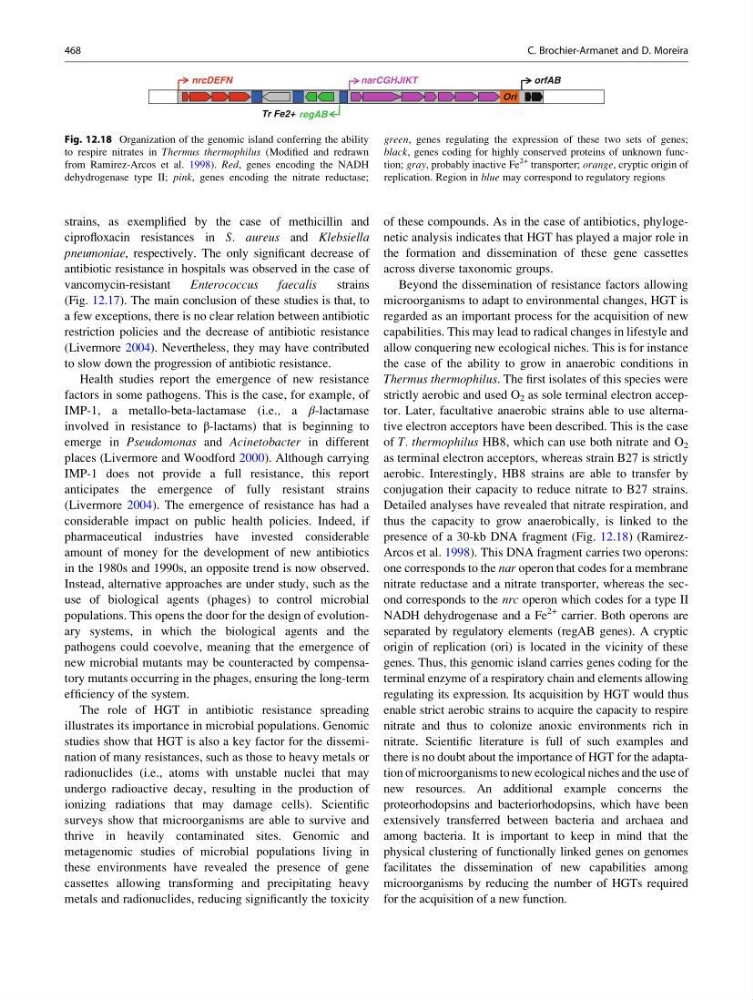
presence of a 30-kb DNA fragment (Fig. 12.18) (RamirezArcos et al. 1998). This DNA fragment carries two operons:
one corresponds to the nar operon that codes for a membrane
nitrate reductase and a nitrate transporter, whereas the second corresponds to the nrc operon which codes for a type II
NADH dehydrogenase and a Fe
2+ carrier. Both operons are
separated by regulatory elements (regAB genes). A cryptic
origin of replication (ori) is located in the vicinity of these
genes. Thus, this genomic island carries genes coding for the
terminal enzyme of a respiratory chain and elements allowing
regulating its expression. Its acquisition by HGT would thus
enable strict aerobic strains to acquire the capacity to respire
nitrate and thus to colonize anoxic environments rich in
nitrate. Scientific literature is full of such examples and
there is no doubt about the importance of HGT for the adaptation of microorganisms to new ecological niches and the use of
new resources. An additional example concerns the
proteorhodopsins and bacteriorhodopsins, which have been
extensively transferred between bacteria and archaea and
among bacteria. It is important to keep in mind that the
physical clustering of functionally linked genes on genomes
facilitates the dissemination of new capabilities among
microorganisms by reducing the number of HGTs required
for the acquisition of a new function.
nrcDEFN
regAB
Tr Fe2+
orfAB
Ori
narCGHJIKT
Fig. 12.18 Organization of the genomic island conferring the ability
to respire nitrates in Thermus thermophilus (Modified and redrawn
from Ramirez-Arcos et al. 1998). Red, genes encoding the NADH
dehydrogenase type II; pink, genes encoding the nitrate reductase;
green, genes regulating the expression of these two sets of genes;
black, genes coding for highly conserved proteins of unknown function; gray, probably inactive Fe
2+ transporter; orange, cryptic origin of
replication. Region in blue may correspond to regulatory regions
468
C. Brochier-Armanet and D. Moreira
ciprofloxacin resistances in S. aureus and Klebsiella
pneumoniae, respectively. The only significant decrease of
antibiotic resistance in hospitals was observed in the case of
vancomycin-resistant
Enterococcus
faecalis
strains
(Fig. 12.17). The main conclusion of these studies is that, to
a few exceptions, there is no clear relation between antibiotic
restriction policies and the decrease of antibiotic resistance
(Livermore 2004). Nevertheless, they may have contributed
to slow down the progression of antibiotic resistance.
Health studies report the emergence of new resistance
factors in some pathogens. This is the case, for example, of
IMP-1, a metallo-beta-lactamase (i.e., a β-lactamase
involved in resistance to β-lactams) that is beginning to
emerge in Pseudomonas and Acinetobacter in different
places (Livermore and Woodford 2000). Although carrying
IMP-1 does not provide a full resistance, this report
anticipates the emergence of fully resistant strains
(Livermore 2004). The emergence of resistance has had a
considerable impact on public health policies. Indeed, if
pharmaceutical industries have invested considerable
amount of money for the development of new antibiotics
in the 1980s and 1990s, an opposite trend is now observed.
Instead, alternative approaches are under study, such as the
use of biological agents (phages) to control microbial
populations. This opens the door for the design of evolutionary systems, in which the biological agents and the
pathogens could coevolve, meaning that the emergence of
new microbial mutants may be counteracted by compensatory mutants occurring in the phages, ensuring the long-term
efficiency of the system.
The role of HGT in antibiotic resistance spreading
illustrates its importance in microbial populations. Genomic
studies show that HGT is also a key factor for the dissemination of many resistances, such as those to heavy metals or
radionuclides (i.e., atoms with unstable nuclei that may
undergo radioactive decay, resulting in the production of
ionizing radiations that may damage cells). Scientific
surveys show that microorganisms are able to survive and
thrive in heavily contaminated sites. Genomic and
metagenomic studies of microbial populations living in
these environments have revealed the presence of gene
cassettes allowing transforming and precipitating heavy
metals and radionuclides, reducing significantly the toxicity
of these compounds. As in the case of antibiotics, phylogenetic analysis indicates that HGT has played a major role in
the formation and dissemination of these gene cassettes
across diverse taxonomic groups.
Beyond the dissemination of resistance factors allowing
microorganisms to adapt to environmental changes, HGT is
regarded as an important process for the acquisition of new
capabilities. This may lead to radical changes in lifestyle and
allow conquering new ecological niches. This is for instance
the case of the ability to grow in anaerobic conditions in
Thermus thermophilus. The first isolates of this species were
strictly aerobic and used O 2 as sole terminal electron acceptor. Later, facultative anaerobic strains able to use alternative electron acceptors have been described. This is the case
of T. thermophilus HB8, which can use both nitrate and O 2
as terminal electron acceptors, whereas strain B27 is strictly
aerobic. Interestingly, HB8 strains are able to transfer by
conjugation their capacity to reduce nitrate to B27 strains.
Detailed analyses have revealed that nitrate respiration, and
thus the capacity to grow anaerobically, is linked to the
presence of a 30-kb DNA fragment (Fig. 12.18) (RamirezArcos et al. 1998). This DNA fragment carries two operons:
one corresponds to the nar operon that codes for a membrane
nitrate reductase and a nitrate transporter, whereas the second corresponds to the nrc operon which codes for a type II
NADH dehydrogenase and a Fe
2+ carrier. Both operons are
separated by regulatory elements (regAB genes). A cryptic
origin of replication (ori) is located in the vicinity of these
genes. Thus, this genomic island carries genes coding for the
terminal enzyme of a respiratory chain and elements allowing
regulating its expression. Its acquisition by HGT would thus
enable strict aerobic strains to acquire the capacity to respire
nitrate and thus to colonize anoxic environments rich in
nitrate. Scientific literature is full of such examples and
there is no doubt about the importance of HGT for the adaptation of microorganisms to new ecological niches and the use of
new resources. An additional example concerns the
proteorhodopsins and bacteriorhodopsins, which have been
extensively transferred between bacteria and archaea and
among bacteria. It is important to keep in mind that the
physical clustering of functionally linked genes on genomes
facilitates the dissemination of new capabilities among
microorganisms by reducing the number of HGTs required
for the acquisition of a new function.
nrcDEFN
regAB
Tr Fe2+
orfAB
Ori
narCGHJIKT
Fig. 12.18 Organization of the genomic island conferring the ability
to respire nitrates in Thermus thermophilus (Modified and redrawn
from Ramirez-Arcos et al. 1998). Red, genes encoding the NADH
dehydrogenase type II; pink, genes encoding the nitrate reductase;
green, genes regulating the expression of these two sets of genes;
black, genes coding for highly conserved proteins of unknown function; gray, probably inactive Fe
2+ transporter; orange, cryptic origin of
replication. Region in blue may correspond to regulatory regions
468
C. Brochier-Armanet and D. Moreira