

– Tetracycline, an antibiotic which blocks translation by
inhibiting the attachment of charged aminoacyl-tRNAs
to the A site on the ribosome
– Quaternary ammonium compounds that destroy cell
membranes and proteins
– Silver ions which are toxic to cells
– Tellurite
Phylogenetic analyses show that resistance cassettes are
heteroclite assemblies of genes of very diverse origins which
have been brought together on the genome by successive
recombination events. Successive HGT through different
hosts favors the emergence of multiresistance cassettes
because at each step, the acquired cassette may be enriched
by new resistance factors which are present in the genome of
the recipient cell. Resistance cassettes are key players in the
dissemination process of resistances through HGT, because
a single HGT event allows the recipient cell acquiring a
large set of resistance genes.
The emergence of antibiotic resistances raises serious
public health concerns. First worldwide antibiotic
resistances were reported few years after the massive clinical
use of penicillin and sulfonamide against microbial
infections during the first half of the twentieth century
(Livermore 2004). In Europe, the rapid expansion of antibiotic resistances has been taken seriously, by adopting, at the
end of the 1960s, the first measures aiming at restricting the
use of antibiotics, especially in the food industry. Microbial
antibiotic resistance was overcome in the 1970s and 1980s
by the development of second-generation antimicrobial
drugs such as cephalosporins and fluoroquinolones
(Livermore 2004). However, the 1990s witnessed the emergence of the first Gram-negative strains resistant to this new
generation of antibiotics and soon after the emergence of the
first multiresistant Gram-positive strains (i.e., staphylococci,
pneumococci, enterococci, etc.) (Bhavnani et al. 2005).
In order to slow down the spread of antibiotic resistance, at
the end of the 1990s many European countries adopted
measures aiming at restricting the prescription of antibiotics.
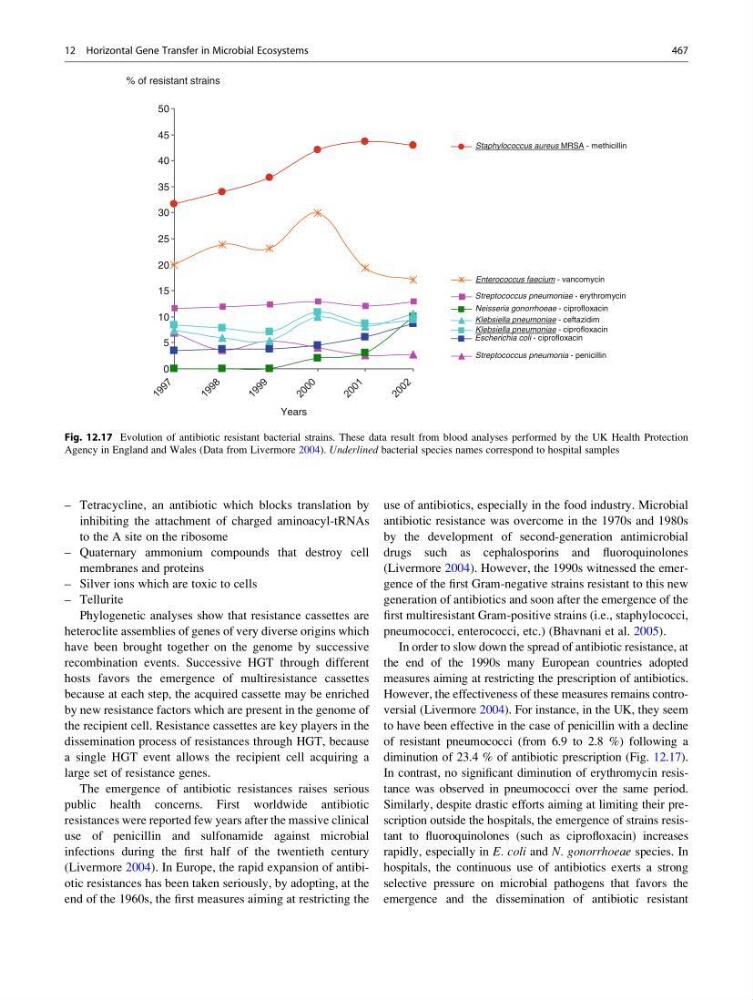
However, the effectiveness of these measures remains controversial (Livermore 2004). For instance, in the UK, they seem
to have been effective in the case of penicillin with a decline
of resistant pneumococci (from 6.9 to 2.8 %) following a
diminution of 23.4 % of antibiotic prescription (Fig. 12.17).
In contrast, no significant diminution of erythromycin resistance was observed in pneumococci over the same period.
Similarly, despite drastic efforts aiming at limiting their prescription outside the hospitals, the emergence of strains resistant to fluoroquinolones (such as ciprofloxacin) increases
rapidly, especially in E. coli and N. gonorrhoeae species. In
hospitals, the continuous use of antibiotics exerts a strong
selective pressure on microbial pathogens that favors the
emergence and the dissemination of antibiotic resistant
0
5
10
15
20
25
30
35
40
45
50
Years
% of resistant strains
Streptococcus pneumonia - penicillin
Streptococcus pneumoniae - erythromycin
Escherichia coli - ciprofloxacin
Neisseria gonorrhoeae - ciprofloxacin
Staphylococcus aureus MRSA - methicillin
Klebsiella pneumoniae - ciprofloxacin
Klebsiella pneumoniae - ceftazidim
Enterococcus faecium - vancomycin
Fig. 12.17 Evolution of antibiotic resistant bacterial strains. These data result from blood analyses performed by the UK Health Protection
Agency in England and Wales (Data from Livermore 2004). Underlined bacterial species names correspond to hospital samples
12 Horizontal Gene Transfer in Microbial Ecosystems
467
inhibiting the attachment of charged aminoacyl-tRNAs
to the A site on the ribosome
– Quaternary ammonium compounds that destroy cell
membranes and proteins
– Silver ions which are toxic to cells
– Tellurite
Phylogenetic analyses show that resistance cassettes are
heteroclite assemblies of genes of very diverse origins which
have been brought together on the genome by successive
recombination events. Successive HGT through different
hosts favors the emergence of multiresistance cassettes
because at each step, the acquired cassette may be enriched
by new resistance factors which are present in the genome of
the recipient cell. Resistance cassettes are key players in the
dissemination process of resistances through HGT, because
a single HGT event allows the recipient cell acquiring a
large set of resistance genes.
The emergence of antibiotic resistances raises serious
public health concerns. First worldwide antibiotic
resistances were reported few years after the massive clinical
use of penicillin and sulfonamide against microbial
infections during the first half of the twentieth century
(Livermore 2004). In Europe, the rapid expansion of antibiotic resistances has been taken seriously, by adopting, at the
end of the 1960s, the first measures aiming at restricting the
use of antibiotics, especially in the food industry. Microbial
antibiotic resistance was overcome in the 1970s and 1980s
by the development of second-generation antimicrobial
drugs such as cephalosporins and fluoroquinolones
(Livermore 2004). However, the 1990s witnessed the emergence of the first Gram-negative strains resistant to this new
generation of antibiotics and soon after the emergence of the
first multiresistant Gram-positive strains (i.e., staphylococci,
pneumococci, enterococci, etc.) (Bhavnani et al. 2005).
In order to slow down the spread of antibiotic resistance, at
the end of the 1990s many European countries adopted
measures aiming at restricting the prescription of antibiotics.
However, the effectiveness of these measures remains controversial (Livermore 2004). For instance, in the UK, they seem
to have been effective in the case of penicillin with a decline
of resistant pneumococci (from 6.9 to 2.8 %) following a
diminution of 23.4 % of antibiotic prescription (Fig. 12.17).
In contrast, no significant diminution of erythromycin resistance was observed in pneumococci over the same period.
Similarly, despite drastic efforts aiming at limiting their prescription outside the hospitals, the emergence of strains resistant to fluoroquinolones (such as ciprofloxacin) increases
rapidly, especially in E. coli and N. gonorrhoeae species. In
hospitals, the continuous use of antibiotics exerts a strong
selective pressure on microbial pathogens that favors the
emergence and the dissemination of antibiotic resistant
0
5
10
15
20
25
30
35
40
45
50
Years
% of resistant strains
Streptococcus pneumonia - penicillin
Streptococcus pneumoniae - erythromycin
Escherichia coli - ciprofloxacin
Neisseria gonorrhoeae - ciprofloxacin
Staphylococcus aureus MRSA - methicillin
Klebsiella pneumoniae - ciprofloxacin
Klebsiella pneumoniae - ceftazidim
Enterococcus faecium - vancomycin
Fig. 12.17 Evolution of antibiotic resistant bacterial strains. These data result from blood analyses performed by the UK Health Protection
Agency in England and Wales (Data from Livermore 2004). Underlined bacterial species names correspond to hospital samples
12 Horizontal Gene Transfer in Microbial Ecosystems
467