

phylogenetic approaches allow determining the direction of
transfer or, in other words, distinguishing between the donor
and the recipient lineages.
Applying phylogenetic approaches, it is possible to identify the genes (or groups of genes) presenting similar phylogenetic histories. Among these sets of genes, one
corresponds to genes that have been vertically transmitted
during the evolution of the organisms under study, while
others represent groups of genes with atypical stories which
may result from HGT. The study of these sets of genes can
provide a lot of information for understanding the evolution
of genomes and thus of organisms.
12.3.3.2 Limits
Although regarded as one of the most efficient methods to
detect HGT, the implementation of phylogenetic approaches
is actually complex. Indeed, besides the phylogenetic inference
itself, these approaches require the identification of the
homologues of the gene under study, the construction of a
multiple alignment, and the trimming of the resulting alignment in order to remove from the analysis the regions where
the alignment is ambiguous. Although these steps can be
automated, phylogenetic reconstruction is time consuming,
especially when the number of sequences to analyze is high.
In addition, applying these approaches necessitates the knowledge of the phylogenetic relationships among the organisms
studied. However, most of the time, this phylogeny of
organisms is not known a priori. In that case, a preliminary
step in the analysis consists in establishing the phylogeny of
organisms. Genes that are most frequently used for this purpose
are those encoding the RNA component of the small subunit of
the ribosome, ribosomal proteins, or housekeeping genes (i.e.,
genes expressed in a constitutive manner and/or whose product
is essential to the cell) (cf. Sect. 6.4). Finally, accurate identification of HGT requires that the phylogeny of the gene under
study is well resolved (i.e., statically significant), that is to
say, the branching pattern of sequences must be unambiguous
(i.e., supported by significant bootstrap values or posterior
probabilities). If this condition is not met, it is not possible to
determine whether the phylogeny of the gene is consistent or
inconsistent with the phylogeny of organisms. Last but not
least, the phylogenies of genes shall not be affected by tree
reconstruction artifacts, which make the topology of the
reconstructed tree different from the evolutionary history of
sequences. Tree reconstruction artifacts may have several
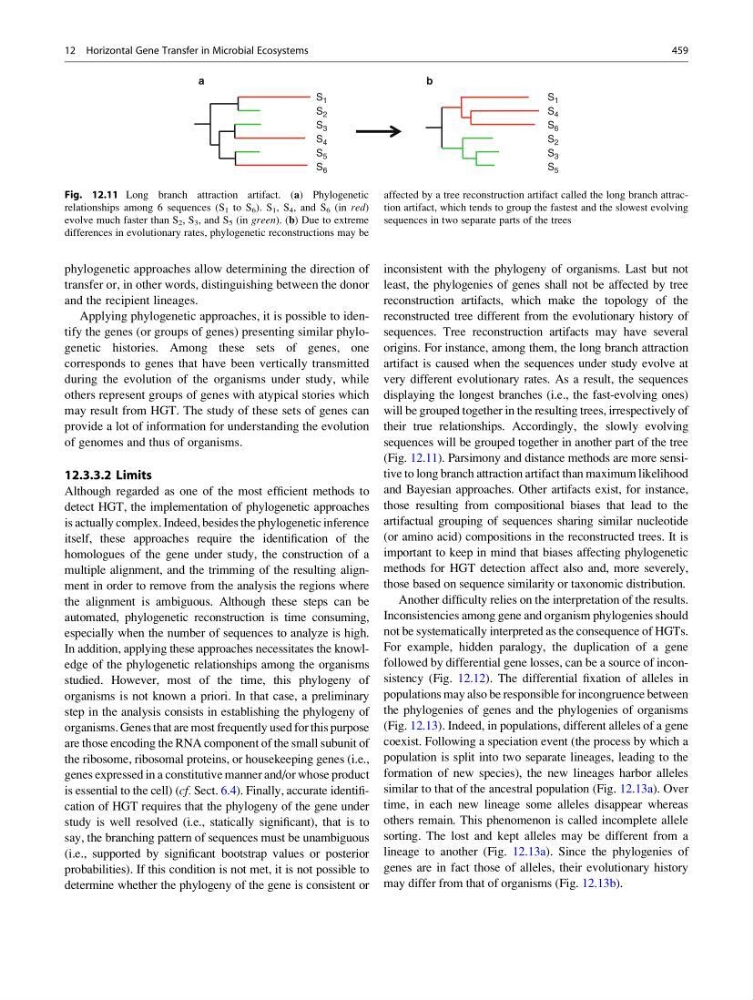
origins. For instance, among them, the long branch attraction
artifact is caused when the sequences under study evolve at
very different evolutionary rates. As a result, the sequences
displaying the longest branches (i.e., the fast-evolving ones)
will be grouped together in the resulting trees, irrespectively of
their true relationships. Accordingly, the slowly evolving
sequences will be grouped together in another part of the tree
(Fig. 12.11). Parsimony and distance methods are more sensitive to long branch attraction artifact than maximum likelihood
and Bayesian approaches. Other artifacts exist, for instance,
those resulting from compositional biases that lead to the
artifactual grouping of sequences sharing similar nucleotide
(or amino acid) compositions in the reconstructed trees. It is
important to keep in mind that biases affecting phylogenetic
methods for HGT detection affect also and, more severely,
those based on sequence similarity or taxonomic distribution.
Another difficulty relies on the interpretation of the results.
Inconsistencies among gene and organism phylogenies should
not be systematically interpreted as the consequence of HGTs.
For example, hidden paralogy, the duplication of a gene
followed by differential gene losses, can be a source of inconsistency (Fig. 12.12). The differential fixation of alleles in
populations may also be responsible for incongruence between
the phylogenies of genes and the phylogenies of organisms
(Fig. 12.13). Indeed, in populations, different alleles of a gene
coexist. Following a speciation event (the process by which a
population is split into two separate lineages, leading to the
formation of new species), the new lineages harbor alleles
similar to that of the ancestral population (Fig. 12.13a). Over
time, in each new lineage some alleles disappear whereas
others remain. This phenomenon is called incomplete allele
sorting. The lost and kept alleles may be different from a
lineage to another (Fig. 12.13a). Since the phylogenies of
genes are in fact those of alleles, their evolutionary history
may differ from that of organisms (Fig. 12.13b).
a
b
S 1
S 2
S 3
S 4
S 5
S 6
S 1
S 4
S 6
S 2
S 3
S 5
Fig. 12.11 Long branch attraction artifact. (a) Phylogenetic
relationships among 6 sequences (S 1 to S 6 ). S 1 , S 4 , and S 6 (in red)
evolve much faster than S 2 , S 3 , and S 5 (in green). (b) Due to extreme
differences in evolutionary rates, phylogenetic reconstructions may be
affected by a tree reconstruction artifact called the long branch attraction artifact, which tends to group the fastest and the slowest evolving
sequences in two separate parts of the trees
12 Horizontal Gene Transfer in Microbial Ecosystems
459
transfer or, in other words, distinguishing between the donor
and the recipient lineages.
Applying phylogenetic approaches, it is possible to identify the genes (or groups of genes) presenting similar phylogenetic histories. Among these sets of genes, one
corresponds to genes that have been vertically transmitted
during the evolution of the organisms under study, while
others represent groups of genes with atypical stories which
may result from HGT. The study of these sets of genes can
provide a lot of information for understanding the evolution
of genomes and thus of organisms.
12.3.3.2 Limits
Although regarded as one of the most efficient methods to
detect HGT, the implementation of phylogenetic approaches
is actually complex. Indeed, besides the phylogenetic inference
itself, these approaches require the identification of the
homologues of the gene under study, the construction of a
multiple alignment, and the trimming of the resulting alignment in order to remove from the analysis the regions where
the alignment is ambiguous. Although these steps can be
automated, phylogenetic reconstruction is time consuming,
especially when the number of sequences to analyze is high.
In addition, applying these approaches necessitates the knowledge of the phylogenetic relationships among the organisms
studied. However, most of the time, this phylogeny of
organisms is not known a priori. In that case, a preliminary
step in the analysis consists in establishing the phylogeny of
organisms. Genes that are most frequently used for this purpose
are those encoding the RNA component of the small subunit of
the ribosome, ribosomal proteins, or housekeeping genes (i.e.,
genes expressed in a constitutive manner and/or whose product
is essential to the cell) (cf. Sect. 6.4). Finally, accurate identification of HGT requires that the phylogeny of the gene under
study is well resolved (i.e., statically significant), that is to
say, the branching pattern of sequences must be unambiguous
(i.e., supported by significant bootstrap values or posterior
probabilities). If this condition is not met, it is not possible to
determine whether the phylogeny of the gene is consistent or
inconsistent with the phylogeny of organisms. Last but not
least, the phylogenies of genes shall not be affected by tree
reconstruction artifacts, which make the topology of the
reconstructed tree different from the evolutionary history of
sequences. Tree reconstruction artifacts may have several
origins. For instance, among them, the long branch attraction
artifact is caused when the sequences under study evolve at
very different evolutionary rates. As a result, the sequences
displaying the longest branches (i.e., the fast-evolving ones)
will be grouped together in the resulting trees, irrespectively of
their true relationships. Accordingly, the slowly evolving
sequences will be grouped together in another part of the tree
(Fig. 12.11). Parsimony and distance methods are more sensitive to long branch attraction artifact than maximum likelihood
and Bayesian approaches. Other artifacts exist, for instance,
those resulting from compositional biases that lead to the
artifactual grouping of sequences sharing similar nucleotide
(or amino acid) compositions in the reconstructed trees. It is
important to keep in mind that biases affecting phylogenetic
methods for HGT detection affect also and, more severely,
those based on sequence similarity or taxonomic distribution.
Another difficulty relies on the interpretation of the results.
Inconsistencies among gene and organism phylogenies should
not be systematically interpreted as the consequence of HGTs.
For example, hidden paralogy, the duplication of a gene
followed by differential gene losses, can be a source of inconsistency (Fig. 12.12). The differential fixation of alleles in
populations may also be responsible for incongruence between
the phylogenies of genes and the phylogenies of organisms
(Fig. 12.13). Indeed, in populations, different alleles of a gene
coexist. Following a speciation event (the process by which a
population is split into two separate lineages, leading to the
formation of new species), the new lineages harbor alleles
similar to that of the ancestral population (Fig. 12.13a). Over
time, in each new lineage some alleles disappear whereas
others remain. This phenomenon is called incomplete allele
sorting. The lost and kept alleles may be different from a
lineage to another (Fig. 12.13a). Since the phylogenies of
genes are in fact those of alleles, their evolutionary history
may differ from that of organisms (Fig. 12.13b).
a
b
S 1
S 2
S 3
S 4
S 5
S 6
S 1
S 4
S 6
S 2
S 3
S 5
Fig. 12.11 Long branch attraction artifact. (a) Phylogenetic
relationships among 6 sequences (S 1 to S 6 ). S 1 , S 4 , and S 6 (in red)
evolve much faster than S 2 , S 3 , and S 5 (in green). (b) Due to extreme
differences in evolutionary rates, phylogenetic reconstructions may be
affected by a tree reconstruction artifact called the long branch attraction artifact, which tends to group the fastest and the slowest evolving
sequences in two separate parts of the trees
12 Horizontal Gene Transfer in Microbial Ecosystems
459