

Finally, phylogenetic methods are unable to detect HGTs
that occurred between sister-lineages, because the
corresponding gene phylogenies will be similar to that of
organisms. For instance, if the HGT shown on Fig. 12.10 had
occurred between ancestors of the organisms O 5 and O 6 ,
then the sequence S 5 would emerge as the sister group of
S 6 , as it would have been expected in the absence of HGT.
In summary, although the methods of phylogenetic reconstruction are more adapted to HGT detection than those
based on sequence similarity, they are more complex to
a
b
c
O 1
O 2
O 3
O 4
O 5
O 6
S’’ 6
D
S 1
S 2
S 3
S’ 4
S’ 5
S’ 6
S’’ 4
S’’ 5
S’’ 6
S 1
S 2
S 3
S’ 4
S’ 5
S 1
S 2
S 3
S’ 4
S’ 5
S’ 6
S’’ 4
S’’ 5
S’’ 6
D
d
D
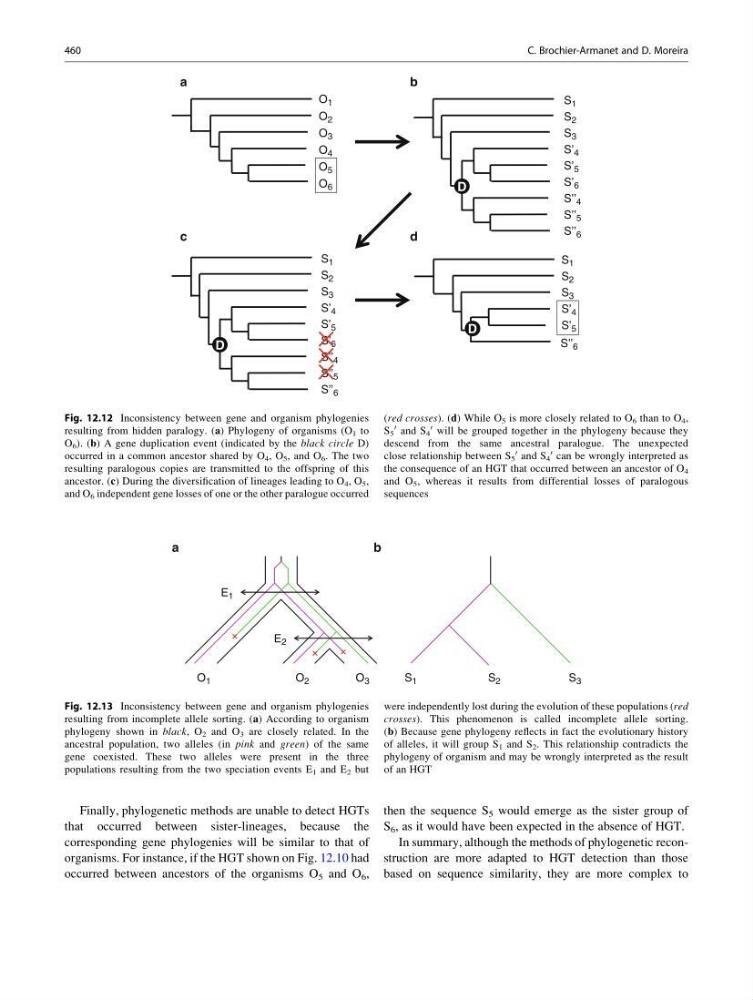
Fig. 12.12 Inconsistency between gene and organism phylogenies
resulting from hidden paralogy. (a) Phylogeny of organisms (O 1 to
O 6 ). (b) A gene duplication event (indicated by the black circle D)
occurred in a common ancestor shared by O 4 , O 5 , and O 6 . The two
resulting paralogous copies are transmitted to the offspring of this
ancestor. (c) During the diversification of lineages leading to O 4 , O 5 ,
and O 6 independent gene losses of one or the other paralogue occurred
(red crosses). (d) While O 5 is more closely related to O 6 than to O 4 ,
S 5
0 and S 4
0 will be grouped together in the phylogeny because they
descend from the same ancestral paralogue. The unexpected
close relationship between S 5
0 and S 4
0 can be wrongly interpreted as
the consequence of an HGT that occurred between an ancestor of O 4
and O 5 , whereas it results from differential losses of paralogous
sequences
a
b
O 1
O 2
O 3
S 1
S 2
S 3
E 1
E 2
Fig. 12.13 Inconsistency between gene and organism phylogenies
resulting from incomplete allele sorting. (a) According to organism
phylogeny shown in black, O 2 and O 3 are closely related. In the
ancestral population, two alleles (in pink and green) of the same
gene coexisted. These two alleles were present in the three
populations resulting from the two speciation events E 1 and E 2 but
were independently lost during the evolution of these populations (red
crosses). This phenomenon is called incomplete allele sorting.
(b) Because gene phylogeny reflects in fact the evolutionary history
of alleles, it will group S 1 and S 2 . This relationship contradicts the
phylogeny of organism and may be wrongly interpreted as the result
of an HGT
460
C. Brochier-Armanet and D. Moreira
that occurred between sister-lineages, because the
corresponding gene phylogenies will be similar to that of
organisms. For instance, if the HGT shown on Fig. 12.10 had
occurred between ancestors of the organisms O 5 and O 6 ,
then the sequence S 5 would emerge as the sister group of
S 6 , as it would have been expected in the absence of HGT.
In summary, although the methods of phylogenetic reconstruction are more adapted to HGT detection than those
based on sequence similarity, they are more complex to
a
b
c
O 1
O 2
O 3
O 4
O 5
O 6
S’’ 6
D
S 1
S 2
S 3
S’ 4
S’ 5
S’ 6
S’’ 4
S’’ 5
S’’ 6
S 1
S 2
S 3
S’ 4
S’ 5
S 1
S 2
S 3
S’ 4
S’ 5
S’ 6
S’’ 4
S’’ 5
S’’ 6
D
d
D
Fig. 12.12 Inconsistency between gene and organism phylogenies
resulting from hidden paralogy. (a) Phylogeny of organisms (O 1 to
O 6 ). (b) A gene duplication event (indicated by the black circle D)
occurred in a common ancestor shared by O 4 , O 5 , and O 6 . The two
resulting paralogous copies are transmitted to the offspring of this
ancestor. (c) During the diversification of lineages leading to O 4 , O 5 ,
and O 6 independent gene losses of one or the other paralogue occurred
(red crosses). (d) While O 5 is more closely related to O 6 than to O 4 ,
S 5
0 and S 4
0 will be grouped together in the phylogeny because they
descend from the same ancestral paralogue. The unexpected
close relationship between S 5
0 and S 4
0 can be wrongly interpreted as
the consequence of an HGT that occurred between an ancestor of O 4
and O 5 , whereas it results from differential losses of paralogous
sequences
a
b
O 1
O 2
O 3
S 1
S 2
S 3
E 1
E 2
Fig. 12.13 Inconsistency between gene and organism phylogenies
resulting from incomplete allele sorting. (a) According to organism
phylogeny shown in black, O 2 and O 3 are closely related. In the
ancestral population, two alleles (in pink and green) of the same
gene coexisted. These two alleles were present in the three
populations resulting from the two speciation events E 1 and E 2 but
were independently lost during the evolution of these populations (red
crosses). This phenomenon is called incomplete allele sorting.
(b) Because gene phylogeny reflects in fact the evolutionary history
of alleles, it will group S 1 and S 2 . This relationship contradicts the
phylogeny of organism and may be wrongly interpreted as the result
of an HGT
460
C. Brochier-Armanet and D. Moreira