

enzymes in microbial virulence. These enzymes include
glyceraldehyde-3-phosphate dehydrogenase (GAPGH), enolase, aldolase, and pyruvate kinase in staphylococci,
mycobacteria or the fungus Candida albicans (Pancholi
and Chhatwal 2003).
11.4.3.3 Mutualistic Interactions
Relationships between animals and their “normal” microbial
communities may evolve toward mutualism, with sometimes
spectacular effects on the host biology. These mutualistic
associations are maintained stably and sustainably by fitness
gains of partners because of their interdependence, as already
observed and noted by Charles Darwin (1859). Genetic studies suggest population coevolution cases for mutualistic
associations which are often highly specific (Futayama
1986). The phenomenon of coevolution refers to
transformations that occur during the evolution of species
and the resulting reciprocal influences of interacting partners.
Mainly studied in bipartite relations, coevolution may involve
mutualistic associations as well as multi-parasitic ones. They
may include, among others, transfer mechanisms and interspecies genomic coadaptations, but also qualitative and quantitative controls of microbial communities by the host.
Mutualistic interactions between microorganisms and
invertebrates are the most studied at the molecular and evolutionary levels, especially insect–bacteria endosymbioses.
Insect Nutritional Symbioses
The example of aphids (Homoptera, Insecta) and their symbiotic bacteria is one of the best described. These insect pests
attack almost all plant species feeding off their phloem rich
in carbohydrates but low in amino acids. This imbalance is
compensated by a mutualistic association with symbiotic
bacteria Buchnera, which are housed in specific organs of
the host, bacteriomes, or bacteriocytes where they play
nutritional functions (Douglas 1998). Buchnera genomes
contain multiple copies of genes that encode the biosynthesis
of essential amino acids such as tryptophan and appropriate
gene regulators (Shigenobu et al. 2000). The intracellular
localization of the bacteria facilitates the transfer of microbial compounds produced to the host. In return, the host
provides the bacteria with energy for growth in an environment free of competitors.
Like most obligate intracellular symbionts, unable to
grow outside the host cell, the genome of Buchnera has
undergone a significant size reduction by eliminating a
large number of genes (for membranes, metabolism, etc.),
whose functions are performed by the aphid. It is possible to
identify genes lost in Buchnera by comparative analysis with
the genome of its closest relative, the bacterial saprophyte E.
coli (Moran and Mira 2001). From an evolutionary point of
view, the mutual dependence between aphids and Buchnera
dates back nearly 200 million years and the congruence of
phylogenies of the partners reflects a coevolutionary process
supported by vertical transmission of Buchnera across
generations of aphids (van Ham et al. 2003). In addition to
Buchnera, aphids are hosts of many bacteria termed secondary symbionts. The role of these clandestine passengers is
now better understood. Some of these secondary symbionts
are involved in tolerance to heat stress, and resistance to
parasitoids, which are insects that develop as aliens at the
expense of other insects they parasitize, which content they
consume and kill (Oliver et al. 2003; Dunbar et al. 2007;
Moran et al. 2008).
A spectacular multipartner symbiotic interaction in the
world of insects is that between social ants of the genus Atta
and some fungi (Bacci et al. 1995). Unlike humans and
herbivorous animals that depend on endosymbiotic microbial partners to digest cellulolysic compounds of the plants
they eat, ants have adopted an ectosymbiotic strategy that is
surprising but effective. They grow in their nest cellulolytic
fungi of the genera Leucoagaricus and Lepiota that they feed
with plant material brought from the outside, often also
causing considerable damage in the tropics. Fungi decompose the plant material, use it as nutrient, and develop
numerous hyphae that can grow to represent large biomass.
In return, ants, exclusively mycophagous, feed the fungal
hyphae. Even more remarkable, these ants establish a symbiotic association with bacteria of the genus Burkholderia
that produce an antibiotic involved in the fight against other
fungi that contaminate nests (Santos et al. 2004).
Symbiosis with Marine Animals
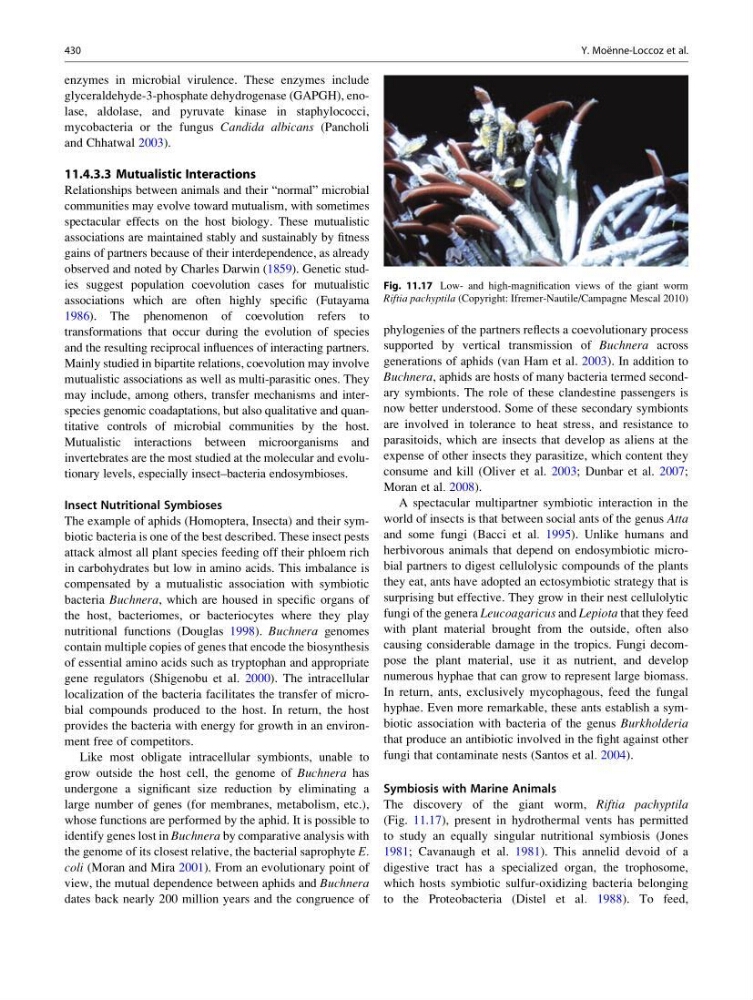
The discovery of the giant worm, Riftia pachyptila
(Fig. 11.17), present in hydrothermal vents has permitted
to study an equally singular nutritional symbiosis (Jones
1981; Cavanaugh et al. 1981). This annelid devoid of a
digestive tract has a specialized organ, the trophosome,
which hosts symbiotic sulfur-oxidizing bacteria belonging
to the Proteobacteria (Distel et al. 1988). To feed,
Fig. 11.17 Low- and high-magnification views of the giant worm
Riftia pachyptila (Copyright: Ifremer-Nautile/Campagne Mescal 2010)
430
Y. Moe ¨nne-Loccoz et al.
glyceraldehyde-3-phosphate dehydrogenase (GAPGH), enolase, aldolase, and pyruvate kinase in staphylococci,
mycobacteria or the fungus Candida albicans (Pancholi
and Chhatwal 2003).
11.4.3.3 Mutualistic Interactions
Relationships between animals and their “normal” microbial
communities may evolve toward mutualism, with sometimes
spectacular effects on the host biology. These mutualistic
associations are maintained stably and sustainably by fitness
gains of partners because of their interdependence, as already
observed and noted by Charles Darwin (1859). Genetic studies suggest population coevolution cases for mutualistic
associations which are often highly specific (Futayama
1986). The phenomenon of coevolution refers to
transformations that occur during the evolution of species
and the resulting reciprocal influences of interacting partners.
Mainly studied in bipartite relations, coevolution may involve
mutualistic associations as well as multi-parasitic ones. They
may include, among others, transfer mechanisms and interspecies genomic coadaptations, but also qualitative and quantitative controls of microbial communities by the host.
Mutualistic interactions between microorganisms and
invertebrates are the most studied at the molecular and evolutionary levels, especially insect–bacteria endosymbioses.
Insect Nutritional Symbioses
The example of aphids (Homoptera, Insecta) and their symbiotic bacteria is one of the best described. These insect pests
attack almost all plant species feeding off their phloem rich
in carbohydrates but low in amino acids. This imbalance is
compensated by a mutualistic association with symbiotic
bacteria Buchnera, which are housed in specific organs of
the host, bacteriomes, or bacteriocytes where they play
nutritional functions (Douglas 1998). Buchnera genomes
contain multiple copies of genes that encode the biosynthesis
of essential amino acids such as tryptophan and appropriate
gene regulators (Shigenobu et al. 2000). The intracellular
localization of the bacteria facilitates the transfer of microbial compounds produced to the host. In return, the host
provides the bacteria with energy for growth in an environment free of competitors.
Like most obligate intracellular symbionts, unable to
grow outside the host cell, the genome of Buchnera has
undergone a significant size reduction by eliminating a
large number of genes (for membranes, metabolism, etc.),
whose functions are performed by the aphid. It is possible to
identify genes lost in Buchnera by comparative analysis with
the genome of its closest relative, the bacterial saprophyte E.
coli (Moran and Mira 2001). From an evolutionary point of
view, the mutual dependence between aphids and Buchnera
dates back nearly 200 million years and the congruence of
phylogenies of the partners reflects a coevolutionary process
supported by vertical transmission of Buchnera across
generations of aphids (van Ham et al. 2003). In addition to
Buchnera, aphids are hosts of many bacteria termed secondary symbionts. The role of these clandestine passengers is
now better understood. Some of these secondary symbionts
are involved in tolerance to heat stress, and resistance to
parasitoids, which are insects that develop as aliens at the
expense of other insects they parasitize, which content they
consume and kill (Oliver et al. 2003; Dunbar et al. 2007;
Moran et al. 2008).
A spectacular multipartner symbiotic interaction in the
world of insects is that between social ants of the genus Atta
and some fungi (Bacci et al. 1995). Unlike humans and
herbivorous animals that depend on endosymbiotic microbial partners to digest cellulolysic compounds of the plants
they eat, ants have adopted an ectosymbiotic strategy that is
surprising but effective. They grow in their nest cellulolytic
fungi of the genera Leucoagaricus and Lepiota that they feed
with plant material brought from the outside, often also
causing considerable damage in the tropics. Fungi decompose the plant material, use it as nutrient, and develop
numerous hyphae that can grow to represent large biomass.
In return, ants, exclusively mycophagous, feed the fungal
hyphae. Even more remarkable, these ants establish a symbiotic association with bacteria of the genus Burkholderia
that produce an antibiotic involved in the fight against other
fungi that contaminate nests (Santos et al. 2004).
Symbiosis with Marine Animals
The discovery of the giant worm, Riftia pachyptila
(Fig. 11.17), present in hydrothermal vents has permitted
to study an equally singular nutritional symbiosis (Jones
1981; Cavanaugh et al. 1981). This annelid devoid of a
digestive tract has a specialized organ, the trophosome,
which hosts symbiotic sulfur-oxidizing bacteria belonging
to the Proteobacteria (Distel et al. 1988). To feed,
Fig. 11.17 Low- and high-magnification views of the giant worm
Riftia pachyptila (Copyright: Ifremer-Nautile/Campagne Mescal 2010)
430
Y. Moe ¨nne-Loccoz et al.