

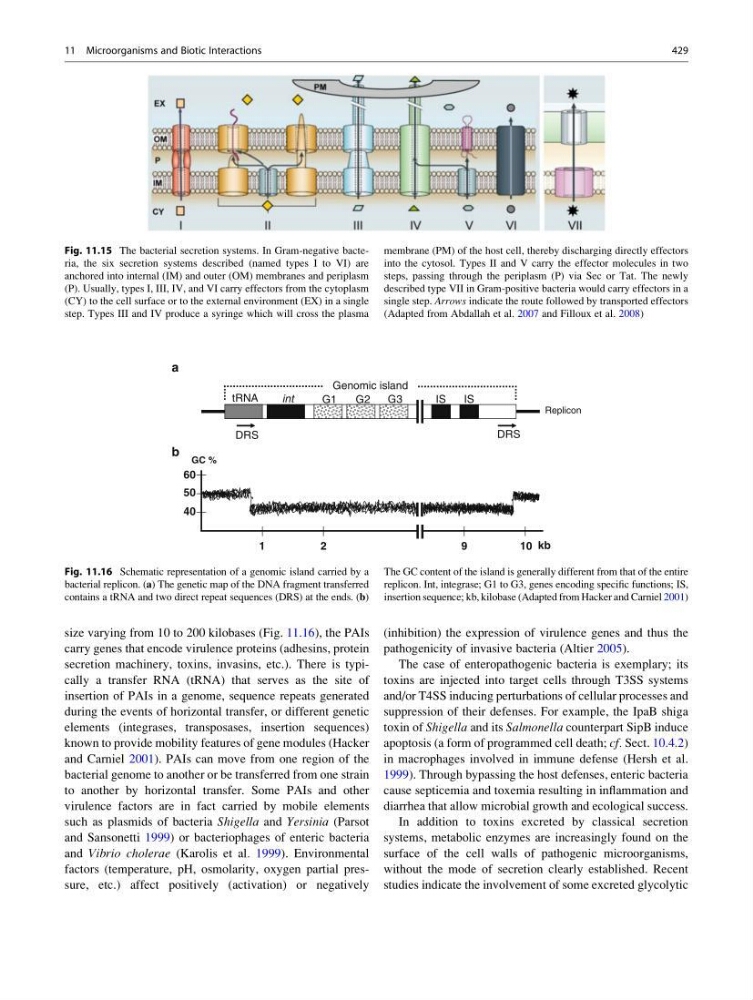
size varying from 10 to 200 kilobases (Fig. 11.16), the PAIs
carry genes that encode virulence proteins (adhesins, protein
secretion machinery, toxins, invasins, etc.). There is typically a transfer RNA (tRNA) that serves as the site of
insertion of PAIs in a genome, sequence repeats generated
during the events of horizontal transfer, or different genetic
elements (integrases, transposases, insertion sequences)
known to provide mobility features of gene modules (Hacker
and Carniel 2001). PAIs can move from one region of the
bacterial genome to another or be transferred from one strain
to another by horizontal transfer. Some PAIs and other
virulence factors are in fact carried by mobile elements
such as plasmids of bacteria Shigella and Yersinia (Parsot
and Sansonetti 1999) or bacteriophages of enteric bacteria
and Vibrio cholerae (Karolis et al. 1999). Environmental
factors (temperature, pH, osmolarity, oxygen partial pressure, etc.) affect positively (activation) or negatively
(inhibition) the expression of virulence genes and thus the
pathogenicity of invasive bacteria (Altier 2005).
The case of enteropathogenic bacteria is exemplary; its
toxins are injected into target cells through T3SS systems
and/or T4SS inducing perturbations of cellular processes and
suppression of their defenses. For example, the IpaB shiga
toxin of Shigella and its Salmonella counterpart SipB induce
apoptosis (a form of programmed cell death; cf. Sect. 10.4.2)
in macrophages involved in immune defense (Hersh et al.
1999). Through bypassing the host defenses, enteric bacteria
cause septicemia and toxemia resulting in inflammation and
diarrhea that allow microbial growth and ecological success.
In addition to toxins excreted by classical secretion
systems, metabolic enzymes are increasingly found on the
surface of the cell walls of pathogenic microorganisms,
without the mode of secretion clearly established. Recent
studies indicate the involvement of some excreted glycolytic
Genomic island
DRS
DRS
tRNA
int
G1
G2
G3
GC %
40
50
60
IS
IS
1
2
9
1 0
a
b
kb
Replicon
Fig. 11.16 Schematic representation of a genomic island carried by a
bacterial replicon. (a) The genetic map of the DNA fragment transferred
contains a tRNA and two direct repeat sequences (DRS) at the ends. (b)
The GC content of the island is generally different from that of the entire
replicon. Int, integrase; G1 to G3, genes encoding specific functions; IS,
insertion sequence; kb, kilobase (Adapted from Hacker and Carniel 2001)
Fig. 11.15 The bacterial secretion systems. In Gram-negative bacteria, the six secretion systems described (named types I to VI) are
anchored into internal (IM) and outer (OM) membranes and periplasm
(P). Usually, types I, III, IV, and VI carry effectors from the cytoplasm
(CY) to the cell surface or to the external environment (EX) in a single
step. Types III and IV produce a syringe which will cross the plasma
membrane (PM) of the host cell, thereby discharging directly effectors
into the cytosol. Types II and V carry the effector molecules in two
steps, passing through the periplasm (P) via Sec or Tat. The newly
described type VII in Gram-positive bacteria would carry effectors in a
single step. Arrows indicate the route followed by transported effectors
(Adapted from Abdallah et al. 2007 and Filloux et al. 2008)
11 Microorganisms and Biotic Interactions
429
carry genes that encode virulence proteins (adhesins, protein
secretion machinery, toxins, invasins, etc.). There is typically a transfer RNA (tRNA) that serves as the site of
insertion of PAIs in a genome, sequence repeats generated
during the events of horizontal transfer, or different genetic
elements (integrases, transposases, insertion sequences)
known to provide mobility features of gene modules (Hacker
and Carniel 2001). PAIs can move from one region of the
bacterial genome to another or be transferred from one strain
to another by horizontal transfer. Some PAIs and other
virulence factors are in fact carried by mobile elements
such as plasmids of bacteria Shigella and Yersinia (Parsot
and Sansonetti 1999) or bacteriophages of enteric bacteria
and Vibrio cholerae (Karolis et al. 1999). Environmental
factors (temperature, pH, osmolarity, oxygen partial pressure, etc.) affect positively (activation) or negatively
(inhibition) the expression of virulence genes and thus the
pathogenicity of invasive bacteria (Altier 2005).
The case of enteropathogenic bacteria is exemplary; its
toxins are injected into target cells through T3SS systems
and/or T4SS inducing perturbations of cellular processes and
suppression of their defenses. For example, the IpaB shiga
toxin of Shigella and its Salmonella counterpart SipB induce
apoptosis (a form of programmed cell death; cf. Sect. 10.4.2)
in macrophages involved in immune defense (Hersh et al.
1999). Through bypassing the host defenses, enteric bacteria
cause septicemia and toxemia resulting in inflammation and
diarrhea that allow microbial growth and ecological success.
In addition to toxins excreted by classical secretion
systems, metabolic enzymes are increasingly found on the
surface of the cell walls of pathogenic microorganisms,
without the mode of secretion clearly established. Recent
studies indicate the involvement of some excreted glycolytic
Genomic island
DRS
DRS
tRNA
int
G1
G2
G3
GC %
40
50
60
IS
IS
1
2
9
1 0
a
b
kb
Replicon
Fig. 11.16 Schematic representation of a genomic island carried by a
bacterial replicon. (a) The genetic map of the DNA fragment transferred
contains a tRNA and two direct repeat sequences (DRS) at the ends. (b)
The GC content of the island is generally different from that of the entire
replicon. Int, integrase; G1 to G3, genes encoding specific functions; IS,
insertion sequence; kb, kilobase (Adapted from Hacker and Carniel 2001)
Fig. 11.15 The bacterial secretion systems. In Gram-negative bacteria, the six secretion systems described (named types I to VI) are
anchored into internal (IM) and outer (OM) membranes and periplasm
(P). Usually, types I, III, IV, and VI carry effectors from the cytoplasm
(CY) to the cell surface or to the external environment (EX) in a single
step. Types III and IV produce a syringe which will cross the plasma
membrane (PM) of the host cell, thereby discharging directly effectors
into the cytosol. Types II and V carry the effector molecules in two
steps, passing through the periplasm (P) via Sec or Tat. The newly
described type VII in Gram-positive bacteria would carry effectors in a
single step. Arrows indicate the route followed by transported effectors
(Adapted from Abdallah et al. 2007 and Filloux et al. 2008)
11 Microorganisms and Biotic Interactions
429