

R. pachyptila absorbs through its gill filaments oxygen and
hydrogen sulfide that are transported via the blood to the
trophosome, where bacteria perform chemosynthesis,
generating organic matter necessary for the growth of the
host (cf. Chap. 10).
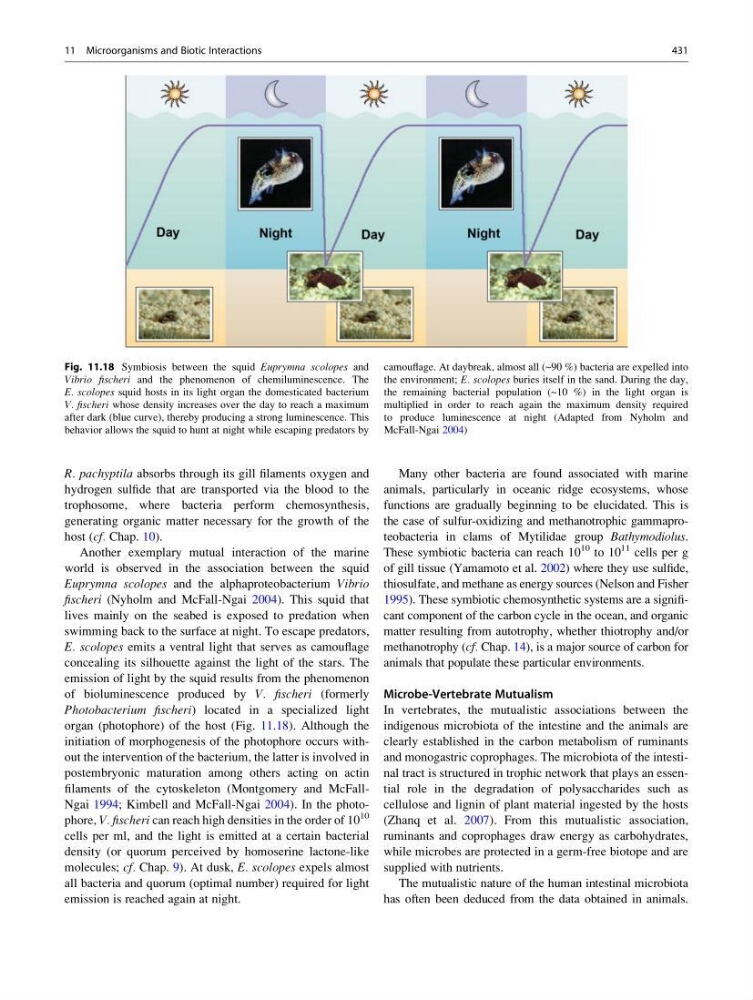
Another exemplary mutual interaction of the marine
world is observed in the association between the squid
Euprymna scolopes and the alphaproteobacterium Vibrio
fischeri (Nyholm and McFall-Ngai 2004). This squid that
lives mainly on the seabed is exposed to predation when
swimming back to the surface at night. To escape predators,
E. scolopes emits a ventral light that serves as camouflage
concealing its silhouette against the light of the stars. The
emission of light by the squid results from the phenomenon
of bioluminescence produced by V. fischeri (formerly
Photobacterium fischeri) located in a specialized light
organ (photophore) of the host (Fig. 11.18). Although the
initiation of morphogenesis of the photophore occurs without the intervention of the bacterium, the latter is involved in
postembryonic maturation among others acting on actin
filaments of the cytoskeleton (Montgomery and McFallNgai 1994; Kimbell and McFall-Ngai 2004). In the photophore, V. fischeri can reach high densities in the order of 10
10
cells per ml, and the light is emitted at a certain bacterial
density (or quorum perceived by homoserine lactone-like
molecules; cf. Chap. 9). At dusk, E. scolopes expels almost
all bacteria and quorum (optimal number) required for light
emission is reached again at night.
Many other bacteria are found associated with marine
animals, particularly in oceanic ridge ecosystems, whose
functions are gradually beginning to be elucidated. This is
the case of sulfur-oxidizing and methanotrophic gammaproteobacteria in clams of Mytilidae group Bathymodiolus.
These symbiotic bacteria can reach 10
10 to 10
11 cells per g
of gill tissue (Yamamoto et al. 2002) where they use sulfide,
thiosulfate, and methane as energy sources (Nelson and Fisher
1995). These symbiotic chemosynthetic systems are a significant component of the carbon cycle in the ocean, and organic
matter resulting from autotrophy, whether thiotrophy and/or
methanotrophy (cf. Chap. 14), is a major source of carbon for
animals that populate these particular environments.
Microbe-Vertebrate Mutualism
In vertebrates, the mutualistic associations between the
indigenous microbiota of the intestine and the animals are
clearly established in the carbon metabolism of ruminants
and monogastric coprophages. The microbiota of the intestinal tract is structured in trophic network that plays an essential role in the degradation of polysaccharides such as
cellulose and lignin of plant material ingested by the hosts
(Zhanq et al. 2007). From this mutualistic association,
ruminants and coprophages draw energy as carbohydrates,
while microbes are protected in a germ-free biotope and are
supplied with nutrients.
The mutualistic nature of the human intestinal microbiota
has often been deduced from the data obtained in animals.
Fig. 11.18 Symbiosis between the squid Euprymna scolopes and
Vibrio fischeri and the phenomenon of chemiluminescence. The
E. scolopes squid hosts in its light organ the domesticated bacterium
V. fischeri whose density increases over the day to reach a maximum
after dark (blue curve), thereby producing a strong luminescence. This
behavior allows the squid to hunt at night while escaping predators by
camouflage. At daybreak, almost all (~90 %) bacteria are expelled into
the environment; E. scolopes buries itself in the sand. During the day,
the remaining bacterial population (~10 %) in the light organ is
multiplied in order to reach again the maximum density required
to produce luminescence at night (Adapted from Nyholm and
McFall-Ngai 2004)
11 Microorganisms and Biotic Interactions
431
hydrogen sulfide that are transported via the blood to the
trophosome, where bacteria perform chemosynthesis,
generating organic matter necessary for the growth of the
host (cf. Chap. 10).
Another exemplary mutual interaction of the marine
world is observed in the association between the squid
Euprymna scolopes and the alphaproteobacterium Vibrio
fischeri (Nyholm and McFall-Ngai 2004). This squid that
lives mainly on the seabed is exposed to predation when
swimming back to the surface at night. To escape predators,
E. scolopes emits a ventral light that serves as camouflage
concealing its silhouette against the light of the stars. The
emission of light by the squid results from the phenomenon
of bioluminescence produced by V. fischeri (formerly
Photobacterium fischeri) located in a specialized light
organ (photophore) of the host (Fig. 11.18). Although the
initiation of morphogenesis of the photophore occurs without the intervention of the bacterium, the latter is involved in
postembryonic maturation among others acting on actin
filaments of the cytoskeleton (Montgomery and McFallNgai 1994; Kimbell and McFall-Ngai 2004). In the photophore, V. fischeri can reach high densities in the order of 10
10
cells per ml, and the light is emitted at a certain bacterial
density (or quorum perceived by homoserine lactone-like
molecules; cf. Chap. 9). At dusk, E. scolopes expels almost
all bacteria and quorum (optimal number) required for light
emission is reached again at night.
Many other bacteria are found associated with marine
animals, particularly in oceanic ridge ecosystems, whose
functions are gradually beginning to be elucidated. This is
the case of sulfur-oxidizing and methanotrophic gammaproteobacteria in clams of Mytilidae group Bathymodiolus.
These symbiotic bacteria can reach 10
10 to 10
11 cells per g
of gill tissue (Yamamoto et al. 2002) where they use sulfide,
thiosulfate, and methane as energy sources (Nelson and Fisher
1995). These symbiotic chemosynthetic systems are a significant component of the carbon cycle in the ocean, and organic
matter resulting from autotrophy, whether thiotrophy and/or
methanotrophy (cf. Chap. 14), is a major source of carbon for
animals that populate these particular environments.
Microbe-Vertebrate Mutualism
In vertebrates, the mutualistic associations between the
indigenous microbiota of the intestine and the animals are
clearly established in the carbon metabolism of ruminants
and monogastric coprophages. The microbiota of the intestinal tract is structured in trophic network that plays an essential role in the degradation of polysaccharides such as
cellulose and lignin of plant material ingested by the hosts
(Zhanq et al. 2007). From this mutualistic association,
ruminants and coprophages draw energy as carbohydrates,
while microbes are protected in a germ-free biotope and are
supplied with nutrients.
The mutualistic nature of the human intestinal microbiota
has often been deduced from the data obtained in animals.
Fig. 11.18 Symbiosis between the squid Euprymna scolopes and
Vibrio fischeri and the phenomenon of chemiluminescence. The
E. scolopes squid hosts in its light organ the domesticated bacterium
V. fischeri whose density increases over the day to reach a maximum
after dark (blue curve), thereby producing a strong luminescence. This
behavior allows the squid to hunt at night while escaping predators by
camouflage. At daybreak, almost all (~90 %) bacteria are expelled into
the environment; E. scolopes buries itself in the sand. During the day,
the remaining bacterial population (~10 %) in the light organ is
multiplied in order to reach again the maximum density required
to produce luminescence at night (Adapted from Nyholm and
McFall-Ngai 2004)
11 Microorganisms and Biotic Interactions
431