

This way of life and the lack of attack on mammalian cells
have even led some to consider the use of Bdellovibrio for
the treatment of infections in humans (Stolp and Starr 1963).
The genus was divided to yield Bacteriovorax to accommodate marine strains physiologically distinct and thereafter
Peredibacter starrii, but all these genera are phylogenetically very close to each other.
In addition, there are many bacteriophages that attack
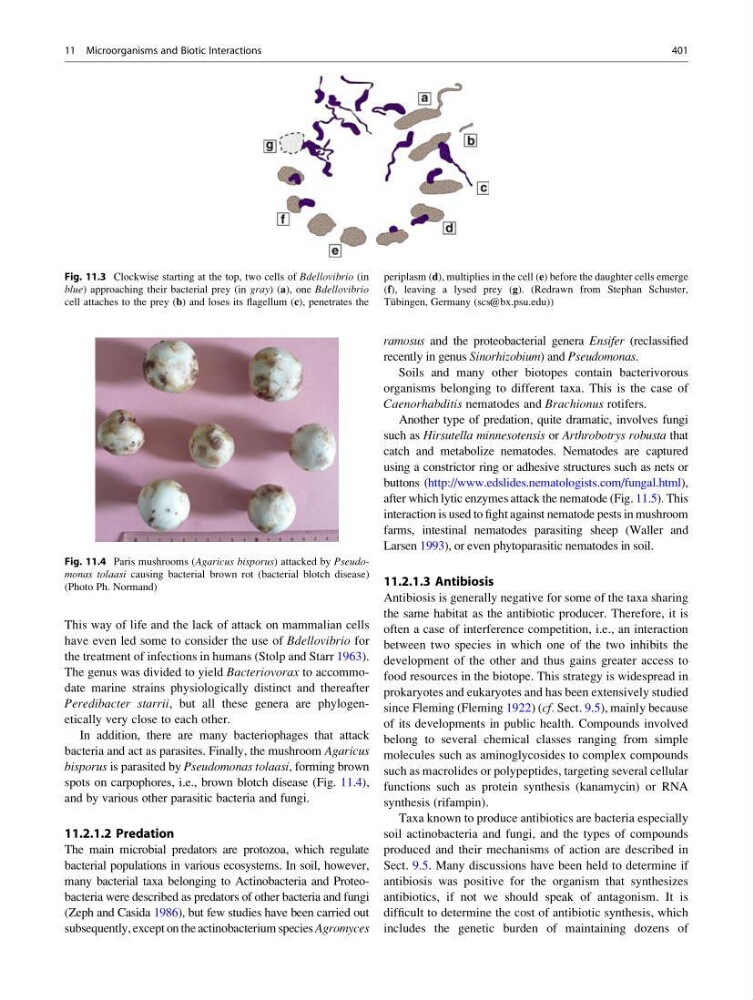
bacteria and act as parasites. Finally, the mushroom Agaricus
bisporus is parasited by Pseudomonas tolaasi, forming brown
spots on carpophores, i.e., brown blotch disease (Fig. 11.4),
and by various other parasitic bacteria and fungi.
11.2.1.2 Predation
The main microbial predators are protozoa, which regulate
bacterial populations in various ecosystems. In soil, however,
many bacterial taxa belonging to Actinobacteria and Proteobacteria were described as predators of other bacteria and fungi
(Zeph and Casida 1986), but few studies have been carried out
subsequently, except on the actinobacterium species Agromyces
ramosus and the proteobacterial genera Ensifer (reclassified
recently in genus Sinorhizobium) and Pseudomonas.
Soils and many other biotopes contain bacterivorous
organisms belonging to different taxa. This is the case of
Caenorhabditis nematodes and Brachionus rotifers.
Another type of predation, quite dramatic, involves fungi
such as Hirsutella minnesotensis or Arthrobotrys robusta that
catch and metabolize nematodes. Nematodes are captured
using a constrictor ring or adhesive structures such as nets or
buttons (http://www.edslides.nematologists.com/fungal.html),
after which lytic enzymes attack the nematode (Fig. 11.5). This
interaction is used to fight against nematode pests in mushroom
farms, intestinal nematodes parasiting sheep (Waller and
Larsen 1993), or even phytoparasitic nematodes in soil.
11.2.1.3 Antibiosis
Antibiosis is generally negative for some of the taxa sharing
the same habitat as the antibiotic producer. Therefore, it is
often a case of interference competition, i.e., an interaction
between two species in which one of the two inhibits the
development of the other and thus gains greater access to
food resources in the biotope. This strategy is widespread in
prokaryotes and eukaryotes and has been extensively studied
since Fleming (Fleming 1922) (cf. Sect. 9.5), mainly because
of its developments in public health. Compounds involved
belong to several chemical classes ranging from simple
molecules such as aminoglycosides to complex compounds
such as macrolides or polypeptides, targeting several cellular
functions such as protein synthesis (kanamycin) or RNA
synthesis (rifampin).
Taxa known to produce antibiotics are bacteria especially
soil actinobacteria and fungi, and the types of compounds
produced and their mechanisms of action are described in
Sect. 9.5. Many discussions have been held to determine if
antibiosis was positive for the organism that synthesizes
antibiotics, if not we should speak of antagonism. It is
difficult to determine the cost of antibiotic synthesis, which
includes the genetic burden of maintaining dozens of
Fig. 11.3 Clockwise starting at the top, two cells of Bdellovibrio (in
blue) approaching their bacterial prey (in gray) (a), one Bdellovibrio
cell attaches to the prey (b) and loses its flagellum (c), penetrates the
periplasm (d), multiplies in the cell (e) before the daughter cells emerge
(f), leaving a lysed prey (g). (Redrawn from Stephan Schuster,
Tu ¨bingen, Germany (scs@bx.psu.edu))
Fig. 11.4 Paris mushrooms (Agaricus bisporus) attacked by Pseudomonas tolaasi causing bacterial brown rot (bacterial blotch disease)
(Photo Ph. Normand)
11 Microorganisms and Biotic Interactions
401
have even led some to consider the use of Bdellovibrio for
the treatment of infections in humans (Stolp and Starr 1963).
The genus was divided to yield Bacteriovorax to accommodate marine strains physiologically distinct and thereafter
Peredibacter starrii, but all these genera are phylogenetically very close to each other.
In addition, there are many bacteriophages that attack
bacteria and act as parasites. Finally, the mushroom Agaricus
bisporus is parasited by Pseudomonas tolaasi, forming brown
spots on carpophores, i.e., brown blotch disease (Fig. 11.4),
and by various other parasitic bacteria and fungi.
11.2.1.2 Predation
The main microbial predators are protozoa, which regulate
bacterial populations in various ecosystems. In soil, however,
many bacterial taxa belonging to Actinobacteria and Proteobacteria were described as predators of other bacteria and fungi
(Zeph and Casida 1986), but few studies have been carried out
subsequently, except on the actinobacterium species Agromyces
ramosus and the proteobacterial genera Ensifer (reclassified
recently in genus Sinorhizobium) and Pseudomonas.
Soils and many other biotopes contain bacterivorous
organisms belonging to different taxa. This is the case of
Caenorhabditis nematodes and Brachionus rotifers.
Another type of predation, quite dramatic, involves fungi
such as Hirsutella minnesotensis or Arthrobotrys robusta that
catch and metabolize nematodes. Nematodes are captured
using a constrictor ring or adhesive structures such as nets or
buttons (http://www.edslides.nematologists.com/fungal.html),
after which lytic enzymes attack the nematode (Fig. 11.5). This
interaction is used to fight against nematode pests in mushroom
farms, intestinal nematodes parasiting sheep (Waller and
Larsen 1993), or even phytoparasitic nematodes in soil.
11.2.1.3 Antibiosis
Antibiosis is generally negative for some of the taxa sharing
the same habitat as the antibiotic producer. Therefore, it is
often a case of interference competition, i.e., an interaction
between two species in which one of the two inhibits the
development of the other and thus gains greater access to
food resources in the biotope. This strategy is widespread in
prokaryotes and eukaryotes and has been extensively studied
since Fleming (Fleming 1922) (cf. Sect. 9.5), mainly because
of its developments in public health. Compounds involved
belong to several chemical classes ranging from simple
molecules such as aminoglycosides to complex compounds
such as macrolides or polypeptides, targeting several cellular
functions such as protein synthesis (kanamycin) or RNA
synthesis (rifampin).
Taxa known to produce antibiotics are bacteria especially
soil actinobacteria and fungi, and the types of compounds
produced and their mechanisms of action are described in
Sect. 9.5. Many discussions have been held to determine if
antibiosis was positive for the organism that synthesizes
antibiotics, if not we should speak of antagonism. It is
difficult to determine the cost of antibiotic synthesis, which
includes the genetic burden of maintaining dozens of
Fig. 11.3 Clockwise starting at the top, two cells of Bdellovibrio (in
blue) approaching their bacterial prey (in gray) (a), one Bdellovibrio
cell attaches to the prey (b) and loses its flagellum (c), penetrates the
periplasm (d), multiplies in the cell (e) before the daughter cells emerge
(f), leaving a lysed prey (g). (Redrawn from Stephan Schuster,
Tu ¨bingen, Germany (scs@bx.psu.edu))
Fig. 11.4 Paris mushrooms (Agaricus bisporus) attacked by Pseudomonas tolaasi causing bacterial brown rot (bacterial blotch disease)
(Photo Ph. Normand)
11 Microorganisms and Biotic Interactions
401