

mutations that arise during development and postembryonic life
are not transmitted and are thus useless for evolution). This issue
is discussed by Ochman and Wilson (1987). They argue that
replication is not the only time when mutations occur; instead
these may occur at any time over the lifespan of organisms.
They conclude that mutations generally take place at constant
rates, independently of generation time, which of course is not
always true, as, for instance, stressful situations lead to the
emergence of hypermutator clones (Foster 2007).
In addition to their short generation time, another advantage enjoyed by infectious agents is their capacity to change
their genetic information. Mutation rates in microorganisms
can be high. In addition, viruses and bacteria are capable of
altering their genomes by exchanging and incorporating
foreign nucleic acid sequences, while the nuclear membrane
has made such exchanges rarer in eukaryotes; evolutionists
even think that one of the reasons for genetic recombination
in meiosis is to maintain gene flow.
Living organisms have developed many types of interaction during evolution; the interactions of microorganisms
with each other, with plants, and finally with animals will
be detailed in the following text.
11.2 Interactions Between Microorganisms
Most biotopes contain many microbial taxa that coexist and
interact in many ways, of which few details are known or
even considered. These interactions are in most cases not
specialized, based mainly on trophic aspects because
resources are always limiting, but in some cases there are
instances of mutualistic or parasitic relations.
11.2.1 Conflictual Interactions
Martin (2002) has classified into a few categories the known
strategies of predation or parasitism: pack predation,
epibiotic attachment, direct cytoplasmic invasion, and periplasmic invasion. These strategies constitute a continuum
toward more and more specialized forms.
11.2.1.1 Parasitism
The best-known example of conflictual interaction involving
two bacterial taxa concerns Bdellovibrio bacteriovorus
(Fig. 11.3). This interaction is often described as predation,
but corresponds rather to parasitism because it is a lasting
interaction, with several cell doublings of Bdellovibrio while
inside the periplasm of the target cell. In fact, this bacterium
should more accurately be called parasitoid since it leads to
the death of the host. The small deltaproteobacterium B.
bacteriovorus consumes motile cells belonging to many
Gram-negative taxa. It starts by entering the periplasm and
sealing the pore entrance and then replicates in the periplasm, yielding daughter cells without flagella that will
invade all the cell space. Thereafter, Bdellovibrio hydrolyzes
cell constituents, forms filamentous cells that become septate, lyses the host cell, and releases flagellated offsprings.
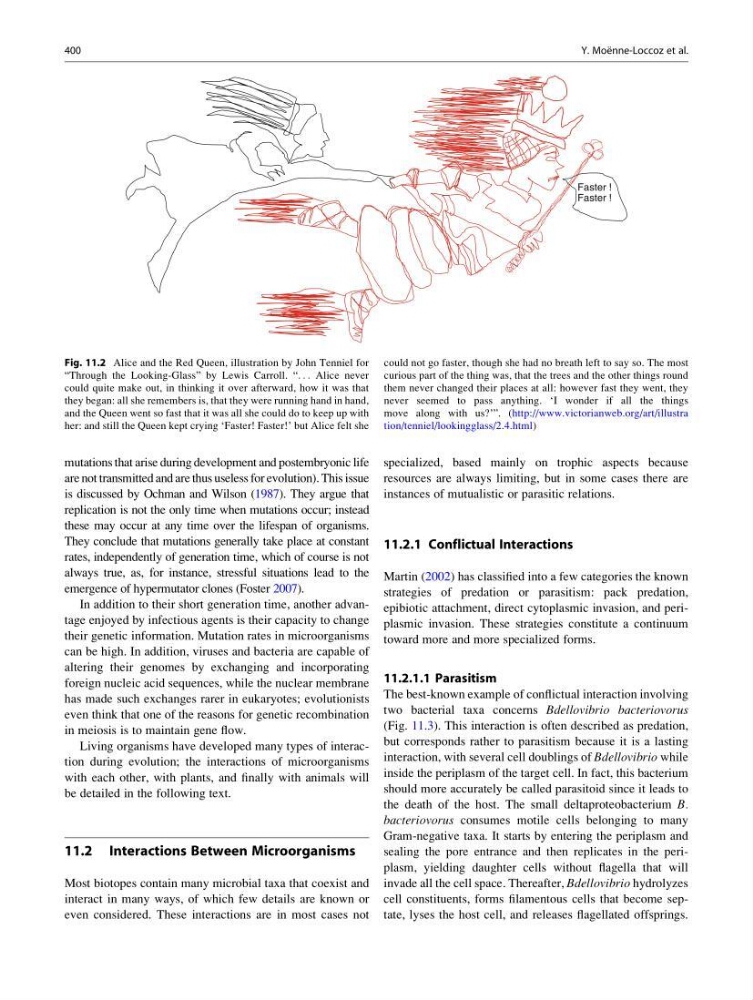
Faster !
Faster !
Fig. 11.2 Alice and the Red Queen, illustration by John Tenniel for
“Through the Looking-Glass” by Lewis Carroll. “. . . Alice never
could quite make out, in thinking it over afterward, how it was that
they began: all she remembers is, that they were running hand in hand,
and the Queen went so fast that it was all she could do to keep up with
her: and still the Queen kept crying ‘Faster! Faster!’ but Alice felt she
could not go faster, though she had no breath left to say so. The most
curious part of the thing was, that the trees and the other things round
them never changed their places at all: however fast they went, they
never seemed to pass anything. ‘I wonder if all the things
move along with us?’”. (http://www.victorianweb.org/art/illustra
tion/tenniel/lookingglass/2.4.html)
400
Y. Moe ¨nne-Loccoz et al.
are not transmitted and are thus useless for evolution). This issue
is discussed by Ochman and Wilson (1987). They argue that
replication is not the only time when mutations occur; instead
these may occur at any time over the lifespan of organisms.
They conclude that mutations generally take place at constant
rates, independently of generation time, which of course is not
always true, as, for instance, stressful situations lead to the
emergence of hypermutator clones (Foster 2007).
In addition to their short generation time, another advantage enjoyed by infectious agents is their capacity to change
their genetic information. Mutation rates in microorganisms
can be high. In addition, viruses and bacteria are capable of
altering their genomes by exchanging and incorporating
foreign nucleic acid sequences, while the nuclear membrane
has made such exchanges rarer in eukaryotes; evolutionists
even think that one of the reasons for genetic recombination
in meiosis is to maintain gene flow.
Living organisms have developed many types of interaction during evolution; the interactions of microorganisms
with each other, with plants, and finally with animals will
be detailed in the following text.
11.2 Interactions Between Microorganisms
Most biotopes contain many microbial taxa that coexist and
interact in many ways, of which few details are known or
even considered. These interactions are in most cases not
specialized, based mainly on trophic aspects because
resources are always limiting, but in some cases there are
instances of mutualistic or parasitic relations.
11.2.1 Conflictual Interactions
Martin (2002) has classified into a few categories the known
strategies of predation or parasitism: pack predation,
epibiotic attachment, direct cytoplasmic invasion, and periplasmic invasion. These strategies constitute a continuum
toward more and more specialized forms.
11.2.1.1 Parasitism
The best-known example of conflictual interaction involving
two bacterial taxa concerns Bdellovibrio bacteriovorus
(Fig. 11.3). This interaction is often described as predation,
but corresponds rather to parasitism because it is a lasting
interaction, with several cell doublings of Bdellovibrio while
inside the periplasm of the target cell. In fact, this bacterium
should more accurately be called parasitoid since it leads to
the death of the host. The small deltaproteobacterium B.
bacteriovorus consumes motile cells belonging to many
Gram-negative taxa. It starts by entering the periplasm and
sealing the pore entrance and then replicates in the periplasm, yielding daughter cells without flagella that will
invade all the cell space. Thereafter, Bdellovibrio hydrolyzes
cell constituents, forms filamentous cells that become septate, lyses the host cell, and releases flagellated offsprings.
Faster !
Faster !
Fig. 11.2 Alice and the Red Queen, illustration by John Tenniel for
“Through the Looking-Glass” by Lewis Carroll. “. . . Alice never
could quite make out, in thinking it over afterward, how it was that
they began: all she remembers is, that they were running hand in hand,
and the Queen went so fast that it was all she could do to keep up with
her: and still the Queen kept crying ‘Faster! Faster!’ but Alice felt she
could not go faster, though she had no breath left to say so. The most
curious part of the thing was, that the trees and the other things round
them never changed their places at all: however fast they went, they
never seemed to pass anything. ‘I wonder if all the things
move along with us?’”. (http://www.victorianweb.org/art/illustra
tion/tenniel/lookingglass/2.4.html)
400
Y. Moe ¨nne-Loccoz et al.